On November 8, 1930, a Pittsburgh plumber in his late twenties named Leo J. Scanlon climbed onto the roof of his new backyard observatory and sat on top of its dome to see whether it would hold. It did. The dome had no internal frame at all: 11 curved sheets of aluminum joined only by folded seams. Pennsylvania’s state historical marker calls the building the first known astronomical observatory with an aluminum dome.
The story has been circulating again this week with a neat ending: the dome led Scanlon to Albert Einstein. The records support most of it, including the meeting with Einstein. They do not support the idea that the dome was the reason for it.
Who Leo Scanlon was
Scanlon (1903 to 1999) earned his living as a plumber, according to his granddaughter, who wrote in 2006 that he and friends scavenged glass and metal from steel mills and glass factories to build telescopes. In June 1929 he and Chester B. Roe founded the Amateur Astronomers’ Association of Pittsburgh. In August 1930 a group of them drove to the amateur telescope makers’ convention at Stellafane, near Springfield, Vermont, and Scanlon came home and typed a 41-page journal of the trip. His trade shows even there: inspecting the clubhouse sink, he noted that it was missing a trap.
Building the dome, from his own journal
Scanlon kept the same day-by-day record of the build, and excerpts compiled by Bert Willard and published by the Springfield Telescope Makers let the project be checked almost hour by hour.
Plans were drawn with his friend Bud White starting September 8, 1930, and inked by September 19. On October 4, a Mr. Johnson of the Aluminum Company of America quoted about $75 for the sheet metal. Five days later he returned with James Somma, a metalworker from the company, who talked Scanlon out of riveting the panels. Aluminum expands so much with heat, about a quarter inch over 100 inches by their figure, that rivets would work loose in their holes over time. Somma suggested a double turned-down seam instead, and they settled on No. 20 gauge, half-hard sheet.
The order came to about 415 square feet including waste, roughly 178 pounds at 35.3 cents a pound, for a net bill of $66.01. The sheets arrived on October 20 and were laid out on a pool table at Scanlon’s Van Buren Street home. On November 15, eight men lifted the finished dome and set it on the building; it rolled easily once two warped spots in the wooden roof had been beaten flat with a mallet.
Scanlon’s figures make the economics easy to check. The dome cost $178 and the rest of the observatory $250, a total of $428. The aluminum itself, at $66.01, was about 37% of the dome’s cost ($66.01 divided by $178); the rest went on the base, rollers, track and fittings. The dedication on Sunday, November 23, 1930, drew about 50 relatives and 20 friends. Frank Jordan, director of the Allegheny Observatory, had been invited and did not come.
Was it really a prototype?
The strongest public claim comes from the state itself. The marker, erected in 1998 by the Pennsylvania Historical and Museum Commission in Ross Township, states that many observatories around the world later used domes of this kind, and that Scanlon’s gleaming metal dome helped shape how people picture a modern observatory. The club he co-founded describes it as the world’s first all-aluminum observatory dome. Both statements support “first known” and a broad influence. Neither names a specific observatory that copied the design, and none of the records consulted here does either, so any claim of a direct line to a particular professional dome should be treated as unproven.
The Einstein meeting
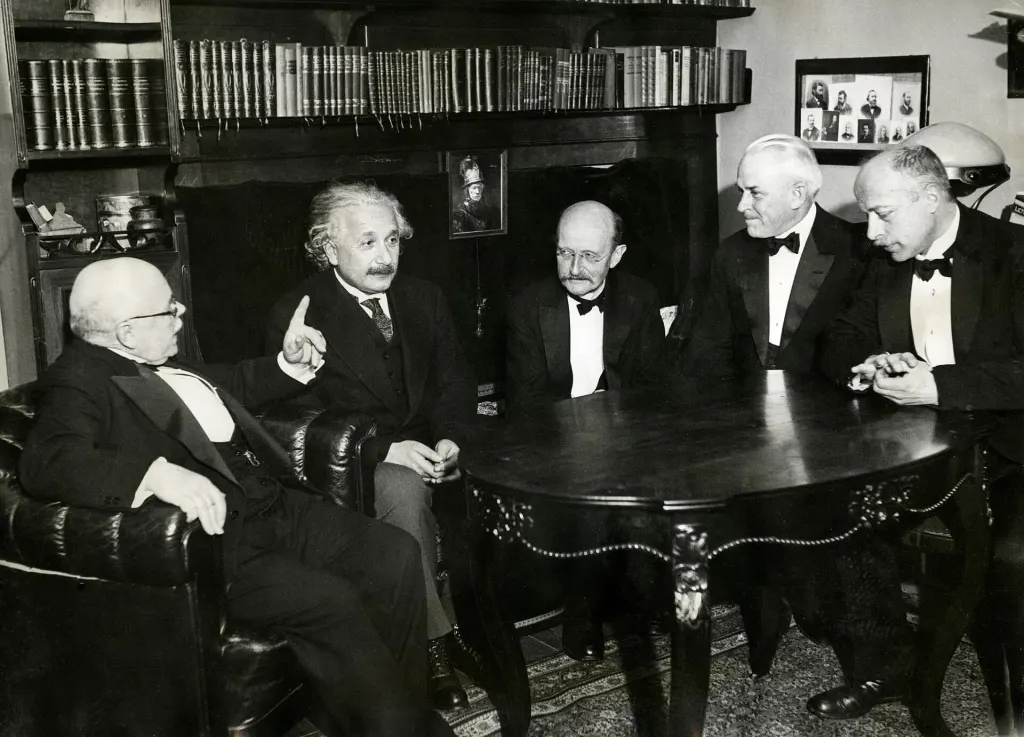
Einstein came to Pittsburgh in December 1934 to give the American Mathematical Society’s Josiah Gibbs Lecture on December 28, at what was then the Carnegie Institute of Technology. According to Carnegie Mellon University, drawing on the written account of his chaperone, Leon Watters, Scanlon invited him to the amateur astronomers’ exhibition at the Mellon Institute, and despite a tight schedule Einstein made a point of going. The Institute for Advanced Study in Princeton holds a 1934 photograph catalogued as “Albert Einstein and Leo J. Scanlon at exhibit, Pittsburg”, photographer unknown.
“He had a thing about amateurs, whom he respected as much as professionals,” the Einstein historian David Topper said of the visit. “He liked average people.”
So the meeting is documented, and it was the club’s exhibition that brought them together. Scanlon’s granddaughter has written that Einstein visited the observatory itself; no record found for this article confirms that, and it is best treated as family memory.
The Valley View Observatory stood until August 1997. Its dome was saved, and as of October 1999 the club planned to mount it on a new observatory. Asteroid 8131 carries Scanlon’s name, and the state marker stands at the corner of McKnight Road and West View Avenue in Ross Township, a short walk east of the rise where the dome once turned.
Further reading
- Institute for Advanced Study archives: Albert Einstein and Leo J. Scanlon at exhibit, Pittsburg (1934)
- Carnegie Mellon University: Iconic Images (Einstein in Pittsburgh, 1934)
Image: Unknown photographer, Public domain via Wikimedia Commons
This article was produced with AI assistance and reviewed by our Editorial Desk. How we work.