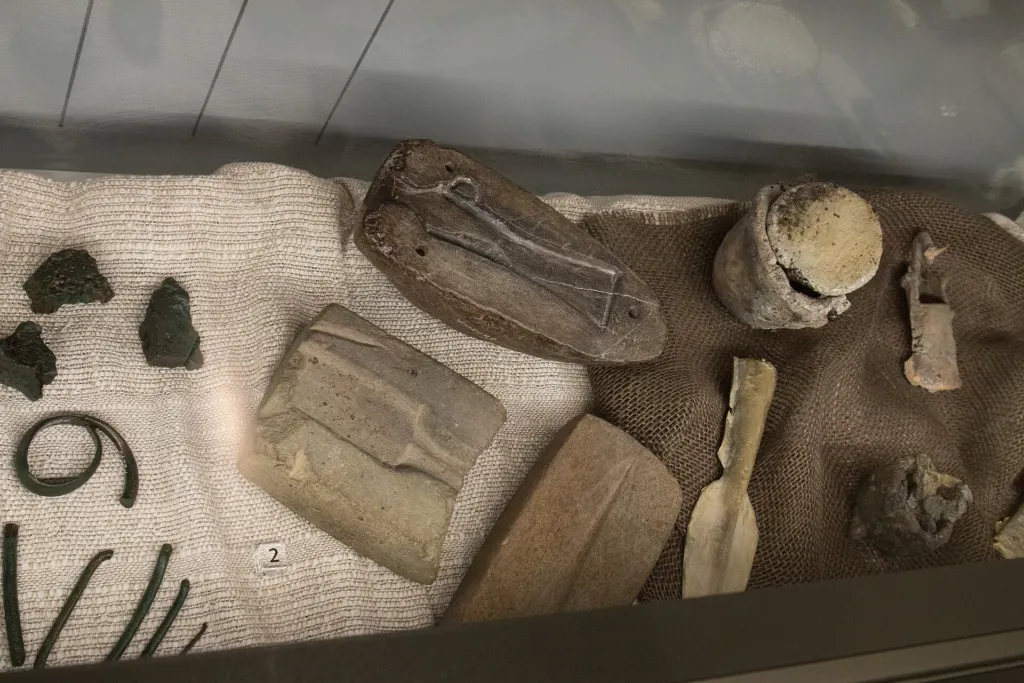
For years a lump of pale volcanic rock held up the corner of a barn in Morkůvky, a village in the Břeclav district of South Moravia in the Czech Republic. When the owner of the house dug it out of his garden in 2007, one corner still poking from the soil, he was holding half of a Late Bronze Age casting mold that once turned out spearheads in series, more than 3,000 years ago.
The Moravian Museum in Brno bought the stone in 2024, and in February 2026 Masaryk University and the museum’s Archaeological Institute published what their tests had found. The 1.09-kilogram block was never cut in Moravia at all. It was carved from rhyolite tuff, a rock whose nearest good deposits lie in what is now northern Hungary, and carried north across the Carpathian basin.
“The mold from Morkůvky is thus demonstrably the result of long-distance import and further evidence of Carpathian influences in the environment of the Middle Danube Urnfield culture,” said Jan Petřík of the Institute of Geological Sciences at Masaryk University.
How a stone mold made a bronze spear
The Morkůvky stone is one half of a two-piece permanent mold. Petřík described the method: “Prehistoric casters poured tin bronze into vertically positioned halves of a mold held together with copper wire.” Molten metal ran down into the carved cavity, cooled, and came out as a spearhead with a pear-shaped blade and ribs running along the leaf and the socket, a design common in the Carpathian region but rare in Moravia.
The heat involved explains why the stone matters. Tin melts at a modest 232 degrees Celsius, copper at 1,085 degrees, and both sat within reach of kilns that Neolithic potters had been firing to at least 900 degrees since around 6000 BC. Iron, by contrast, needs about 1,250 degrees, which is a large part of why it stayed out of everyday use until the end of the second millennium BC. A mold that could survive repeated pours of bronze at well over 1,000 degrees was a serious industrial tool, and the Morkůvky stone carries clear scorching from repeated, intensive use.
Stone molds are oddly scarce in the archaeological record. Bronze objects survive by the thousand, but the permanent molds that produced them turn up only rarely, partly because solid stone or bronze molds were reused again and again rather than discarded after one casting. “Despite minor damage, it is one of the best-preserved halves of casting molds of this type in the Czech Republic,” Petřík said.
Where the mold sits in the Bronze Age
Here is the Badiyaa timeline, drawn from the dating the researchers give and the broader European chronology.
- c. 3200 BC: the Bronze Age opens in Europe, following the Copper Age; it runs to roughly 900 BC on the continent.
- Mid-fourth millennium BC: the Maykop culture of the North Caucasus is working arsenical bronze, the oldest known.
- c. 1300/1250 to 1050/1020 BC: the Late Bronze Age window into which the Morkůvky spearhead type is mostly dated, the era of the Urnfield culture.
- c. 1200 BC: the Late Bronze Age collapse sweeps the eastern Mediterranean.
- 2007: the mold is dug out of a garden in Morkůvky, where it had served as a barn foundation stone.
- 2024: the Moravian Museum acquires it; February 2026: the petrographic analysis is published.
Taking the middle of that dating range, about 1150 BC, the stone was carved roughly 3,175 years before it ended up under a barn.
A spearhead type that traveled
The spearhead profile carved into the stone is a Carpathian design, and Antonín Přichystal’s petrographic analysis of the rock pointed the same way, toward historical Hungary. The researchers think the stone did not travel the final stretch in prehistory: it was most likely brought to the Morkůvky property in modern times from a nearby Urnfield-culture site, then pressed into service as building material.
That pattern fits a wider truth about bronze. Tin was scarce and copper common, so finished bronze was prized and heavily recycled, and the trade networks that moved tin, copper and finished goods were among the defining features of the age. Finds like this one show that the tools of production moved too.
Milan Salaš of the Moravian Museum worked on the stone as part of a long-term research program funded by the Czech Ministry of Culture. The full study appears in the journal Archeologické rozhledy, and the Bronze Age overview linked above gives the regional chronologies the timeline above draws on. The mold is now a museum object in Brno, 1.09 kilograms of rhyolite tuff that spent three millennia as a tool, a ruin and a doorstep before anyone read the shape cut into it.
Further reading
Image: Zde, CC BY-SA 4.0 via Wikimedia Commons
This article was produced with AI assistance and reviewed by our Editorial Desk. How we work.