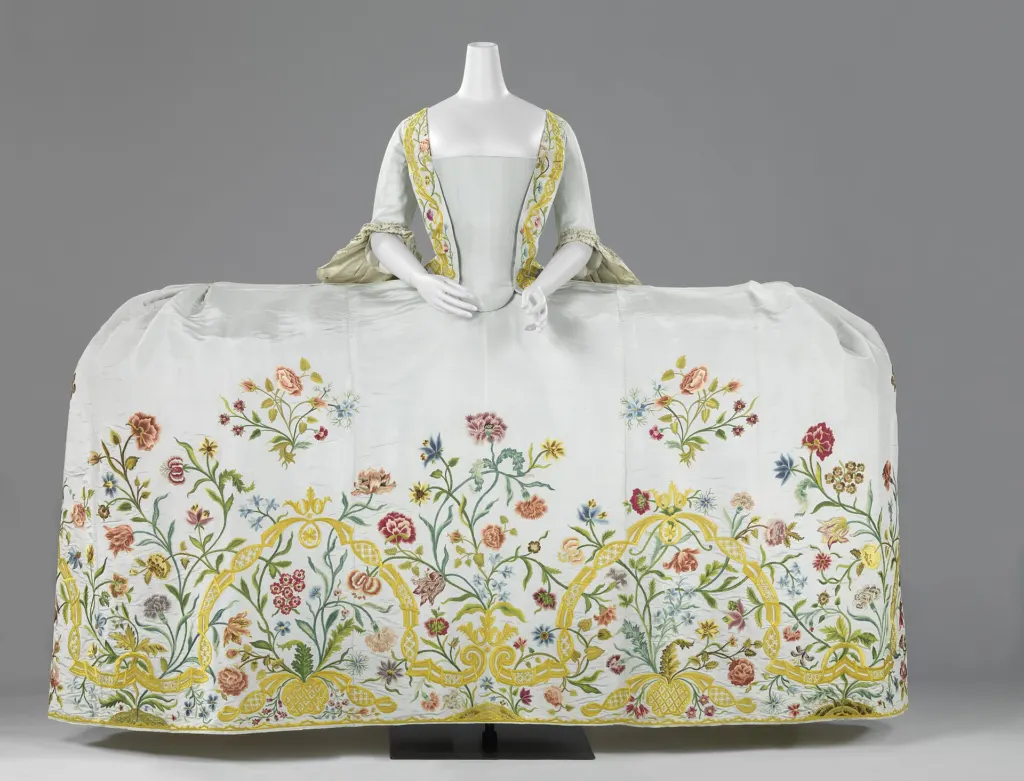
When Helena Slicher married in 1759, her skirt measured about two meters from side to side. The light blue silk wedding gown, now in the Rijksmuseum in Amsterdam, was held out over large panniers, the hooped frames that 18th-century women strapped around their hips to push a skirt sideways.
Two meters is roughly 6 feet 7 inches. Laid on its side, the skirt would be about as wide as a tall man is tall.
What the museum record shows
The museum’s catalog entry describes a three-part outfit: a bodice with a “tail” at the back, a skirt and a separate train. The silk is a ribbed weave in pale blue, embroidered all over with flowers in many colors of silk thread. The bodice is lined in linen, and so are the sleeves. The skirt is built from eight panels of fabric.
The record files the style under “Grande Parure,” the most formal level of dress, and notes that it was worn over a particularly wide hoop of the type called panier à coudes, or elbow panniers, a name that refers to the elbows. The catalog also links the object to the date 4 September 1759.
Nobody signed it. The museum lists the embroiderers and seamstresses as anonymous, from the Low Countries or France, and suggests the skirt may have been made in France.
Two court styles in one gown
The curators single out an unusual mix. The bodice with its tail follows the English court gown known as the mantua. The loose train, by contrast, was a fashion seen mainly on the European mainland. Slicher’s dress puts both on one body, an English top and a Continental train.
The gown stayed in private hands for more than two centuries before Jonkvrouw C. I. Six of ‘s-Graveland, in the Netherlands, gave it to the Rijksmuseum in 1978. It is now in the public domain, and the museum’s own high-resolution photograph is free to reuse.
Why skirts got this wide
Panniers did not start in the Netherlands. Here is the short timeline:
- 17th century: Wide side-hoops appear in Spanish court dress, the style seen in Velázquez portraits.
- Around 1718 to 1719: The fashion spreads to France, and from there across Europe, after Spanish dresses are shown in Paris. Some historians place its roots in England or Germany instead.
- Mid-1700s: Hoops reach their widest. By this point a fashionable woman occupied about three times the space of a man.
- 1759: Slicher marries in her two-meter skirt.
- 1780s: Panniers retreat to the most formal gowns and court wear.
The point of the shape was display. Panniers pushed the skirt out at the sides and kept the front and back fairly flat, which turned each side into a broad panel for showing off patterned silk and embroidery. On Slicher’s gown, that panel is the embroidered flower garden.
The name is practical, too. In French, panniers are the wicker baskets that hang on either side of a pack animal, and from the front a hooped skirt had much the same silhouette.
Royal wardrobes still make headlines for their engineering, as with the Princess of Wales’s Lover’s Knot tiara and cape gown at a Windsor state banquet. For more objects with a story behind them, browse our History section.
The dress is catalogued at the Rijksmuseum under object number BK-1978-247. This year it turns 267 years old.
Further reading
Image: Rijksmuseum, CC0 via Wikimedia Commons
This article was produced with AI assistance and reviewed by our Editorial Desk. How we work.