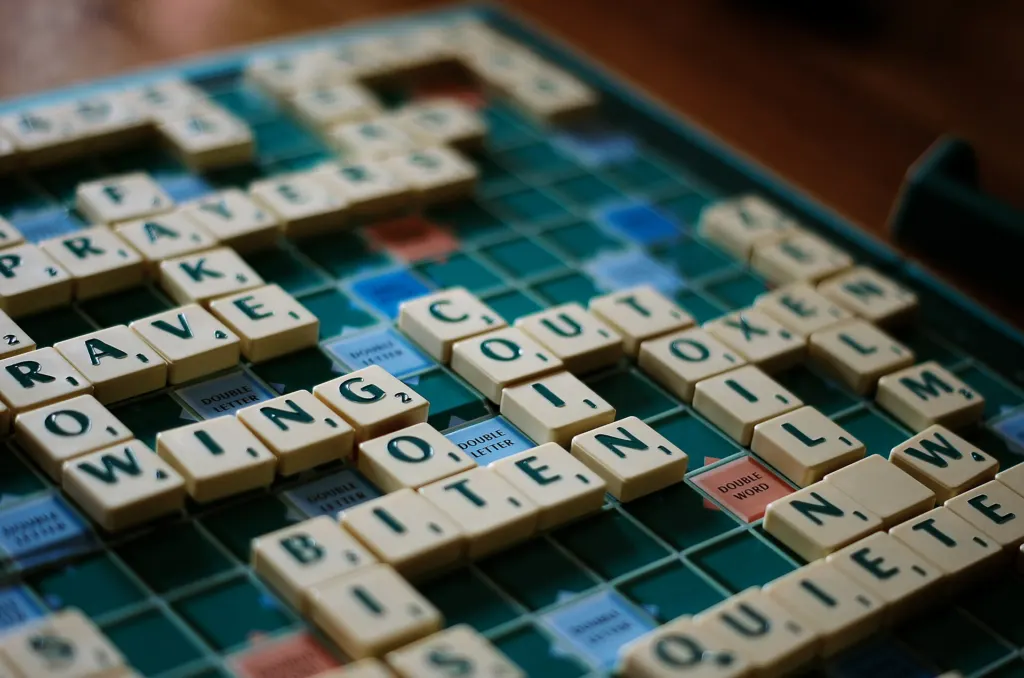
Every Scrabble tile in an English set carries a number that traces back to an out-of-work architect with a pencil. In the early 1930s, Alfred Mosher Butts counted how often each letter appeared on the front pages of a national newspaper. Those tallies decided how many E’s, Q’s and Z’s go in the bag, and the rarer the letter, the more it scores.
The numbers in the bag
Start with the result. Worked out from the official distribution, the modern 100-tile English set looks like this:
- 98 tiles carry letters and two are blanks worth nothing.
- 68 of the 98 letter tiles, about 69%, are worth a single point: E (12), A (9), I (9), O (8), N, R and T (6 each), and L, S and U (4 each).
- The five vowels account for 42 tiles, or 43% of the letters.
- E alone gets 12 tiles, while Q and Z get one each and score 10 points.
- All the tiles together add up to 187 points, an average of about 1.9 points per letter tile.
Read that list as a snapshot of printed American English from around 1930, filtered through one man’s sense of what made a fair game.
How Butts did the counting
He went through newspaper front pages letter by letter, tallied the frequencies, and turned them into tile counts. The North American Scrabble Players Association’s official history describes “painstaking calculations of letter frequency” and says his original distribution has held up for almost three generations.
One choice broke the pattern on purpose. S is common in English, but Butts held it to four tiles so that tacking on plurals would not make the game too easy.
Not every reference is equally sure about the newspaper detail. A widely used history of Scrabble’s letter distributions calls the front-page chart “a popular story” and notes that Butts tried several distributions before settling on one.
Why he needed the math
Butts, born in Poughkeepsie in 1899, earned an architecture degree from the University of Pennsylvania in 1924 and was living in Jackson Heights, New York, when work dried up. He decided to invent a game. Looking at existing ones, he split them into number games like dice and bingo, move games like chess and checkers, and word games like anagrams.
His plan mixed chance with skill by crossing anagrams with the crossword, the puzzle craze of the 1920s. Players draw seven tiles and build words. That only works if the letters in the bag match the language: too many easy letters and the game is dull, too few vowels and nobody can move.
From Lexiko to Scrabble
He called it Lexiko, then Criss Cross Words, and game makers turned it down. Entrepreneur James Brunot bought the rights, adjusted the rules and gave it the name Scrabble, trademarked in 1948. Brunot and his wife set up production in an old schoolhouse in Connecticut. In 1949 they made 2,400 sets and lost $450. By 1952 demand outran them, and Selchow and Righter took over marketing and distribution.
Butts died in 1993 at 93. In his 80s he released a second tile game, Alfreds Other Game, which he called “simultaneous solitaire”; it never matched the first. For more on how English words get bent and named, read how eggcorns like “for all intensive purposes” got their name in 2003, and find more origin stories in our History section.
Jackson Heights still marks his work. At 35th Avenue and 81st Street, the street sign spells out its letters with their Scrabble point values printed as small subscripts.
Further reading
Image: thebarrowboy, CC BY 2.0 via Wikimedia Commons
This article was produced with AI assistance and reviewed by our Editorial Desk. How we work.