On November 16, 534, Emperor Justinian I published a law book so useful that his own first attempt at it vanished from history. The second edition of the Code of Justinian, issued in Constantinople 1,492 years ago today, replaced a version only five years old. Not one copy of that 529 original survives; all that remains is a scrap of its table of contents on an Egyptian papyrus.
The 534 Code is the version lawyers have studied ever since, and its ideas still sit underneath every legal system in the civil law tradition.
Why Justinian rewrote his own law book
Justinian took the throne of the Eastern Roman Empire in 527 and quickly decided its law was a mess. Three older collections of imperial decrees were in circulation, two of them unofficial, and many of their rules contradicted each other or had gone stale.
In February 528 he set up a 10-man commission led by the praetorian prefect John the Cappadocian, with the jurist Tribonian among its members. Their job was to cut whatever was obsolete, edit what remained and produce one collection of laws in force. They worked fast: the first Code took effect on April 7, 529.
It did not settle every dispute. Judges still had to weigh old jurists’ opinions that clashed with each other, so Justinian issued his “Fifty Decisions” and a run of new laws to resolve them. Those reforms left the 529 Code out of date almost at once, and he ordered a replacement. The new edition, known in Latin as the Codex Repetitae Praelectionis, came out on November 16, 534, and became binding on December 30.
What is inside the 534 Code
The second edition is arranged in 12 books:
- Book 1: church law, the sources of law and the duties of senior officials.
- Books 2 to 8: private law, from property to contracts and inheritance.
- Book 9: crimes.
- Books 10 to 12: administrative law.
Its opening law ordered every person under the empire’s rule to follow the Christian faith “handed down by the divine Apostle Peter to the Romans,” a line later scholars mined in debates over who falls under a state’s jurisdiction.
The Code was one of four parts of what is now called the Corpus Juris Civilis, or “Body of Civil Law.” Alongside it sat the Digest, an anthology of extracts from 38 classical jurists finished in 533; the Institutes, a four-book student textbook; and the Novels, new laws passed after 534. Tribonian directed the work.
The timeline in numbers
Count it out and the speed is striking. From the commission’s creation in February 528 to the first Code in April 529 took 14 months. The whole Corpus, Code, Digest and Institutes, was finished between 529 and 534, roughly six years. And the revised Code waited just 44 days between publication on November 16 and taking force on December 30.
Lost, found and copied
In the West the Code was largely lost after the empire’s reach shrank. The only manuscript known to have once held the full Latin text, a palimpsest from Verona, survives only in fragments. Scholars rebuilt most of it by the end of the 12th century, after Justinian’s law was taught again at Bologna from about 1070, where teachers such as Irnerius wrote explanatory notes, or glosses, in the margins.
That revival made Roman law the base of every civil law system and shaped the canon law of the Catholic Church. The Napoleonic Code drew on the same legal thinking. In the East, Greek adaptations such as the 9th-century Basilika carried Justinian’s law forward, and the Basilika served as the first legal code of the new Greek state in the 1820s.
The German scholar Paul Krüger produced the standard modern edition in 1877, and a new English translation was published in October 2016.
For more anniversaries from this week, read about the ruby laser patent granted on November 14, 1967, or how Machiavelli never actually wrote that the end justifies the means.
Further reading
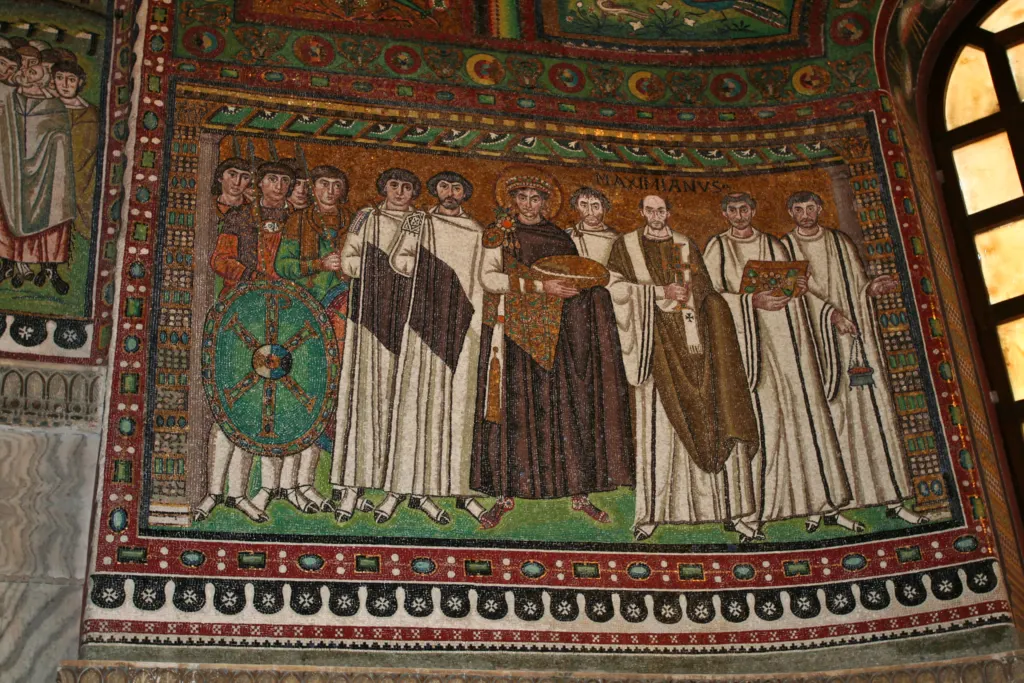
Image: Sharon Mollerus, CC BY 2.0 via Wikimedia Commons
This article was produced with AI assistance and reviewed by our Editorial Desk. How we work.