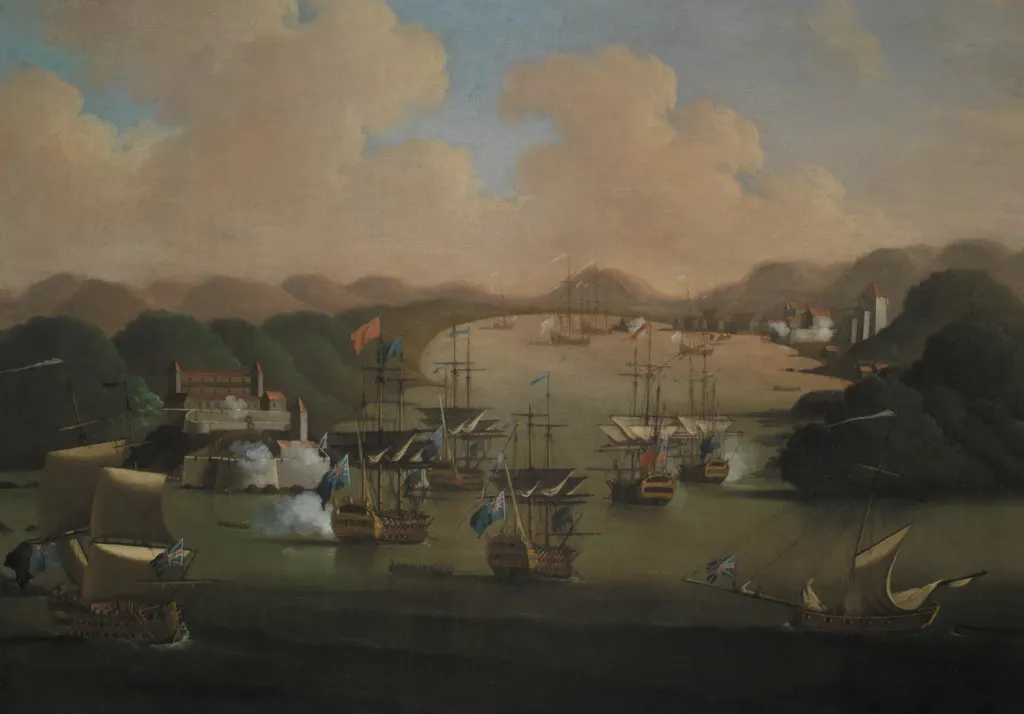
On November 20, 1739, six British warships under Vice Admiral Edward Vernon sailed into the bay at Portobelo, on the Caribbean coast of present-day Panama. By the next afternoon the Spanish governor had surrendered the town, and Britain had lost three men killed and seven wounded. The conflict that raid kicked off has one of the oddest names in military history: the War of Jenkins’ Ear.
The ear came eight years earlier
The name points back to April 1731. A Spanish coast guard vessel stopped the brig Rebecca near Havana on suspicion of smuggling, and her master, a Welsh sailor from Llanelli named Robert Jenkins, lost most of his left ear to a Spanish officer’s cutlass. In his sworn deposition of June 18, 1731, quoted in the Wikipedia biography of Robert Jenkins, he said the Spaniards then “gave him the Piece of his Ear again.” The ship did carry contraband: the Wikipedia history of the War of Jenkins’ Ear says she was found with smuggled sugar.
For years many people doubted the tale. In the late 1880s the naval historian John Knox Laughton found letters from Jamaica that backed it up, including one from Rear-Admiral Charles Stewart, who wrote in October 1731: “I was a little surprised to hear of the usage Captain Jenkins met with off the Havana.”
How an old grievance became a war
By 1738 the mood in London had changed. Opposition politicians who wanted to topple Prime Minister Robert Walpole seized on Spanish searches of British ships, and on March 28, 1738, Parliament voted 257 to 209 to ask King George II to seek redress from Spain. The popular story that Jenkins waved his ear, pickled in a jar, before a Commons committee has no supporting evidence. A deal signed at El Pardo in January 1739 collapsed when the South Sea Company refused to pay its share, Vernon’s squadron left Britain on July 20, and war was formally declared that October.
Six ships, just as he had boasted
Vernon had long claimed he could take Portobelo with six ships, a number critics called far too few. According to the Wikipedia account of the Battle of Porto Bello, an east wind pushed him to aim everything at one harbor fort, the Castillo del Hierro, or Iron Castle. Only about 40 of its 300 defenders had stayed at their posts. Sailors and marines climbed the walls; at dawn the Spanish asked for terms. The British held the town for three weeks, then wrecked its forts and warehouses before sailing off. Some British prints and the main war history give the date of the assault as November 22.
A street name, a song and an estate
Britain went wild for the news. The Porto Bello battle record lists the places renamed in its honor, including Portobello Road in London, the Portobello district of Edinburgh and towns called Porto Bello in Virginia and Maryland. The war’s Wikipedia history adds that more medals were struck for the capture than for any other event of the 18th century.
Lawrence Washington, George Washington’s older half-brother, served under Vernon and later renamed the family farm on the Potomac Mount Vernon after him. Badiyaa has looked at another Mount Vernon legend in its piece on why George Washington’s teeth were never made of wood, and more stories from the period sit in our History section.
From ear to treaty: the timeline
- April 1731: the Rebecca is boarded near Havana and Jenkins loses his ear.
- March 28, 1738: Parliament votes 257 to 209 to press Spain for redress.
- November 20 to 21, 1739: Vernon takes Portobelo with six ships.
- March to May 1741: the huge British attack on Cartagena de Indias fails, with yellow fever killing more men than combat.
- 1748: the Treaty of Aix-la-Chapelle puts the borders back where they started.
So a raid that cost Britain three lives became the high point of a war that gained it nothing. Jenkins went on to run the island of Saint Helena from May 1741 to March 1742. Each May, on its final Saturday, the war is still commemorated at Wormsloe, outside Savannah, Georgia.
Sources
- War of Jenkins’ Ear, Wikipedia, 2026
- Battle of Porto Bello (1739), Wikipedia, 2026
- Robert Jenkins (master mariner), Wikipedia, 2026
Image: Peter Monamy (studio of), Public domain via Wikimedia Commons
This article was produced with AI assistance and reviewed by our Editorial Desk. How we work.