Late on November 20, 1969, a group of 89 American Indians, most of them college students, set out across San Francisco Bay to take over Alcatraz Island. A Coast Guard blockade turned most of them back, but 14 got ashore, and the group calling itself Indians of All Tribes went on to hold the former federal prison for 19 months, until June 1971.
Their legal argument was a century old. Under the 1868 Treaty of Fort Laramie, they said, federal land that had been retired or abandoned should go back to the Native peoples who once held it. Alcatraz penitentiary had closed on March 21, 1963, and the island was declared surplus federal property in 1964, according to the Wikipedia history of the occupation.
Three landings, not one
The 1969 takeover had two rehearsals. The National Park Service’s history of the occupation, We Hold the Rock, counts three separate occupations. On March 9, 1964, Belva Cottier and her cousin Richard McKenzie brought a party of five Sicangu Lakota ashore and claimed the island for four hours. They offered the government what it had once offered tribes for land: 47 cents an acre, or $9.40 for the whole rock.
On November 9, 1969, Richard Oakes, an Akwesasne Mohawk student, and other activists sailed past on a chartered yacht, the Monte Cristo; a few jumped overboard to swim for shore, and a small party stayed overnight before being removed. Eleven days later the long occupation began. Read together, the three landings show a protest that grew from a four-hour stunt into a settlement lasting a year and a half. The Park Service notes that about 80 of the roughly 100 early occupiers were Indian students recruited from UCLA.
How the island was run
The occupiers set up an elected council, and every resident was given a job: security, cooking, laundry, day care, a school. Decisions were made by unanimous consent. At the peak about 400 people lived on the island. Supporters ferried in supplies, and the rock band Creedence Clearwater Revival gave $15,000 to buy a boat, named the Clearwater, for regular runs to the island.
John Trudell, a Santee Dakota veteran, became the voice of the occupation. His Radio Free Alcatraz programs aired at least 39 times on listener-supported stations in Berkeley, Los Angeles and New York, opening each time with Buffy Sainte-Marie’s “Now That the Buffalo’s Gone.”
What the occupiers wanted never changed: the deed to the island, an Indian university, a cultural center and a museum. The government offered a park instead, and the talks stalled.
The end, and what it changed
Over 1970 the federal government cut the island’s electricity and removed the barge that brought fresh water. In June 1971 federal officers removed the last 15 people. On paper, the occupiers lost. The Park Service account argues the result should be judged differently: the federal policy of terminating tribes was ended and self-determination became official policy, and while the occupation was under way the Taos Pueblo got back Blue Lake and 48,000 acres.
Alcatraz occupation timeline
- March 21, 1963: the federal penitentiary closes.
- March 9, 1964: a four-hour Lakota landing claims the island.
- November 9, 1969: the symbolic Monte Cristo trip.
- November 20, 1969: the 19-month occupation begins.
- July 8, 1970: President Nixon’s message to Congress rejects termination.
- June 1971: the last occupiers are removed.
Badiyaa has told other stories of Native history, from the Navajo Code Talkers’ unbroken World War II code to the fan palm oasis on Agua Caliente land near Palm Springs.
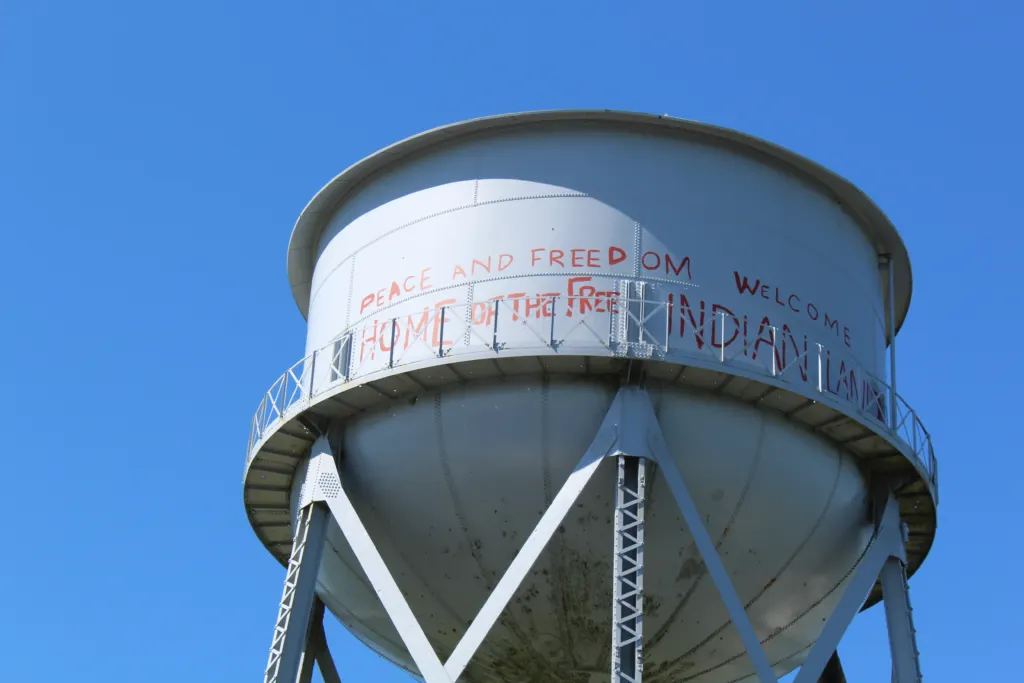
Visitors can still read the occupiers’ painted messages on the island’s water tower. And each year, as the occupation’s Wikipedia entry records, a dawn Unthanksgiving Day ceremony on Alcatraz, held under National Park Service permits, marks what began there on November 20, 1969.
Sources
- Occupation of Alcatraz, Wikipedia, 2026
- We Hold the Rock: The Alcatraz Indian Occupation, National Park Service, Alcatraz Island, 2025
Image: Pnw4077, CC BY-SA 4.0 via Wikimedia Commons
This article was produced with AI assistance and reviewed by our Editorial Desk. How we work.