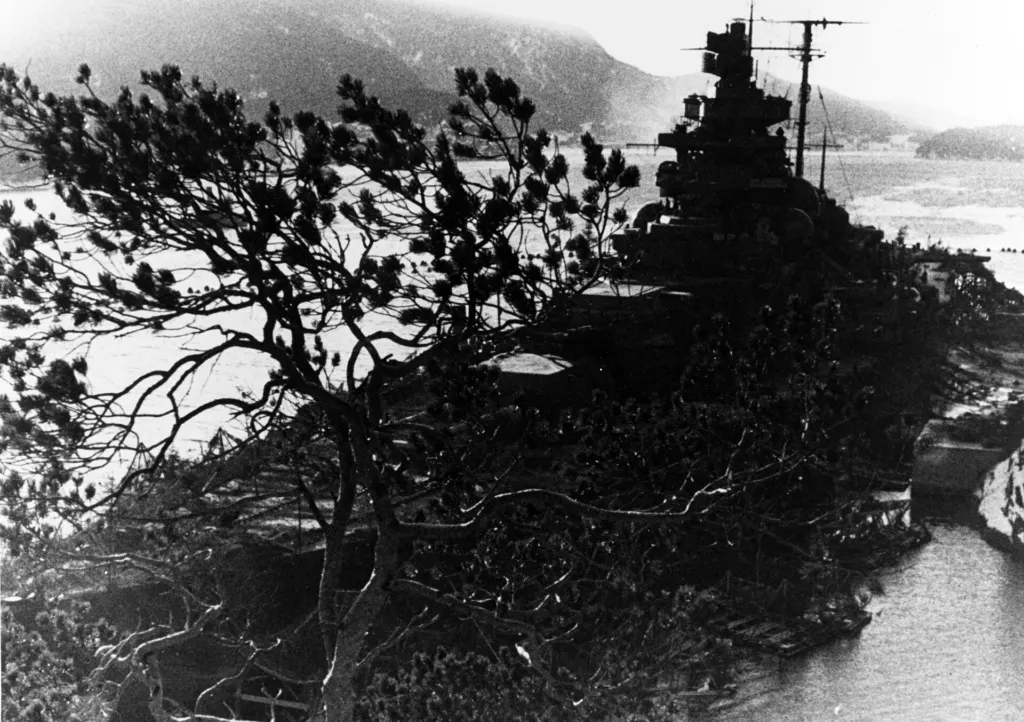
It took eleven minutes. At 9:41 a.m. British time on 12 November 1944, the first 12,000-pound Tallboy bomb hit the German battleship Tirpitz off the island of Håkøya near Tromsø, Norway. By 9:52 a.m. the ship Britain had chased since early 1942 had rolled over and capsized.
The raid, code-named Operation Catechism, ended a campaign that had tied up Allied ships and aircraft for almost three years.
Why Britain wanted Tirpitz gone
From early 1942, Tirpitz hid in Norwegian fjords where she could pounce on the Arctic convoys carrying supplies to the Soviet Union, or break out into the Atlantic. Just the threat forced the British Home Fleet to keep heavy warships on standby.
The Allies threw almost everything at her. RAF bombers raided four times in early 1942 without success. Royal Navy midget submarines planted explosives under her hull in September 1943. Carrier aircraft struck in April 1944 and then repeatedly that summer, with little to show for it. In September 1944, the job passed to RAF Bomber Command, whose Nos. 9 and 617 Squadrons hit Tirpitz with a single Tallboy at Kaafjord and wrecked her bow.
Unable to repair her, Germany moved the crippled ship south to Tromsø to serve as a floating gun battery. Her new mooring was meant to be shallow enough that she could not sink. It was not.
The flight north
A first attack from Scotland on 29 October failed when cloud rolled over the target at the last moment. Bad weather then cancelled two more attempts in early November. Time was short: within weeks the polar night would make bombing almost impossible.
In the early hours of 12 November, 32 Lancasters took off from RAF Kinloss, Lossiemouth and Milltown, stripped of front and mid-upper gun turrets to carry extra fuel. They crossed Norway through a gap in German radar, met over Lake Torneträsk in Sweden and turned for Tromsø. Wing Commander Willie Tait of 617 Squadron saw the ship from 20 miles away, later describing her as “lying squat and black among her torpedo nets like a spider in her web”.
German fighters at nearby Bardufoss were alerted too late. Their leader took off alone and never found the bombers.
The eleven minutes, step by step
- 9:38 a.m.: Tirpitz opens fire with her 15-inch main guns at about 13.5 miles.
- 9:41 a.m.: Tait’s Tallboy strikes amidships and explodes above a boiler room.
- 9:45 a.m.: The list reaches 30 to 40 degrees and the lower decks are ordered cleared.
- 9:49 a.m.: The last bomb falls.
- 9:50 a.m.: The magazine of the stern turret explodes.
- 9:52 a.m.: Tirpitz capsizes.
Measured from the first hit, the battleship went from fighting unit to upturned hull in 11 minutes, after surviving at least ten earlier operations against her over nearly three years.
The human cost
About 1,700 men were aboard. Estimates of the dead range from 940 to 1,204, including the captain, Robert Weber. Within two hours, 596 survivors had swum ashore or been pulled from the water, and rescuers cutting through the upturned hull freed 87 more in the next day. Britain lost no airmen; one damaged Lancaster belly-landed in Sweden and its crew were interned, then sent home.
Even Tait privately doubted the raid’s value, noting that the ship was already crippled. Historians still argue the point. Readers interested in other turning points at sea can see how USS Tang sank 33 ships in nine months, or how the Tuskegee Airmen protected Allied bombers over Europe.
The wreck was scrapped where it lay between 1948 and 1957. Its remains off Håkøya are now a protected war grave, and some of Tirpitz’s armor plates still cover roadworks around Oslo.
Further reading
Image: Unknown photographer, Public domain via Wikimedia Commons
This article was produced with AI assistance and reviewed by our Editorial Desk. How we work.