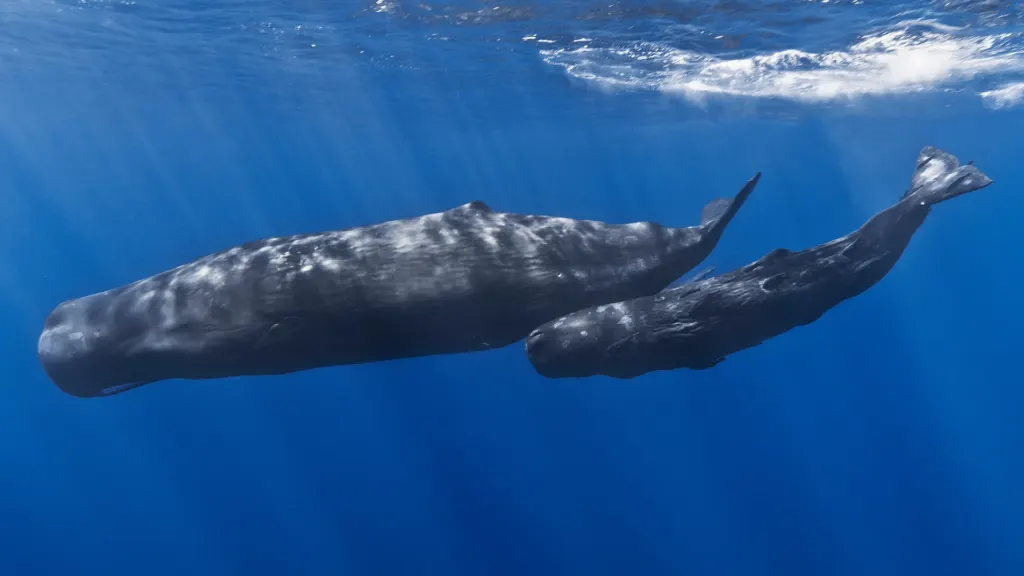
On the morning of November 20, 1820, a bull sperm whale swam straight at the Nantucket whaleship Essex, hit her once, circled away, and then rammed the bow a second time. Within minutes the 87-foot ship was going down roughly 2,000 nautical miles west of South America, and her 20 crewmen were left with three small whaleboats. Thirty years later, that collision gave Herman Melville the ending of Moby-Dick.
A small ship, far from land
Essex was already 20 years old when she left Nantucket on August 12, 1819, and she was small for a three-masted whaler, about 239 tons. Her captain, George Pollard Jr., was 29; first mate Owen Chase was 21; the cabin boy, Thomas Nickerson, was 14. According to the Wikipedia history of the Essex voyage, the boats were out chasing a pod on November 20 while Chase stayed aboard patching a damaged whaleboat. That is when the lookouts saw an unusually large bull, reported at around 85 feet, lying still and facing the ship.
Chase later described the second charge in his own book: the whale came on “with tenfold fury and vengeance in his aspect.” When Pollard rowed back and asked what had happened, Chase answered, “We have been stove by a whale.”
Why the animal attacked is still unknown. One idea is that the hammering on the whaleboat repair sounded like the clicks bull sperm whales use to communicate and locate prey.
Three months in open boats
The officers then made the choice that shaped everything after. Pollard wanted to sail west to the Society Islands; Chase and second mate Matthew Joy feared the islanders and argued for a long loop south and then east toward Chile or Peru. Pollard gave way. The crew landed on uninhabited Henderson Island on December 20, a month to the day after the sinking, and three men chose to stay there. The rest set off again.
The ordeal that followed was one of starvation, and the survivors in the boats were eventually driven to cannibalism. When rescue came in February 1821, only five of the 17 who left Henderson were alive; the three men left on the island were picked up in April. Melville later wrote that the whole disaster might have been avoided if the crew had steered for Tahiti, “But they dreaded cannibals.”
From a mate’s memoir to Melville’s whale
Chase was back on Nantucket by June 11, 1821, and within four months he had finished a book-length account of the wreck, published in New York under a famously long title that opens Narrative of the Most Extraordinary. The Wikipedia biography of Owen Chase notes he had help from a ghostwriter.
Melville met the story at sea. During a gam, a mid-ocean meeting between whaleships, Chase’s son William lent him a copy of his father’s book. The Wikipedia article on Moby-Dick quotes Melville’s later note on reading it “on the landless sea, and so close to the very latitude of the shipwreck.” The novel took two real sources for its whale: Mocha Dick, an albino whale whalers found nearly impossible to catch, supplied the creature, and the Essex supplied the ending, in which the white whale rams and sinks the Pequod.
How the Essex timeline lines up with Moby-Dick
- November 20, 1820: Essex is sunk by a sperm whale in the Pacific.
- 1821: Owen Chase publishes his narrative in New York.
- 1841 to 1844: Melville sails as a common sailor, including on whalers, and reads Chase’s book at sea.
- 1851: Moby-Dick is published, first in London and then in New York.
Badiyaa marked the novel’s own anniversary last week with a look at how Moby-Dick reached American readers in November 1851, and sperm whales made headlines again in 1970 when Oregon blew up a beached sperm whale on a beach in Florence.
The men never forgot the date. The Essex record says Pollard, who later worked as a night watchman on Nantucket, shut himself in his room and fasted every November 20 for the rest of his life. He died in 1870, aged 78.
Sources
- Essex (whaleship), Wikipedia, 2026
- Owen Chase, Wikipedia, 2026
- Moby-Dick, Wikipedia, 2026
Image: Gabriel Barathieu, CC BY-SA 2.0 via Wikimedia Commons
This article was produced with AI assistance and reviewed by our Editorial Desk. How we work.