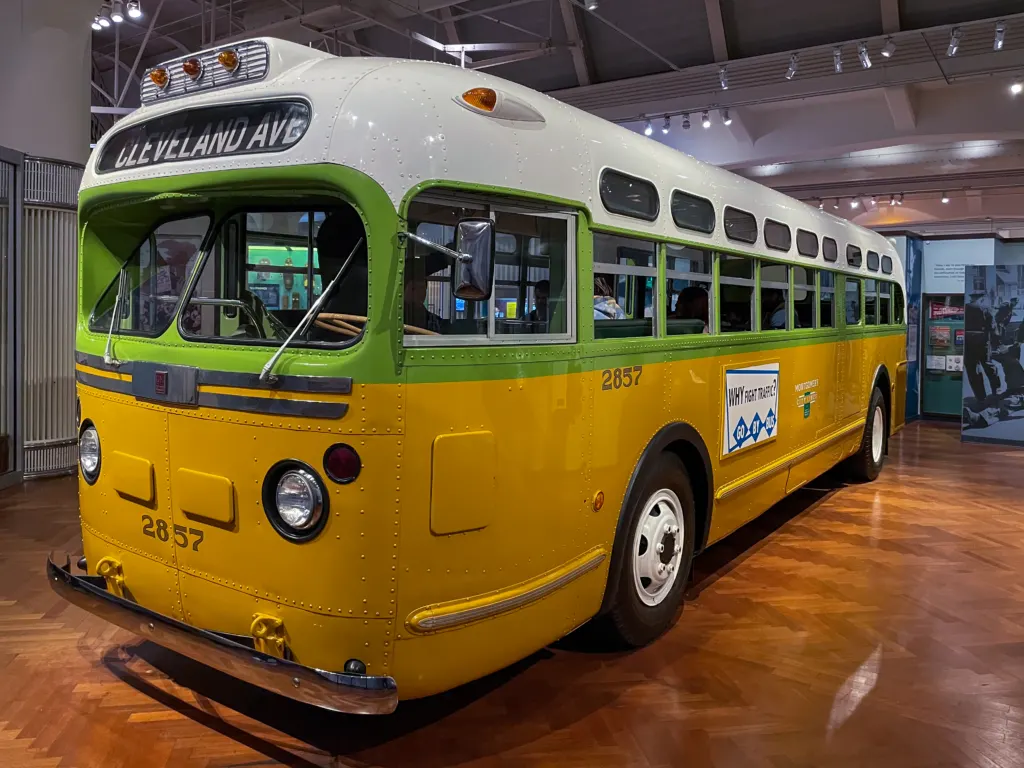
The ruling that ended the Montgomery bus boycott did not carry Rosa Parks’ name. It carried Aurelia Browder’s. On November 13, 1956, the US Supreme Court affirmed a lower court decision in Browder v. Gayle, holding that segregated seating on Montgomery’s buses broke the Constitution, and four women made that happen.
They were Aurelia Browder, Claudette Colvin, Mary Louise Smith and Susie McDonald. Each had been arrested or mistreated for refusing to give up a bus seat in Montgomery, Alabama, and each agreed to put her name on a federal lawsuit when doing so carried real risk.
Four arrests before the famous one
- Claudette Colvin, 15, was arrested on March 2, 1955 for refusing to give her seat to white passengers.
- Aurelia Browder followed on April 19, 1955. She was convicted and fined.
- Mary Louise Smith was arrested on October 21, 1955, held for two hours, then fined.
- Susie McDonald was arrested that same October, though accounts of the exact day conflict.
Rosa Parks’ arrest on December 1, 1955, lit the boycott. But her case faced a slow climb through Alabama’s state courts. Civil rights lawyers wanted a route straight into federal court, where they could also ask for an injunction against the segregation laws.
Why Browder’s name went first
Attorney Fred Gray, working with NAACP Legal Defense Fund lawyers Robert L. Carter and Thurgood Marshall, filed the suit on February 1, 1956. It named Montgomery Mayor W. A. Gayle, the police chief, city commissioners, the bus company and Alabama’s Public Service Commission as defendants.
A fifth woman, Jeanetta Reese, withdrew that month after threatening phone calls and pressure from a senior police officer she worked for. Gray also tried to recruit men, who were too afraid to front the case.
Browder, a 37-year-old widow raising six children, became lead plaintiff. Two of the original five were teenagers and two were senior citizens, so she sat in the middle. Gray explained the choice plainly: “I chose her because she was a matured person, and I thought she would make an excellent first witness if I needed to put someone on (the witness stand).” A colleague, the activist Jo Ann Gibson Robinson, called Browder “well-read, highly intelligent, fearless.”
From Montgomery courtroom to the Supreme Court
On June 5, 1956, a three-judge federal panel ruled 2 to 1 that “the enforced segregation of black and white passengers on motor buses operating in the City of Montgomery violates the Constitution and laws of the United States.” Judges Richard Rives and Frank Minis Johnson formed the majority, with Seybourn Harris Lynne dissenting.
Alabama and the city appealed. The Supreme Court did not even hear arguments; it summarily affirmed. The state asked for a rehearing, which was denied on December 17, and federal marshals served the written order on Gayle on December 20, 1956. The boycott, which had run for more than a year, ended with that order.
A timeline in days
Counting from Colvin’s arrest to the Supreme Court’s decision gives 622 days. From the filing of the lawsuit, the case took 286 days to reach its final affirmation, and just 161 days after the district court ruling. For a constitutional fight over segregated transit, that was remarkably fast.
Who gets remembered
Browder kept working with the NAACP and other civil rights groups, taught veterans and opened her own business. She died in 1971, aged 52. Her son Butler Browder later wrote: “The truth is Browder vs. Gayle changed the laws that mandated bus segregation. If it weren’t for that case and continued efforts to end segregation in this country, we might still be marching.”
For more on two of the women in this story, read how Claudette Colvin refused her seat 274 days before Rosa Parks, and why Rosa Parks was a veteran organizer, not a tired seamstress.
In 2019, Montgomery unveiled a statue of Parks along with four granite markers for the Browder v. Gayle plaintiffs, and Mary Louise Smith attended the ceremony. The Supreme Court’s affirmation turns 70 today.
Further reading
Image: ajay_suresh, CC BY 2.0 via Wikimedia Commons
This article was produced with AI assistance and reviewed by our Editorial Desk. How we work.