Rosa Parks answered the “tired old woman” story herself, in four sentences on page 116 of her 1992 autobiography, Rosa Parks: My Story. The passage, as reproduced by Stanford’s King Institute, reads:
“I was not tired physically, or no more tired than I usually was at the end of a working day. I was not old, although some people have an image of me as being old then. I was forty-two. No, the only tired I was, was tired of giving in.”
Her arithmetic checks out. Born Rosa Louise McCauley in Tuskegee, Alabama, on February 4, 1913, she had turned 42 that February, so on December 1, 1955, she was 42 years and almost 10 months old. She would live to 92, dying in Detroit in October 2005.
What the 1955 arrest papers show
The police file survives because it became evidence. Copies of the report, her fingerprint card and a hand-drawn diagram of the bus were filed in Browder v. Gayle, the federal case that struck down bus segregation in Montgomery, and the National Archives keeps them at its Atlanta branch in Morrow, Georgia, in Civil Case 1147. The first page of the report is National Archives Identifier 596074.
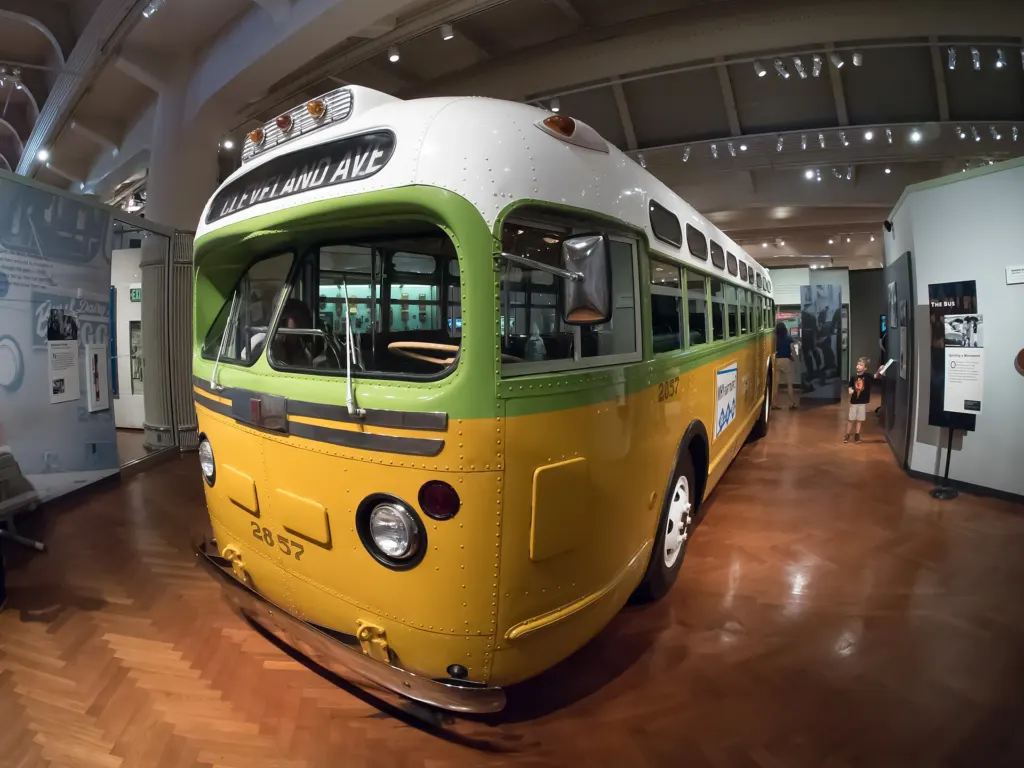
The diagram places her in the first row behind the 10 seats permanently held for white riders. When the bus filled during the evening rush, driver James Blake ordered that row cleared. Three Black passengers moved; Parks stayed, and two officers, Day and Mixon, arrested her. The charge on the report is “refusing to obey orders of bus driver.” When she was allowed to call home, the archives’ account says, her mother’s first question was “Did they beat you?”
She was a seamstress, at the Montgomery Fair department store, and she was going home from work. That much of the popular version is accurate. What it leaves out is the dozen years before.
Twelve years in the Montgomery NAACP
The record of her activism before that evening is long and specific:
- 1943: joins the Montgomery branch of the NAACP and is elected its secretary.
- 1945: registers to vote, having been turned away twice before.
- 1940s-1950s: as secretary, investigates and campaigns around cases of racial and sexual violence, including those of Recy Taylor and Jeremiah Reeves.
- 1949: advises the branch’s NAACP Youth Council, whose members check books out of whites-only libraries.
- Summer 1955: attends a workshop at the Highlander Folk School in Tennessee titled “Racial Desegregation: Implementing the Supreme Court Decision,” where she meets the organizer Septima Clark.
At the time of the arrest, the archives’ summary says, she was working as secretary to the branch’s president, E. D. Nixon. She was also not the first to refuse. Claudette Colvin, 15, had been arrested in March 1955 for the same thing.
None of this makes the evening a staged NAACP operation, and the record does not support that either. According to her biographer Douglas Brinkley, the refusal was not premeditated, and a former classmate, Mary Fair Burks, said that had Parks been acting for the branch, she would have done it openly. She was also in pain that night from chronic bursitis in her shoulders. Her point in 1992 was narrower: the fatigue that mattered was not the kind a day’s work produces.
Where the tired seamstress came from
The King Institute’s biography notes that many news accounts of the time cast her as a tired seamstress. The Library of Congress put it bluntly in its exhibition on her papers, as quoted on its teachers’ blog: “Contrary to popular belief, Parks was not a demure seamstress who chose not to stand because she was physically tired.”
Those papers, held in the Library’s Manuscript Division, sat unseen for nearly a decade after her death because of a dispute over her estate. The Howard G. Buffett Foundation bought them in fall 2014 and placed them with the Library on a 10-year loan; they opened to researchers in February 2015. Her own notes in them describe a “life history of being rebellious,” and record that she knew she might “be manhandled but I was willing to take the chance,” according to an essay drawn from the collection.
The cost was real. She lost her job five weeks after the arrest, as did her husband, Raymond. In February 1956 the city indicted 89 boycott leaders, Parks among them. The boycott ran 381 days, and the Supreme Court upheld the ruling against bus segregation on November 13, 1956.
The 71st anniversary of her arrest falls on Tuesday, December 1, 2026.
Further reading
- National Archives: An Act of Courage, The Arrest Records of Rosa Parks
- Stanford King Institute: Parks, Rosa
- Wikipedia: Rosa Parks
Image: Alvintrusty, CC BY-SA 4.0 via Wikimedia Commons
This article was produced with AI assistance and reviewed by our Editorial Desk. How we work.