Martin Luther was born 543 years ago today, on November 10, 1483, in Eisleben in what is now Germany. Most people know him for the Protestant Reformation. Fewer know that millions of children in central Europe and Latin America still open presents from a gift-bringer his movement promoted: the Christkind, or Christ Child.
Why Luther wanted a new gift-bringer
Before the Reformation, the big gift day in much of Europe was December 6, the feast of Saint Nicholas. According to the history of the Christkind, Luther promoted the Christ Child as the bringer of presents to discourage the Catholic devotion to saints such as Nicholas. The Lutheran Church, in a phrase the article quotes, “promoted Christ as the children’s gift-giver, hoping to draw attention to the child for whom Christmas was named.”
The calendar moved with the figure. Gift-giving shifted from December 6 to Christmas Eve, 18 days later, which is still when children in Christkind countries get their presents. The Czech form of the tradition, Ježíšek, credits Luther with coining the term in the 16th century as an alternative name to Saint Nicholas.
Luther also left Christmas music behind. His hymn “Gelobet seist du, Jesu Christ” became the main Lutheran hymn for Christmas, and he wrote “Vom Himmel hoch, da komm ich her,” known in English as “From Heaven Above to Earth I Come.”
A Protestant idea that Catholics adopted
The twist is that the Christkind did not stay Protestant. Catholic areas of Germany took it up in the 19th century, and today it is the traditional gift-bringer in Austria, Switzerland, Liechtenstein, Luxembourg, southern and western Germany, Alsace in France, the Czech Republic, Slovakia, Slovenia, Croatia, Hungary, eastern Belgium, Portugal and parts of Latin America. It even reached Louisiana, where Cajun families knew a New Year’s Eve visitor called La Christine.
What the Christkind looks like
Luther meant the figure as a reference to the infant Jesus. Over time it became a sprite-like child, usually shown with blond hair and angel wings, and in some places it is treated as an angel delivering the gifts rather than Jesus himself.
The custom has a clever rule built in. Children never see the Christkind, and parents warn that it will not come if they try to spot it. On Christmas Eve the family enters the room with the tree for the Bescherung, the giving of presents, and the parents announce that the Christkind has just left, sometimes signaled by a small bell rung secretly by an adult.
Who brings the presents where
A quick guide to the names the figure goes by:
- Germany, Austria, Switzerland: Christkind or Christkindl, on December 24
- Czech Republic and Slovakia: Ježíšek and Ježiško, both meaning “little Jesus”
- Hungary: Jézuska
- Portugal and Brazil: Menino Jesus
- Latin America: Niño Dios or Niño Jesús
- United States: Kris Kringle, an Americanized spelling and pronunciation of Christkindl
That last one carries an irony. Since the 1990s, the Christkind has faced growing competition at home from the Weihnachtsmann, a Father Christmas figure boosted by the use of the American Santa Claus in advertising, while in America the Christ Child’s own name lives on as Kris Kringle.
Christmas planning is already under way: Badiyaa has reported that Rockefeller Center’s 2026 Christmas tree is a 76-foot Norway spruce and that the Old Farmer’s Almanac forecasts a white Christmas for the Northeast.
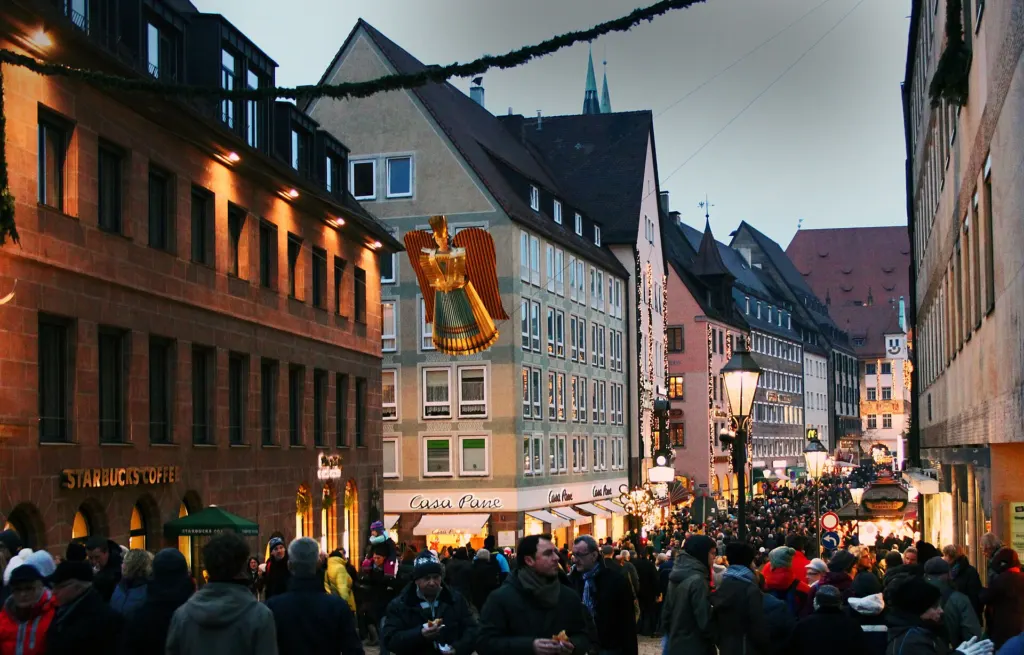
The best-known Christkind today is the one who opens the Christkindlesmarkt in Nuremberg, a role given to a young woman chosen every two years.
Further reading
Illustrative image. Image: Max Schrader, CC BY-SA 2.5 via Wikimedia Commons
This article was produced with AI assistance and reviewed by our Editorial Desk. How we work.