Singapore’s first mobile library started life as a decommissioned army bus. Fitted with custom shelves and painted cream, the van carrying the words “Raffles National Library – UNESCO” rolled out on its first official run on September 6, 1960, loaded with up to 2,000 books in English, Malay, Chinese and Tamil.
Its first stop was a cluster of schools in the Naval Base area of Nee Soon. Within two weeks it had called at 37 schools across outlying districts including Sembawang, Jurong, Bukit Panjang and Tampines, according to the National Library Singapore’s own history of the service.
Built on a $2,000 grant
The van was paid for with a US$2,000 UNESCO grant, made in 1957 and earmarked for children’s mobile libraries. It made its public debut at the Singapore Constitution Exposition at the former Kallang Airport in early 1959, where visitors queued to climb aboard, but then sat idle for more than a year because there were no trained staff to drive and run it.
Demand was not the problem. Membership fees at the library had been abolished, and in the first two months of 1958 new children’s memberships tripled compared with a year earlier. More than half of Singapore’s population in 1957 was under 20.
Hedwig Anuar, seconded from the University of Malaya Library in April 1960 to oversee the new National Library building, got the van moving. Two of the library’s four part-time branches had just closed, and the bus was her way to reach rural children. “The response to the mobile library is overwhelming,” she said at the time, noting that about 300 more children than the expected 2,000 had signed up.
Life inside a library bus
Former staff remembered the details. The van’s interior was stripped bare, and the new shelves were built with an upward tilt so books would not slide off on the move. A driver’s seat and a small registration table filled the front. Because the space was tight, staff set up a counter outside: children returned their books first, boarded to choose new ones, then had them stamped on the way out. Regular borrowers sometimes complained about the “same same same collection”.
A timeline of Singapore’s libraries on wheels
- 1957: UNESCO grants US$2,000 for a children’s mobile library.
- 1959: The converted van is shown at the Constitution Exposition; two trailers are bought.
- September 6, 1960: The van starts its school runs.
- 1962: Membership reaches 5,000, but the service stops for lack of staff and money for new books.
- July 1964: A revived service begins weekly stops at community centers in Tanjong Pagar and West Coast.
- 1969 to 1973: The service peaks at 12 stops; a mobile library bus joins the fleet in 1972.
- January 14, 1991: The last six stops close after 26 years.
- April 3, 2008: The National Library Board launches Molly, a converted transit bus.
The revival proved how hungry readers were. In the first six months of the 1964 pilot, 877 children borrowed 16,081 books. That works out to about 18 books per child, or roughly one book every week and a half for each young reader over the 26 weeks.
Staff kept the vans going through floods and breakdowns. After an island-wide flood in 1969 stalled a vehicle, organizer Chan Thye Seng recalled, staff hired two or three taxis to carry the books to waiting children, “Rain or shine”.
Libraries keep turning up in strange places on Badiyaa, from the Haskell Free Library that straddles the US-Canada border to Taylor Swift’s 6,000-book gift to Reading, Pennsylvania. Singapore’s wheels still turn today: Big Molly, launched in September 2016, carries up to 3,000 books and has a hydraulic wheelchair lift, while two Mini Molly vans reach about 48,000 children at 160 preschools each year.
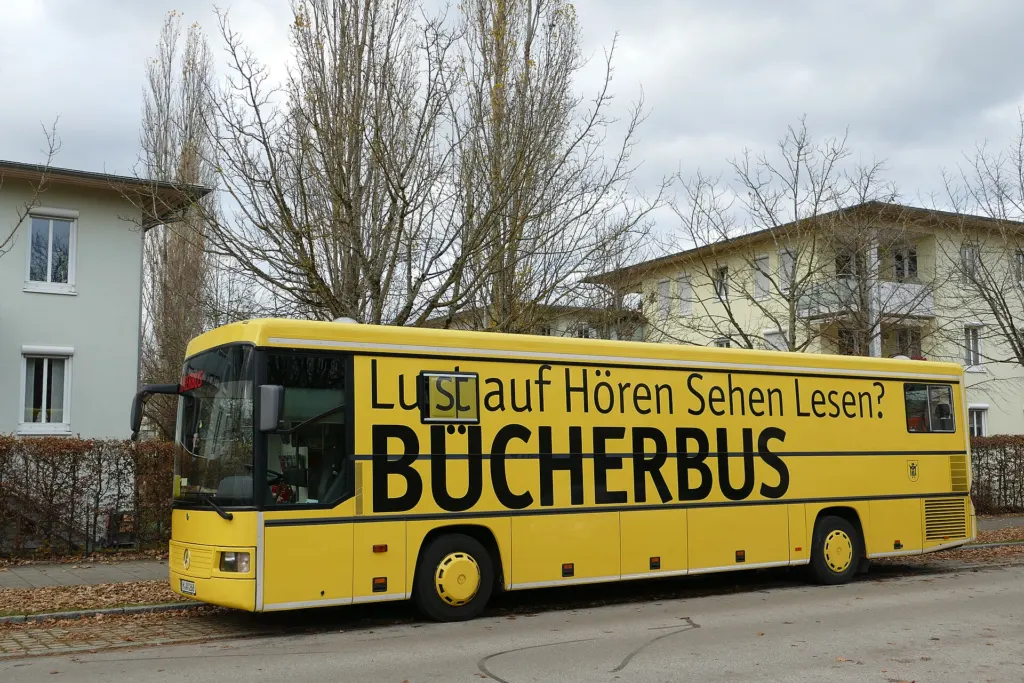
Image: Kritzolina, CC BY-SA 4.0 via Wikimedia Commons
This article was produced with AI assistance and reviewed by our Editorial Desk. How we work.