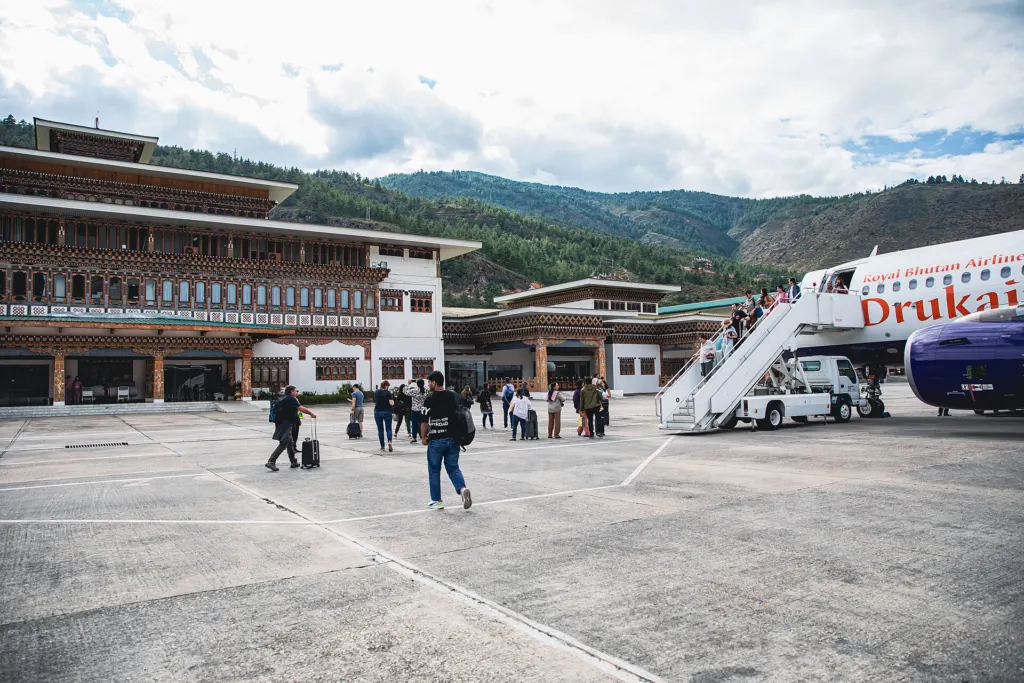
Bhutan’s only international airport sits at the bottom of a deep Himalayan valley, with mountains rising to about 5,500 meters (18,000 feet) on every side. Only a very small number of airline pilots hold the certification to land there.
Paro International Airport, airport code PBH, lies about 6 kilometers from the town of Paro on the banks of the Paro Chhu river, and 54 kilometers by road from the capital, Thimphu. Its single asphalt runway is 2,265 meters (7,431 feet) long, and the field itself is 2,235 meters above sea level, according to the airport’s reference entry. Bhutan’s Department of Civil Aviation runs it.
Why so few pilots are cleared
The problem is the terrain. Here is the arithmetic: peaks of 5,500 meters around a runway at 2,235 meters means ridges standing roughly 3,265 meters, or about 10,700 feet, above the touchdown point. That is a wall of rock more than twice the height of the runway is long, packed into a narrow valley.
Because of that, the rules at Paro are strict. Flights may only operate under visual meteorological conditions, meaning pilots must be able to see the ground and the ridges rather than fly in on instruments alone. Operations are limited to daylight, from sunrise to sunset, and afternoon flights face extra limits in the windy seasons. The airport is widely regarded as one of the most demanding in the world, and only pilots specifically certified for it fly in.
The daylight rule shows on the airport’s own online flight board. On November 11, every scheduled Drukair movement fell between a 7:10 a.m. departure to Kathmandu and a 4:20 p.m. departure to Bangkok.
A runway that began as a helicopter strip
The site started small. In 1968, India’s Border Roads Organisation cut an airstrip in the Paro valley, used at first for on-call Indian military helicopter flights on behalf of Bhutan’s royal government. Drukair, the national airline, was founded by royal charter on April 5, 1981.
Finding a plane for the original 1,200-meter strip was its own puzzle. Bhutan wanted an 18- to 20-seat short-takeoff aircraft with a high ceiling and a steep climb that could fly from Kolkata to Paro and back, about 1,200 kilometers, without refueling. Three types were tested between 1978 and 1980, and none passed.
The answer was a Dornier 228-200. The first one touched down at Paro on January 14, 1983, and the high lama of Paro Dzong set the exact landing time, the number of passengers aboard and even which way the plane would face once parked. Scheduled service began on February 11, 1983, with Flight 101 to Kolkata. Back then, the airport was a runway, a two-room control building whose ground floor doubled as check-in, and a departure lounge on the lawn.
From 18 seats to Airbus jets
- 1988: Drukair’s first jet, a BAe 146-100, arrives on November 21.
- 1990: The runway is stretched from 1,402 to 1,964 meters and strengthened for heavier aircraft.
- 1999: The current terminal building opens.
- 2004: Drukair’s first Airbus A319 lands on October 19.
- 2010: Nepal’s Buddha Air becomes the first foreign airline to run charters to Paro.
Paro was Bhutan’s only airport until 2011, and it remains the hub for both Drukair and Bhutan Airlines, with routes to Bangkok, Delhi, Kathmandu, Singapore and Dubai among others.
Mountain landings fascinate travelers for the same reason steep trails do. Badiyaa recently looked at Kalavantin Durg, a rock spire in India climbed by steps cut into the cliff, and at the history of steel-mat runways that let armies build airfields in days.
Traffic is modest by world standards. In 2023 the airport handled 189,878 passengers on 3,752 departures, which works out to about 51 travelers per departing flight.
Further reading
Image: Mussi Katz, CC0 via Wikimedia Commons
This article was produced with AI assistance and reviewed by our Editorial Desk. How we work.