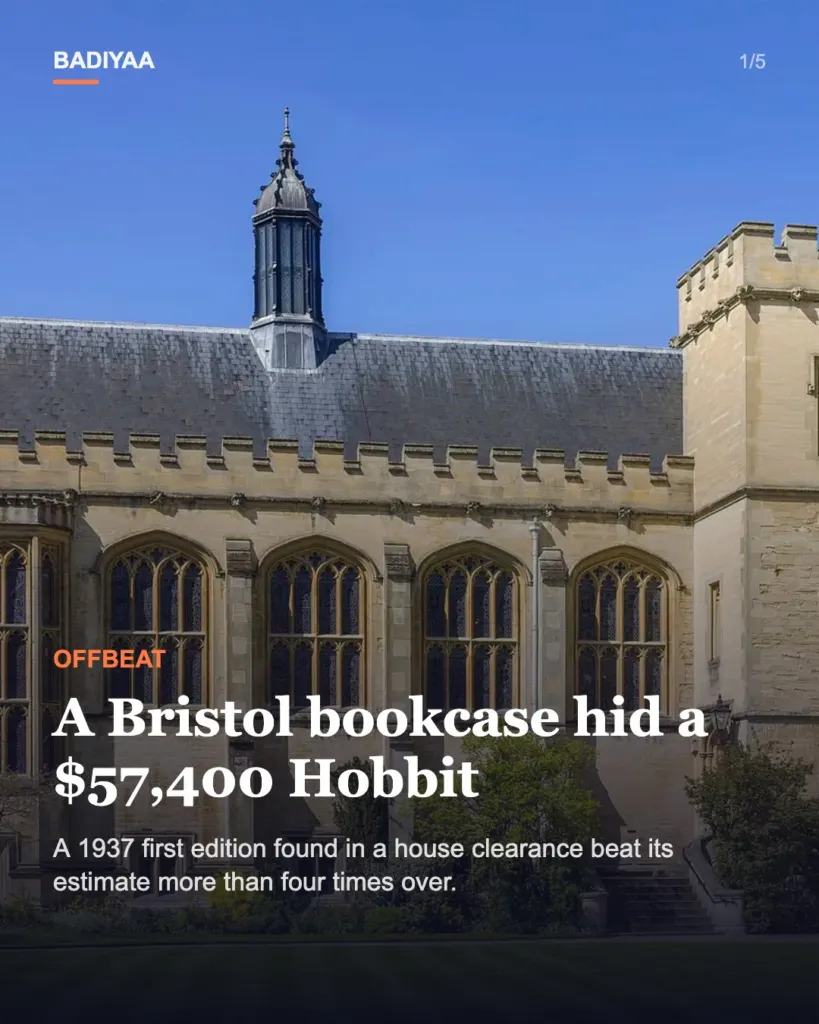
A first edition of J.R.R. Tolkien’s The Hobbit, spotted on an ordinary bookcase during a house clearance in Bristol, England, sold at auction for £43,000 on August 6, 2025. At that day’s exchange rate, the price works out to about $57,400. The sale is more than a year old, but the story has been circulating online again this week.
The buyer was a private collector in the UK. The seller was the estate of the home’s late owner: the Bristol and Bath auction house Auctioneum had been called in to assess the contents after the owner’s death, and its book specialist, Caitlin Riley, found the novel among other books on the shelf.
“It was clearly an early Hobbit at first glance, so I just pulled it out and began to flick through it, never expecting it to be a true first edition,” Riley said at the time. “Nobody knew it was there.”
The price in dollars
The Federal Reserve’s published rate for the pound on August 6, 2025, was $1.3360. Using that rate:
- Sale price: £43,000 x 1.3360 = $57,448, or roughly $57,400.
- Pre-sale estimate: £10,000 to £12,000, which is $13,360 to $16,032.
- The result was 4.3 times the low estimate and about 3.6 times the high one.
The reports we read do not say whether the £43,000 includes the buyer’s fees, so the total paid may differ.
Why this copy was worth so much
George Allen & Unwin published The Hobbit on September 21, 1937, in a first printing of 1,500 copies, and that run sold out by December. Auctioneum says it believes only a few hundred survive. It also believes £43,000 is a record for a first edition that has lost its dust jacket, as this one had.
Condition was one reason. Riley noted that most surviving copies of a children’s book show signs of young readers, sometimes colored pens, while this one looked as if nobody had opened it.
The pictures were another. The 1937 printing carried Tolkien’s own drawings in black and white only, with two endpaper maps. Tolkien had wanted color plates, and he got them first in the American edition from Houghton Mifflin of Boston, timed for early 1938. Allen & Unwin liked the color plates enough to add them to its own second printing at the end of 1937, so the black-and-white-only look belongs to that first run of 1,500.
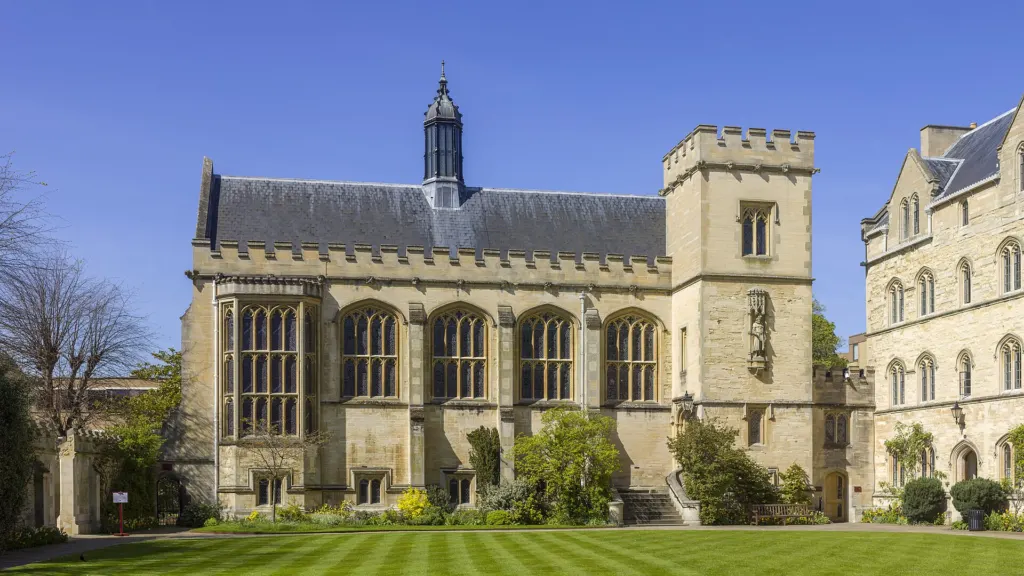
Then there is the family history. The book came from the library of Hubert Priestley, a botanist with links to the University of Oxford, where Tolkien taught Anglo-Saxon and was a Fellow of Pembroke College. Auctioneum thinks the two men probably knew each other; both were in touch with C.S. Lewis.
A different Gollum
A 1937 reader met a gentler version of a famous scene. In that first text, Gollum puts up his magic ring freely as the prize in the riddle contest, and he and Bilbo leave on good terms. Tolkien later reworked the chapter, “Riddles in the Dark,” to fit The Lord of the Rings, turning Gollum hostile and frantic over the lost ring. That revision went into the second edition, so the friendly Gollum survives only in the early printings.
How it compares
The Bristol copy is far from the costliest Hobbit. In June 2015, a first edition carrying a handwritten note in Elvish by Tolkien sold at Sotheby’s for £137,000. At the same August 2025 rate used above, that would be about $183,000, more than three times the Bristol result.
Further reading
Image: Godot13, CC BY-SA 4.0 via Wikimedia Commons
This article was produced with AI assistance and reviewed by our Editorial Desk. How we work.
Spot an error? Help verify this story
The story in 5 slides