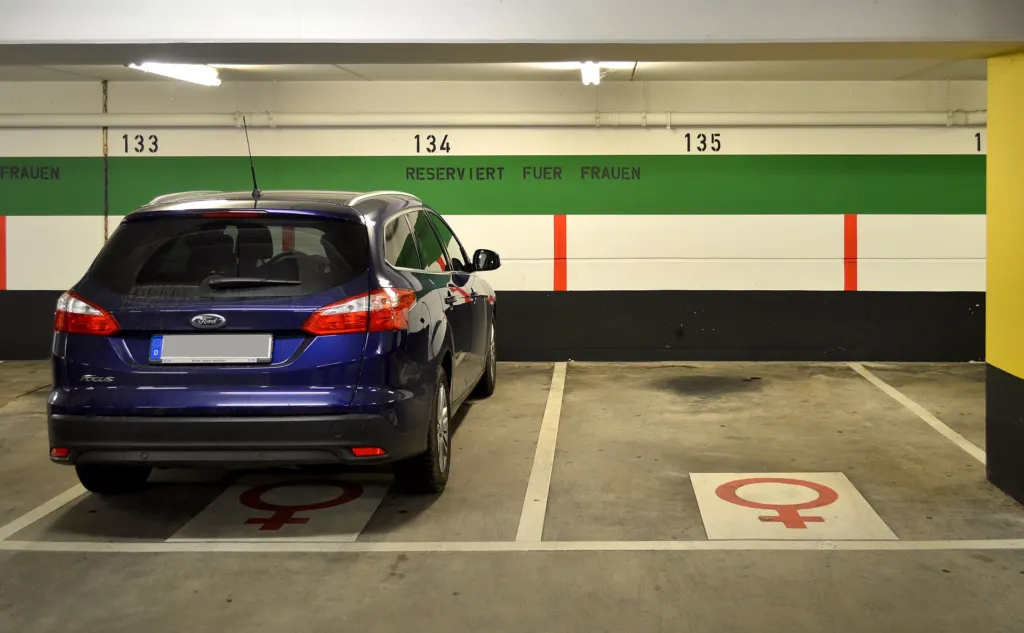
In Brandenburg, eastern Germany, the rules for big parking garages once demanded that at least 30% of spaces be reserved for women. That requirement lasted until November 2025, and it is the most extreme example of a very German fixture: the Frauenparkplatz, or women’s parking space.
Drivers from North America or Britain who pull into a German underground garage often meet them for the first time near the exit, marked with a pictogram of a woman and sometimes painted in a different color. They are not a joke and not a marketing gimmick. In several states they are written into building regulations.
How they started
The idea grew out of the 1990s, when studies began documenting how unsafe many women felt in public places at night. Urban planners started redesigning so-called fear spaces, such as underpasses, parks and parking garages, and reserved spaces became one of the fixes. They are usually lit more brightly, sit closer to exits and stairwells, and fall within view of staff or security cameras.
The rules, state by state
Germany’s national road traffic code does not mention women-only spaces at all, unlike spaces for disabled drivers. On private property, the owner’s house rules apply, so a garage operator can set them up and enforce them.
Several of Germany’s 16 states go further through their garage ordinances. In North Rhine-Westphalia and Schleswig-Holstein, women’s spaces must:
- be clearly marked as such;
- sit near the entrance;
- be visible to the attendant or to video surveillance, along with the stairs and lifts that lead to them;
- have an alarm button nearby.
Baden-Württemberg requires them to make up at least 10% of spaces in large garages. Brandenburg’s old 30% floor was three times that.
Is it discrimination?
Germany’s federal justice ministry, under Brigitte Zypries, addressed the question while drafting the country’s anti-discrimination law. Its reasoning: the spaces are socially accepted, and treating the sexes differently is allowed when there is a plausible reason, here that women are more often victims of sexual offenses. In 2011 the state labor court of Rhineland-Palatinate threw out a male nurse’s complaint against an employer that gave women priority for parking near work.
The safety case is weaker than the comfort case, though. The criminal police office in Hesse has said the spaces mainly raise women’s sense of security. Its crime figures for 2003 showed only one in every 1,000 offenses committed in Hesse’s parking garages was a sexual offense. Feminist planners have also argued that the focus on dark garages distracts from where most violence against women actually happens: at home, by partners or former partners.
Beyond Germany
Austria has its own Damenparkplätze, backed by a 2007 Vienna survey in which 49% of women said driving alone into an underground garage felt uncomfortable. Switzerland went the other way: since 2011, cities including Lucerne and Zurich have scrapped theirs, arguing that garages had become brighter and safer for everyone. Seoul painted 4,929 pink spaces for women in 2009.
German customs can look odd from outside, much like the Christkind gift-bringer that Martin Luther promoted over Saint Nicholas. More oddities from around the world sit in Badiyaa’s Offbeat section.
For now, the floor that remains on the books is Baden-Württemberg’s 10%.
Further reading
Image: DimiTalen, CC0 via Wikimedia Commons
This article was produced with AI assistance and reviewed by our Editorial Desk. How we work.