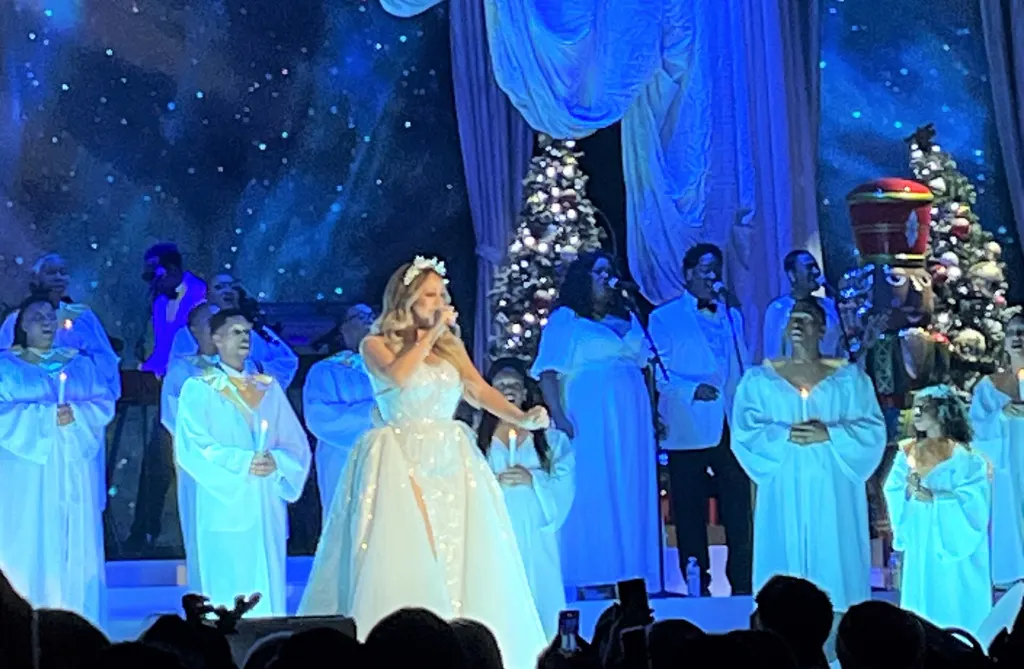
A man singing Mariah Carey’s 1998 ballad “My All” in whistle tone, the thin, flute-like top of the human voice, became one of the most-upvoted clips on a Reddit board devoted to impressive feats this week. The post’s title called his whistle tone flawless. The notes he was reaching sit in a register most singers, male or female, never touch.
We could not open the Reddit post or trace the singer’s own account, so we are not naming him or quoting view counts. What we can explain is why a man hitting those notes stops people scrolling.
What the whistle register is
Voice teachers split the voice into registers. The everyday speaking and singing voice is the modal register; above it sits falsetto; above that sits the whistle register, also called the flute or flageolet register. It gets its name from its sound, which is closer to a whistle than to an ordinary sung note.
For most singers it starts above the soprano’s “high D,” the note written as D6, and runs about an octave higher to D7. It works differently from the other registers: only part of the vocal folds vibrates, which shortens the vibrating length and makes very high pitches easier. It is also the least understood register, partly because the epiglottis closes down over the larynx, which makes the folds hard to film while it is in use.
The numbers behind the notes
Pitch is a frequency, and every octave doubles it. Using the standard tuning where the A above middle C is 440 hertz:
- B2, the lowest note Carey sings on the original “My All”: about 123 Hz.
- F5, the highest note listed for the original: about 698 Hz.
- D6, where the whistle register usually begins: about 1,175 Hz.
- D7, roughly where it tops out for most singers: about 2,349 Hz.
Those figures come from the equal-temperament formula, 440 times 2 raised to the number of semitones from A4 divided by 12. D6 is 17 semitones above A4, so 440 times 2 to the power of 17/12 gives roughly 1,175 Hz. The gap from F5 to D6 is nine semitones, which means the recorded vocal on “My All” stays below the whistle range. A whistle-tone cover is adding territory the album version does not use.
Why a man doing it stands out
In popular music the whistle register has mostly been the domain of women: Minnie Riperton on “Lovin’ You,” Betty Wright, Christina Aguilera, Ariana Grande and Carey herself, who uses it heavily, most famously on “Emotions.” A smaller group of men can reach it too, among them Vitas, Adam Lopez, Axl Rose and Dimash Qudaibergen.
The song he picked
“My All” came from Carey’s sixth studio album, Butterfly, and was released as a single on April 21, 1998. She wrote and produced it with Walter Afanasieff, built it on Spanish-style guitar sounds and a G minor progression, and took it to No. 1 in the US, her 13th chart-topper there. It reached No. 4 in the United Kingdom and was certified double platinum in the US.
The song has drawn cover versions before. Alisa Kozhikina won the Russian children’s edition of The Voice in 2014 singing a Russian version called “Vsyo,” and Australian singer Greg Gould recorded a Spanglish duet of it in 2020.
The original runs 3 minutes 51 seconds and peaks at F5. Any cover that climbs nine semitones past that, into D6 territory, is singing at better than 1,000 vibrations a second.
More stories like this one are collected in the Badiyaa Offbeat section.
Further reading
Illustrative image. Image: Heartfox, CC BY-SA 4.0 via Wikimedia Commons
This article was produced with AI assistance and reviewed by our Editorial Desk. How we work.