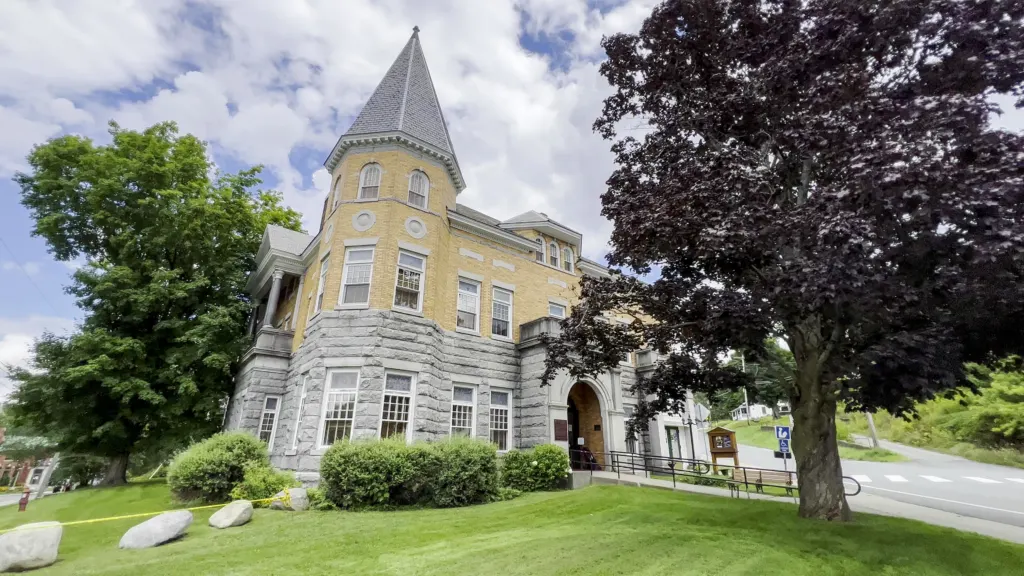
At the Haskell Free Library and Opera House, a thick black line runs diagonally across the floor, and it is the border between the United States and Canada. Readers browse books in Quebec. Theatergoers walk in through Vermont, take seats that are mostly American, and watch a stage that sits in Canada.
That is why the Haskell is sometimes called “the only opera house in the U.S.A. with no stage.” On November 15, 1985, Canada designated it a National Historic Site, which makes Sunday the 41st anniversary of that honor.
Built on the line on purpose
The building was no surveying accident. Martha Stewart Haskell and her son, Horace Stewart Haskell, of Derby Line, Vermont, paid for it in memory of her parents and her late husband, Carlos Freeman Haskell. They wanted Canadians and Americans to have equal access, so they deliberately placed it across what was then an open border between Derby Line and the village of Rock Island, now part of Stanstead, Quebec.
Construction began in 1901. The opera house opened on June 7, 1904, and the library followed in 1905. The reported cost was about $25,000, close to $900,000 in 2025 money. The walls are two feet thick and built of local Stanstead granite.
One building, two of everything
- Two addresses: 93 Caswell Avenue, Derby Line, Vermont 05830, and 1 rue Church, Stanstead, Quebec J0B 3E2.
- Two heritage listings: the US National Register of Historic Places in 1976, Quebec heritage status in 1977, and Canada’s National Historic Site designation in 1985.
- Two languages on the shelves: more than 20,000 books in English and French, shelved separately because English spines usually read top to bottom and most French spines read bottom to top.
- A split board: four American and three Canadian directors run the place.
Membership is free for anyone who can prove they live within 30 miles, or 50 kilometers, of the building.
The theater upstairs
The opera hall fills the second and third floors. It still shows off a drop curtain painted with a scene of Venice, plus four other backdrops by Erwin Lamoss dated 1901, and plaster scrollwork with plump cherubs made in Boston. Sources give its capacity as 400 to 500 seats depending on the count.
Here is the arithmetic that makes the place famous. The stage is in Canada and roughly half the seats are too, while the main entrance and the rest of the hall are in the United States. A performer standing at center stage is singing from one country to an audience sitting partly in another.
How visitors get in now
For decades, Canadians could walk to the American front door along a set sidewalk route on rue Church and go straight home afterward without visiting a customs post. That arrangement ended in 2025, when US authorities said Canadian visitors would need to clear US customs before using the main entrance.
The library responded by building its own way in from Quebec. A fundraiser aimed at CA$100,000 raised CA$170,000 within a week, and for a while visitors climbed three flights of stairs through the opera house from an emergency door. The permanent Canadian-side entrance opened officially on June 10, 2026. The board president put the total at C$700,000, with more than $350,000 from crowdfunding.
Border oddities like this have a small fan club. We have covered Calexico and Mexicali, the twin cities split by the US-Mexico line, Martelange’s border road lined with Luxembourg gas stations, and Kentucky Bend, the cut-off corner of Kentucky.
The Haskell’s library is open to the public five days a week, and the black line on the children’s room floor is still there for anyone who wants to stand in two countries at once.
Further reading
Image: Lea-Kim, CC BY-SA 2.0 via Wikimedia Commons
This article was produced with AI assistance and reviewed by our Editorial Desk. How we work.