Two reed pipes, one player, and a leather strap wrapped around the face: that was how the loudest instrument of ancient Greece was played. The aulos, a double-reed wind instrument heard at wrestling matches, sacrifices, plays and on the decks of warships, is being heard again on rebuilt copies, and the strangest part of any performance is the harness the player wears.
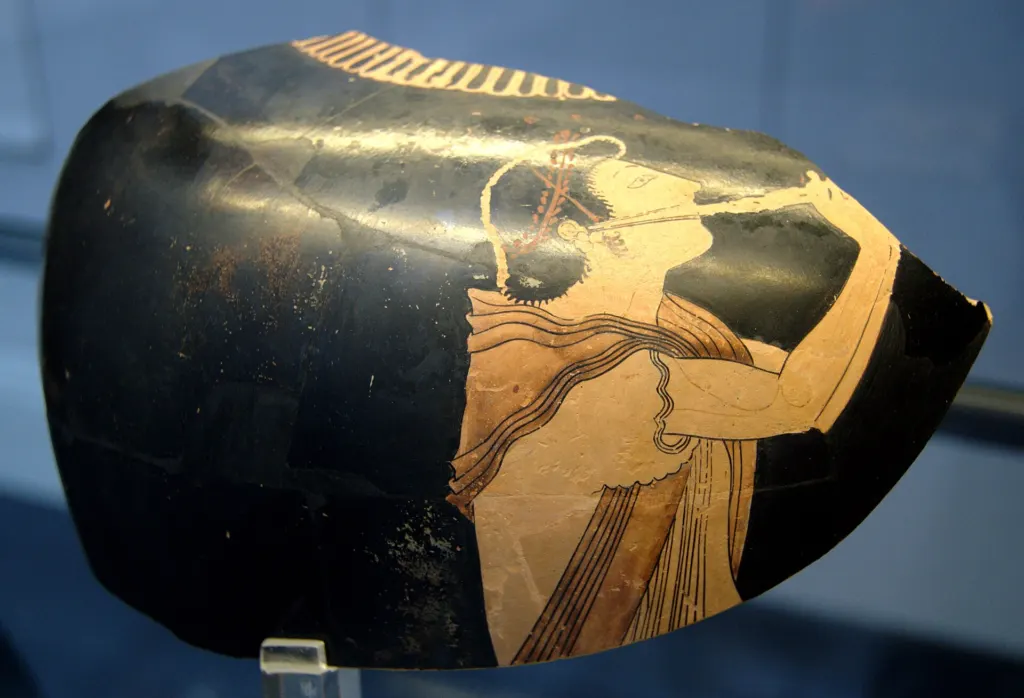
That harness was the phorbeia, known to the Romans as the capistrum. It used two bands: one ran over the crown of the head, while the other went around the back of the head and across the face from ear to ear, pressing on the cheeks. Painted pots and Roman mosaics show players wearing it while their cheeks stay flat instead of ballooning out.
A flute that was never a flute
The word aulos is often translated as “flute” or “double flute,” and that sends modern readers in the wrong direction. Archaeological finds and ancient pictures point to a double reed, close to an oboe but with a wider mouthpiece, closer to the Armenian duduk. Ancient listeners described its tone as “penetrating, insisting and exciting.”
Most auloi had two separate pipes, held in a V shape and played together. With a reed in each, the player could run a melody on one pipe and hold a steady note, or a second line, on the other. That takes a lot of air pushed at steady pressure, which is where the strap earned its keep.
Why players wore the strap
Historians list several jobs the phorbeia may have done at once:
- It supported the cheeks, helping players keep up the steady breath needed for circular breathing.
- It held the pipes steady at the lips, so both hands stayed free for the finger holes.
- It took strain off the lip muscles over long performances.
- It may have stopped the small reeds from slipping back toward the throat.
The strain was real. The Greek writer Lucian tells of a young aulos player named Harmonides who died from blowing too hard in practice, according to the dialogue named after him. Myth carried the same message from the other side: the goddess Athena was said to have thrown the aulos away because playing it puffed out her cheeks and spoiled her looks.
From warships to film scores
The aulos was a working instrument. It set the rhythm for rowers on triremes, accompanied the long jump and the discus, and on the Chigi vase an aulos player keeps soldiers in step as their formation advances. In Sparta it marched into battle with the hoplites. Plato distrusted it, banning it from his ideal city in the Republic but letting it back in for his later Laws.
Real pieces survive, though rarely whole. The Reading Aulos, one half of a double pipe kept at the Ure Museum of Greek Archaeology in Reading, England, is 38 centimeters long, made of wood with bronze cladding and silver bands. The museum bought it at auction in 1967 for 100 pounds, and a University of Reading scholar dated it to no earlier than the 4th century BC.
Copies built from finds like that are what modern players use. Composer Ludwig Göransson used a replica aulos made by Max Brumberg and played by Callum Armstrong in his score for the 2026 film version of the Odyssey and so put a sound from ancient Greek theaters into a 2026 cinema soundtrack.
How to hear the difference
A quick listening guide for anyone hearing a rebuilt aulos for the first time: the buzz comes from the double reeds, the two-part sound comes from the twin pipes, and the unbroken line with no gaps for breath is the trick the strap was there to help. If the player’s cheeks stay flat while the sound keeps going, the phorbeia is doing exactly the job it did 2,500 years ago.
For more on music caught at a surprising moment, read how Ray Chen’s violin string snapped at the Royal Albert Hall and was fixed mid-concerto. For another ancient story that is not what it seems, see why Caesar’s “Et tu, Brute?” appears in no ancient biography.
Further reading
Image: Smikros (attributed), Public domain via Wikimedia Commons
This article was produced with AI assistance and reviewed by our Editorial Desk. How we work.