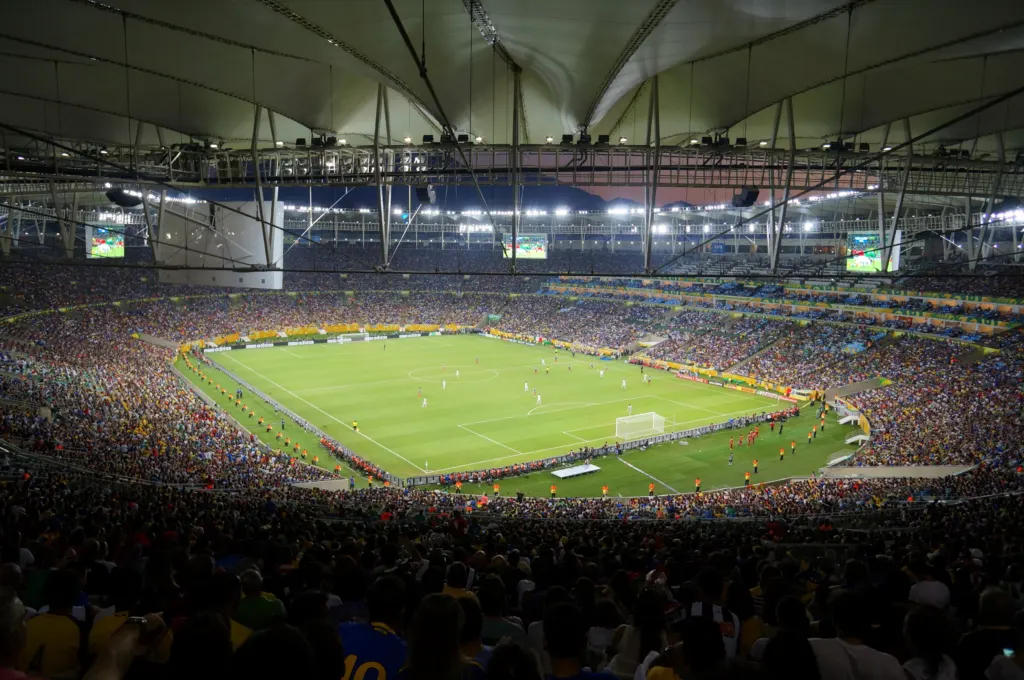
Pelé’s 1,000th goal was a penalty kick. On November 19, 1969, at the Maracanã Stadium in Rio de Janeiro, the Santos forward stepped up against Vasco da Gama, sent the ball toward goalkeeper Edgardo Andrada’s left-hand corner and finally reached the number Brazil had been counting down to for weeks.
Andrada got a hand to it and still could not keep it out. When he realized the ball was in, he punched the grass. That image of a beaten keeper pounding the turf while Pelé celebrated became one of the most famous photographs in Brazilian sport.
A whole stadium chanting one name
As soon as the referee pointed to the spot, the crowd started chanting Pelé’s name, and Vasco’s own supporters joined in. After the ball went in, Pelé ran to collect it and kissed it. Reporters swarmed him and Santos officials carried him on their shoulders.
Play stopped for about 20 minutes. Pelé took a lap of honor around the Maracanã wearing a Vasco shirt with “1000” printed on the back.
The moment even got a name of its own: O Milésimo, Portuguese for “the thousandth”.
Who he dedicated it to
With microphones pushed toward him, Pelé dedicated the goal to children, to poor people and to elderly blind people. In Portuguese he spoke of “crianças”, “pessoas pobres” and “velhinhos cegos”. Some listeners in Brazil had hoped for something sharper, and the speech drew criticism at the time.
Andrada, an Argentine who had joined Vasco from Rosario Central that same year, had said the day before that he wanted to be the man who stopped goal number 1,000. Years later he made peace with it, saying the goal came and that over time you get used to it and end up adopting it like a son.
Was it really number 1,000?
Here the count gets slippery, and that is half the fun. Five days earlier, on November 14, 1969, Santos had played a friendly against Botafogo of Paraíba. Pelé reluctantly took a penalty there, scored what was logged as goal 999, then spent the rest of the match in goal, apparently so the milestone would land in Rio.
In the 1990s, a recount of his career turned up a goal against Paraguay at the 1959 South American Championship that the official tally had missed. Add it in and the Botafogo penalty becomes the real thousandth goal, and the Maracanã strike becomes 1,001.
The wider record is just as elastic. Depending on which matches you include, published totals for Pelé’s career run from 1,279 to 1,324 goals in 1,363 to 1,413 games. Guinness World Records recognizes 1,279 goals in 1,363 games, a figure that counts exhibition matches.
Doing the math on the milestone
Pelé made his senior Santos debut in a friendly on September 7, 1956. That puts goal 1,000 about 13 years and two months into his professional career, or roughly 159 months. At that pace he averaged more than six goals a month, every month, for 13 years. He was 29 years old.
He went on to win a third World Cup with Brazil the following summer in Mexico, finished his Santos career after the 1974 season and later played for the New York Cosmos.
The man who could do anything on a pitch once kept goal too: read how Pelé played four matches as Santos goalkeeper and was never beaten. Brazilian stars still pull crowds decades on, as when Ronaldinho, 46, played a half for Ravenna in Italy. More moments from the game’s past are on our History page.
Further reading
Image: Leandro Neumann Ciuffo, CC BY 2.0 via Wikimedia Commons
This article was produced with AI assistance and reviewed by our Editorial Desk. How we work.