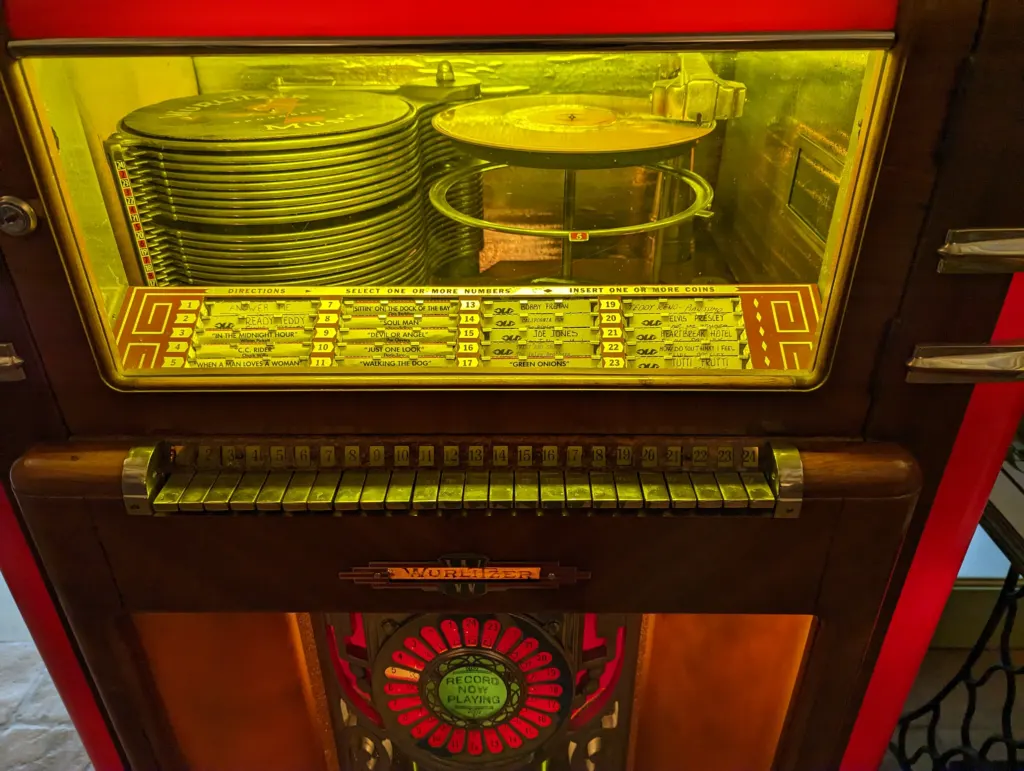
On November 23, 1889, drinkers at the Palais Royale Saloon in San Francisco could drop a nickel into a slot and hear a recording of music, with no band in the room. The coin-operated phonograph that Louis Glass and William S. Arnold had installed at 303 Sutter Street is remembered as the world’s first jukebox, more than 50 years before anyone called it that.
An Edison machine with a coin slot
Glass and Arnold did not build a new music machine from scratch. According to the Wikipedia history of the jukebox, they took an Edison Class M Electric Phonograph and fitted it with a device they patented as a “Coin Actuated Attachment for Phonograph.” Their company, Pacific Phonograph, had its offices two blocks from the saloon. There was no loudspeaker. Customers pressed listening tubes to their ears, a little like a stethoscope, and heard a wax cylinder play.
The date itself is recorded in the Wikipedia timeline of 1889 in the United States, which lists November 23 as the day the first jukebox went into operation at the Palais Royale. The same year had already brought the founding of Columbia Phonograph in Washington, D.C., on January 22, so 1889 was the year recorded sound started turning into a business.
Where the word came from
The name “jukebox” only appeared in the United States around 1940. It came from the juke joint, the informal music, dancing and drinking spots run mainly by African Americans in the Southeast. The two Wikipedia articles give slightly different meanings for the root word. The jukebox article says the Gullah word juke means “bawdy,” while the Wikipedia article on juke joints traces it to the Gullah joog or jug, meaning rowdy or disorderly, and further back to the Wolof word dzug, to misbehave. Because of those rough associations, manufacturers avoided the word “jukebox” for years.
The juke joint article also makes the musical link plain: until record players and jukeboxes arrived, a juke joint needed at least one live musician for anyone to dance.
From one saloon to every diner
Loudspeakers came much later. In 1928 Justus P. Seeburg, a player-piano maker, paired a speaker with a coin-operated record player; his Audiophone held eight records on a rotating wheel. The machines boomed from the 1940s to the mid-1960s. By the middle of the 1940s, the jukebox history says, three-quarters of all records made in America went into jukeboxes. The 1946 Wurlitzer Model 1015, the “bubbler” designed by Paul Fuller, offered 24 selections and sold more than 56,000 units in under two years.
A nickel slot to a touch screen: the timeline
- November 23, 1889: Glass and Arnold’s coin phonograph starts playing at the Palais Royale.
- 1928: Seeburg adds a loudspeaker and eight selectable records.
- Around 1940: the word “jukebox” enters American speech.
- 1946: Wurlitzer’s 1015 becomes the classic diner machine.
- 1995: the US Postal Service issues a 25-cent jukebox stamp.
- Today: internet-connected touch-screen machines fill bars, while Rock-Ola in California and Sound Leisure in Leeds still build classic-style units.
The machine at the Palais Royale and Thomas Edison’s talking machine are closely related. Badiyaa told the story of how Edison announced the phonograph in November 1877, the invention Glass and Arnold modified 12 years later. Records built for coin machines went on to chart history too, as in our piece on Glenn Miller’s first gold record for ‘Chattanooga Choo Choo’.
The idea of paying a small coin to choose a song has outlived the cylinder, the 78 and the 45. The 1889 record puts the start of it in one San Francisco saloon, 137 years ago this Monday.
Sources
- Jukebox, Wikipedia, 2026
- 1889 in the United States, Wikipedia, 2026
- Juke joint, Wikipedia, 2026
Image: Museo del disco d'epoca, CC0 via Wikimedia Commons
This article was produced with AI assistance and reviewed by our Editorial Desk. How we work.