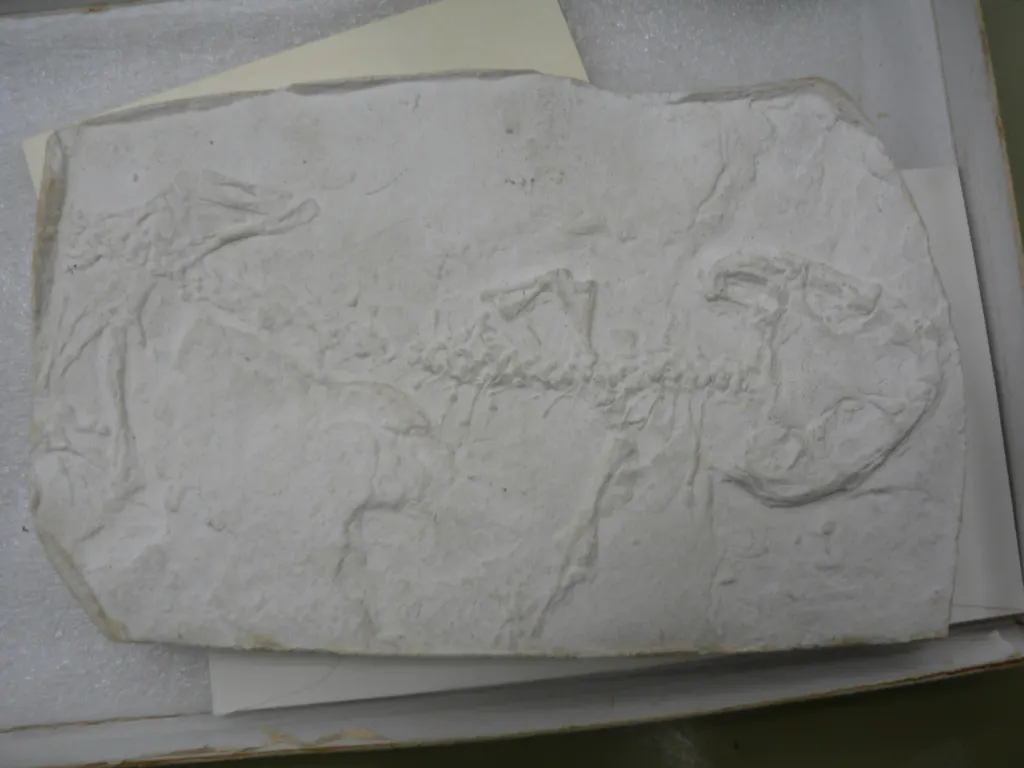
A squat, frog-shaped animal that crawled around what is now northern Illinois 309 million years ago, long before the first dinosaurs, has been named Jeanerpeton mazonensis, “Jean’s crawler from Mazon Creek.” The two student scientists who described it, Allison Sefcovic and Payton Kohlberg, named it for their mothers, who are both called Jean.
The species was formally described in a paper in the Journal of Vertebrate Paleontology, written with Field Museum researchers Calvin So and Arjan Mann. The authors class it as an amphibamiform, part of the group of early tetrapods that sits close to the ancestry of today’s frogs and salamanders.
A fossil hiding under the wrong name
The specimen is not a new find. An amateur collector picked it up years ago and gave it to the Field Museum in Chicago, where it was filed as Amphibamus grandiceps, a well-known Mazon Creek species first named by Edward Drinker Cope in 1865. According to Wikipedia’s entry on Amphibamus, that animal was about 20 centimeters (7.9 inches) long and is considered close to the ancestry of modern amphibians.
Over time, many poorly studied Mazon Creek specimens were lumped under that one name, a habit paleontologists call a “waste bin taxon.” The Field Museum team has been pulling distinct animals back out of that bin one by one. Their anatomical comparison showed this fossil differs enough from Amphibamus to deserve its own genus and species.
Why Mazon Creek keeps soft details
The fossil comes from the Mazon Creek fossil beds near Morris, Illinois, a National Historic Landmark since 1997. The site formed about 309 million years ago, in the Pennsylvanian part of the Carboniferous period, when the region lay within 10 degrees of the equator. Dead plants and animals were buried fast in muddy sediment. Bacteria breaking down the bodies released carbon dioxide that reacted with iron in groundwater, forming siderite casts that hardened into ironstone nodules around the remains.
That process explains why Jeanerpeton shows details most fossils lose. The researchers could see scales on its back, the outline of its eyes and thin belly ribs called gastralia. The same beds preserve over 320 animal species, including the famous “Tully Monster,” the Illinois state fossil.
Where it fits on the family tree
It helps to line up the dates. Mazon Creek is about 309 million years old. The oldest dinosaurs appear in the record roughly 230 million years ago, so Jeanerpeton lived around 80 million years before them, which is longer than the time separating the last non-bird dinosaurs from us. Badiyaa has followed other steps in this long story, from how the first necks evolved in Tiktaalik to Gerrothorax maritimus, an early amphibian that took to the sea.
The paper’s significance is less about a single fossil than about the method: re-examining old museum drawers. Every specimen reassigned from Amphibamus sharpens the picture of how many kinds of small amphibian relatives lived in the Carboniferous swamps, and when traits we now see in frogs and salamanders first showed up.
Limits of the study
The new species rests on one specimen, so how much its body shape varied between individuals is unknown. Mazon Creek nodules preserve outlines and impressions rather than full three-dimensional bones, which limits some measurements. The team’s broader review of other Amphibamus specimens in the collection is still under way, and more reassignments may follow.
Sources
- “Jeanerpeton mazonensis, gen. et sp. nov.: a new, exceptionally preserved, late Carboniferous amphibamiform from the Mazon Creek Lagerstätte, Illinois”, Journal of Vertebrate Paleontology (Sefcovic et al.), 2026
- “Mazon Creek fossil beds”, Wikipedia, 2026
- “Amphibamus”, Wikipedia, 2026
Image: Jeyradan, Public domain via Wikimedia Commons
This article was produced with AI assistance and reviewed by our Editorial Desk. How we work.