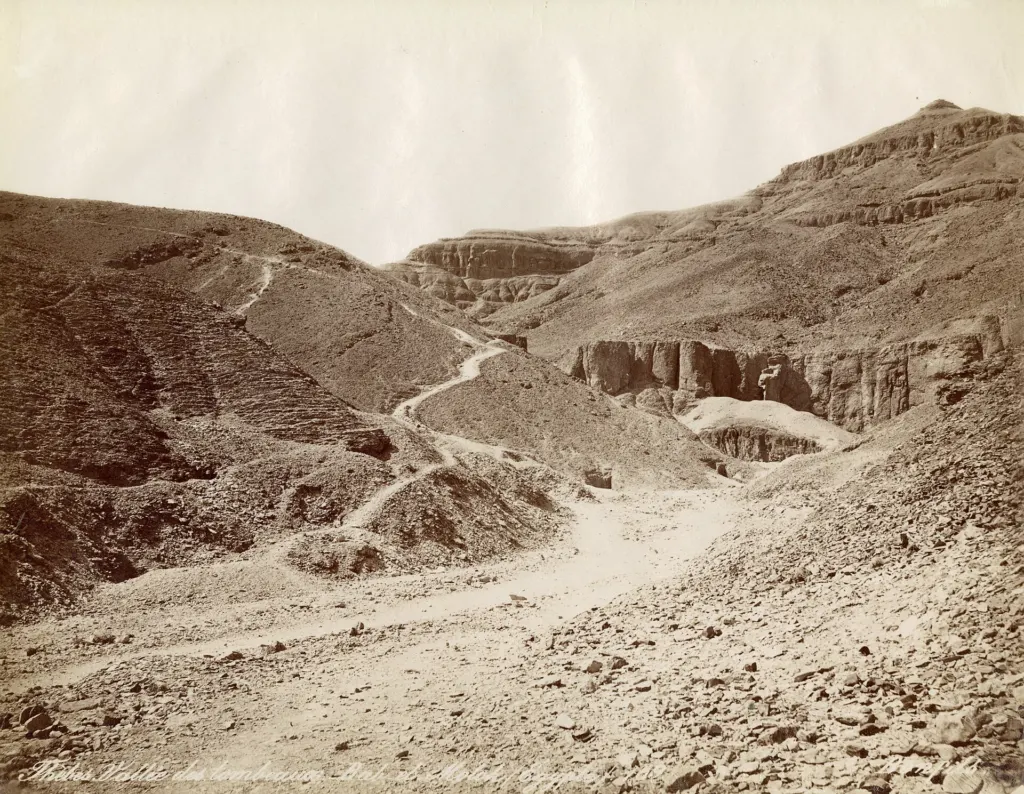
“Wonderful things” may be the most famous two words in archaeology, but they are not what Howard Carter wrote on the night he first looked into Tutankhamun’s tomb. In his own excavation journal for November 26, 1922, Carter recorded Lord Carnarvon asking “Can you see anything” and his reply as: “Yes, it is wonderful.”
What the journal says
The handwritten journal survives at the University of Oxford, and the Griffith Institute’s transcript of Carter’s 1922 excavation journal gives the entry in full. That afternoon, after clearing 9 meters of a sloping passage, the team reached a second sealed doorway. Carter made “a tiny breach in the top left hand corner,” pushed a candle through to test for bad air, and peered in while Carnarvon, his daughter Lady Evelyn and Carter’s colleague Arthur Callender waited behind him.
The hot air made the flame flicker. Then, Carter wrote, the room “gradually loomed before one,” crowded with gilded couches, chests, alabaster vases and overturned chariot parts. Carnarvon spoke, and Carter answered him. The journal entry for November 26 reads: “Lord Carnarvon said to me ‘Can you see anything’. I replied to him Yes, it is wonderful.” Carter added that the jumble reminded him of “the property-room of an opera-house of a vanished civilization.”
Where ‘wonderful things’ came from
The punchier version appeared later, in the popular book on the find that Carter co-wrote with Arthur Cruttenden Mace. As the Wikipedia history of the discovery of Tutankhamun’s tomb puts it, accounts differ over the exact wording, and in the best-known one, from the book, Carter replied “Yes, wonderful things.” The book also polished the scene into “strange animals, statues, and gold – everywhere the glint of gold.”
Journal and book, side by side
- Carnarvon’s question: journal, “Can you see anything”; book, he asked whether Carter could see anything.
- Carter’s answer: journal, “Yes, it is wonderful”; book, “Yes, wonderful things.”
- What he saw: journal, a long list of furniture, vases, shrines and chariots; book, “everywhere the glint of gold.”
- Who stood by: both name Carnarvon, Lady Evelyn and Callender.
Read together, the two texts show a familiar pattern: the private note is plainer and more precise, and the published line is the one that sticks. Carter did not invent a new event for the book; he tidied his own words. He also had form with that adjective. On November 5, after uncovering the first sealed doorway, he cabled Carnarvon in England: “At last have made wonderful discovery in Valley a magnificent tomb with seals intact recovered same for your arrival congratulations.”
The three weeks that led to the doorway
Carter’s journal lets the run-up be dated day by day. He found the first step of the staircase at about 10 a.m. on November 4, 1922. Carnarvon reached Luxor on November 23, Lady Evelyn arrived the next day, and the cleared staircase proved to have sixteen steps, with seals bearing Tutankhamun’s name. On November 27 electric lights went in, and Carter and Carnarvon crept under a gilded couch to peer into a second room, later called the Annexe.
The tomb would eventually yield 5,398 catalogued objects, the discovery’s Wikipedia record notes, most of them now in the Egyptian Museum in Cairo, and the last were shipped there in 1932. Carter’s notebooks went to Oxford after his death, and the institute put them online in the early 2010s.
Badiyaa has traced other famous lines back to the person’s own words, including what Paul Revere actually wrote about his 1775 ride, and has followed an earlier royal traveler to the Pyramids in Mansa Musa’s 1324 hajj through Cairo.
The Griffith Institute record describes the 1922 journal as a black ring-binder of 148 loose-leaf, graph-lined pages. On page 33 of that binder, the word is still “wonderful,” and nothing more.
Sources
- Howard Carter’s excavation journal, 1st season 1922–1923 (transcript), Griffith Institute, University of Oxford, 2026
- Discovery of the tomb of Tutankhamun, Wikipedia, 2026
Image: Félix Bonfils, CC0 via Wikimedia Commons
This article was produced with AI assistance and reviewed by our Editorial Desk. How we work.