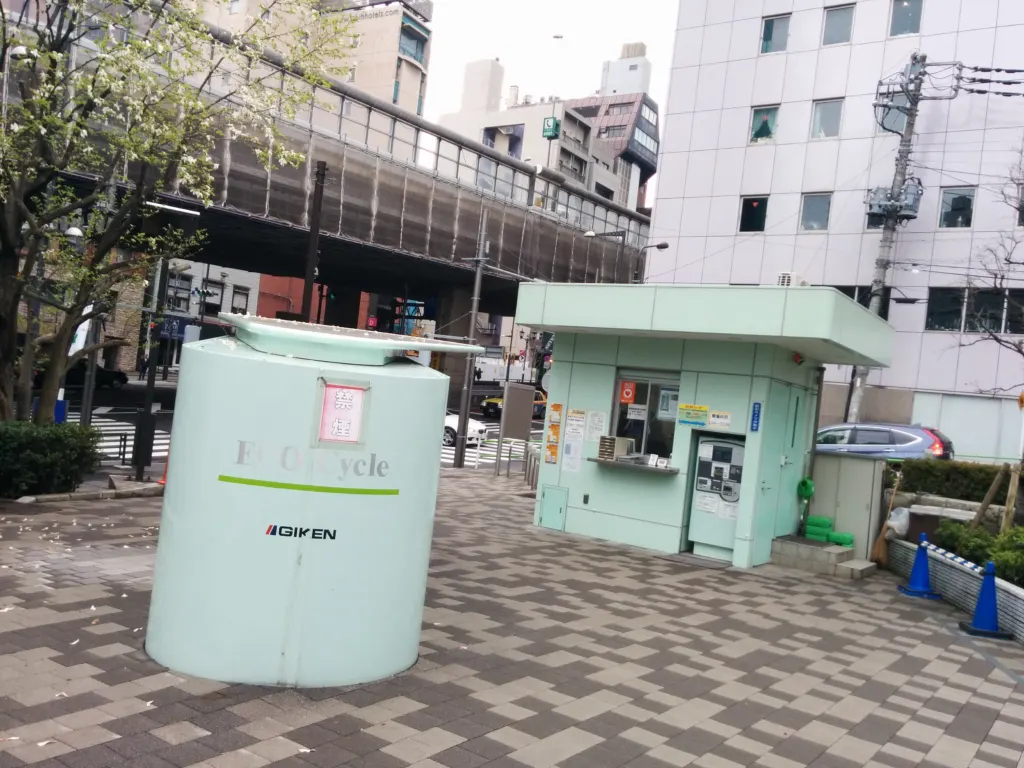
Push a bicycle onto a rail, step back, press a button, and it vanishes into the pavement. That is the trick behind ECO Cycle, the robotic underground bike garage that Japanese engineering firm GIKEN LTD. has been sinking beneath station squares across Japan. A clip of the machine swallowing and then returning bikes climbed high in a popular Reddit community this week, but the system itself is no prototype: GIKEN says it now runs at 28 locations with 67 units in all.
The headline numbers on GIKEN’s specification sheet are simple. A standard underground unit holds 200 bicycles. Getting yours back takes 15 seconds on average and as little as 10, measured from the swipe of a card to the exit door opening.
How the bike disappears
Riders line the wheels up along a guide rail and step off a pressure-sensitive mat before pressing the button. The machine then takes the bike down into a vertical cylinder, where a rotating elevator files it away in a ring of storage slots. To collect it, the owner swipes an IC card or tag and waits by the door.
GIKEN lists a string of safety interlocks. The loading slot opens only as wide as a tire, so hands and bags stay out. The exit door opens only when a bicycle is passing through. If someone steps onto the mat mid-transfer, the run stops and the bike is sent back slowly. Sensors flag a wheel that has slipped off the rail or a locked rear wheel, and an earthquake detector halts everything once shaking passes 100 gals.
The garage is not fussy about what it takes. Tires from 18 to 28 inches fit, as do electric-assist bikes, child-seat bikes, folding bikes, road bikes and mountain bikes, up to 40 kilograms and 1.95 meters long.
Built by pushing steel into the ground
The construction method matters as much as the robot. GIKEN builds each shaft with its own Press-in Method: a hydraulic machine pushes specially shaped steel sheet piles into the ground to form a round wall, crews dig out the soil inside, the machinery is lowered in, and a small entrance booth goes on top. The company puts the build at about two months per unit and says the process avoids the vibration and noise of conventional piling, which is why it can work beside busy stations.
The steel shell is rated to withstand shaking of 6-high on Japan’s seismic intensity scale, which runs from zero to 7. The design also carries a general rating from the Building Center of Japan, granted on January 14, 2011. GIKEN also designs the shafts to be pulled out and reused if a city no longer needs them.
Japan measures its earthquake shaking on a different scale from the magnitude figures most Western readers know; Badiyaa explained why the Richter scale no longer rates big earthquakes.
Kobe’s new bike basement, by the numbers
The newest install shows the scale cities are now buying at. In a June 22, 2026 release, GIKEN said three underground units holding 228 bicycles each opened on June 1 on the Hyogo Station side of the plaza north of Kobe Station. Two more units of 204 bicycles each are under construction on the Motomachi side, due in fiscal 2027.
The arithmetic is straightforward: three units of 228 make 684 spaces, two units of 204 add 408, and together that is the 1,092 bicycles GIKEN quotes for the finished site. Bike racks had previously covered most of the station square; moving them underground frees that space for people.
For comparison, general planning guidance holds that the space needed to park a single car can hold close to a dozen bicycles. Stacking those bicycles in a shaft instead of spreading them across a plaza is the whole point of the design.
Japan keeps turning up in odd and practical corners of the internet, from Tokyo’s deadpan Mundane Halloween costumes to this; more stories like it sit on Badiyaa’s Offbeat page.
Kobe’s last two units are scheduled to open in fiscal 2027, taking the station’s underground bike park to 1,092 spaces.
Further reading
Image: Hanonimas, CC BY-SA 3.0 via Wikimedia Commons
This article was produced with AI assistance and reviewed by our Editorial Desk. How we work.