When a big earthquake hits and the first figure reported is something like 7.8, that number is almost certainly not on the Richter scale. For large quakes, seismologists at the US Geological Survey and other agencies use the moment magnitude scale, written Mw, which seismologists Thomas Hanks and Hiroo Kanamori set out in 1979. The name “Richter” survives mostly as a habit of speech.
What Richter actually built
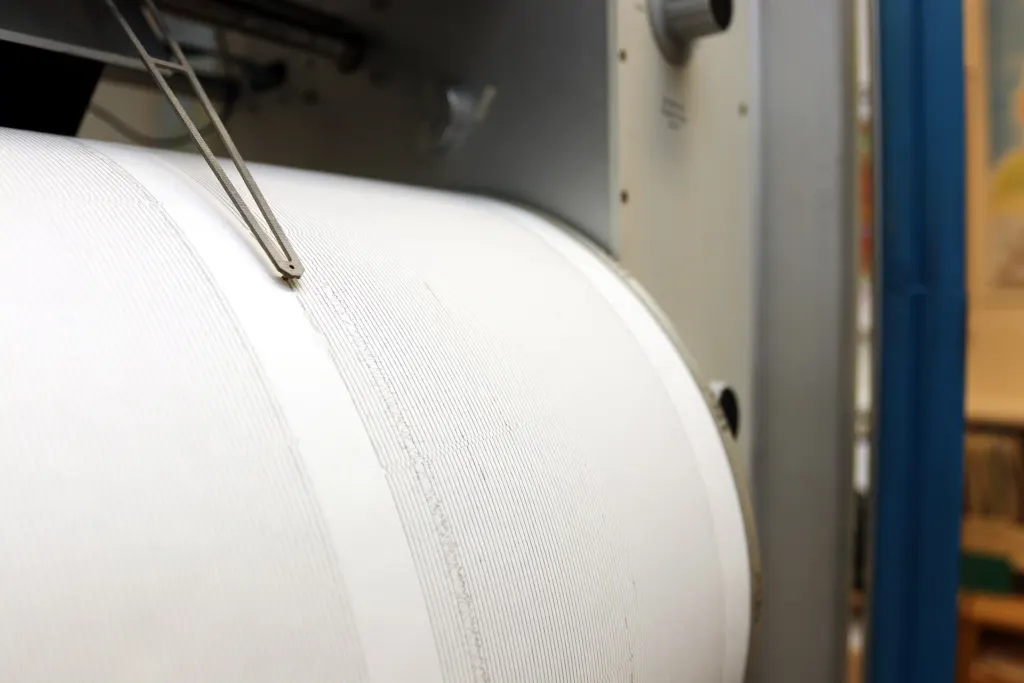
Charles Richter published his scale in 1935. It was designed for shallow, moderate earthquakes in southern California, read from nearby seismograph stations using fairly high-frequency waves. Its label is ML, the L standing for local. Each step on the scale meant a tenfold bigger swing on the seismograph trace, which is why it is logarithmic.
As seismograph stations spread around the world, the USGS explains, it became clear that Richter’s method only held up for certain distances and frequencies. New scales followed, including body-wave magnitude and surface-wave magnitude, each valid in its own range.
The saturation problem
All of those scales share a flaw called saturation. Past a certain size, a bigger quake no longer produces a bigger reading on the waves being measured, so the number stalls. The surface-wave scale, the favorite in the 1970s, tops out around 8.0. That meant the 1960 Chilean and 1964 Alaskan earthquakes were rated about 8.5 and 8.4, even though they were far more powerful than other magnitude 8 quakes. On the moment scale they come out near 9.6 and 9.3.
How moment magnitude works
Instead of measuring how far a needle swings, moment magnitude starts from the physical size of the rupture. Seismic moment is roughly the rigidity of the rock multiplied by the area of the fault that slipped and the average distance it slipped. It can be estimated from seismograms and from ground-movement surveys. A standard formula then converts that moment into a number that lines up with older scales, so small quakes get about the same magnitude either way.
The payoff is a scale that does not saturate. The USGS says moment magnitude gives a valid estimate across the full range of sizes and the most reliable figure for very large earthquakes.
What one step really means
Each whole step on the moment scale means about 32 times more energy released, because 10 raised to the power 1.5 is 31.6. Two steps multiply by 31.6 again, to roughly 1,000 times. So a magnitude 9.0 releases about 1,000 times the energy of a 7.0, and a 7.8 releases about 32 times the energy of a 6.8. Ground shaking at the seismograph grows more slowly, about tenfold per step, which is why the numbers can feel smaller than the gap they describe.
Magnitude is also different from intensity. An earthquake has one magnitude, measured at its source, while intensity describes how hard the shaking was at a given place, and in the US it is rated on the Modified Mercalli Intensity Scale, developed in 1931.
Seismology turns up in odd places on Badiyaa too, from the USGS dye-tracing work that mapped Oregon’s underground River Styx to the 80-ton hanging boulder that finally fell at New Hampshire’s Polar Caves. The moment scale itself runs out at about 10.6, the value at which Earth’s crust would have to break apart completely.
Further reading
- USGS: Moment magnitude, Richter scale – what are the different magnitude scales?
- Wikipedia: Moment magnitude scale
Image: Petr Brož (Czech Academy of Sciences), CC BY-SA 4.0 via Wikimedia Commons
This article was produced with AI assistance and reviewed by our Editorial Desk. How we work.