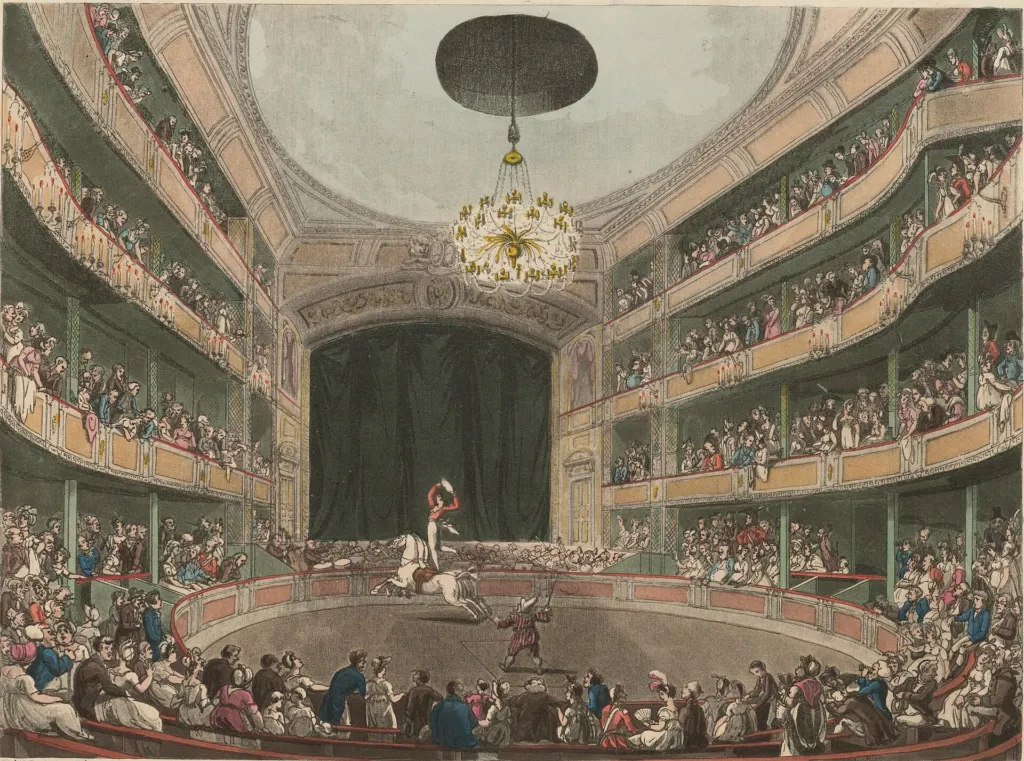
The 42-foot ring that circuses still use around the world traces back to Philip Astley, a former cavalry sergeant major who began giving trick-riding shows with his wife Patty in a field in Lambeth, London, on Easter Monday, 4 April 1768.
That first arena was bigger. Astley called it “the Ride” or “the Circle”, and it measured 65 feet across. Over time he settled on 42 feet, and that size became the international standard for circus rings ever since.
Why the ring is round
Astley did not invent trick riding, and he was not the first to perform in a circle. He understood why the circle worked. A round arena keeps every rider in view of the whole audience. It also helps the performer: a horse cantering on a tight curve generates a centrifugal push that helps a rider stay balanced while standing on its back.
Shrinking the ring had a cost and a payoff, and the arithmetic is simple. A 65-foot ring has a circumference of about 204 feet (65 times pi). A 42-foot ring comes to about 132 feet. Cutting the diameter removed roughly 72 feet from each lap, about 35 percent, which means a tighter curve and a crowd that sits much closer to the action.
From a field near Waterloo to 19 permanent circuses
Astley was born on 8 January 1742 in Newcastle-under-Lyme, Staffordshire, the son of a cabinetmaker. At 17 he joined the 15th Light Dragoons and rose to sergeant major, meeting professional riders and trainers during the Seven Years’ War.
His first shows ran in the open air at Ha’penny Hatch, close to where Waterloo station stands today. From 1769 he leased premises near Westminster Bridge, teaching riding in the mornings and performing in the afternoons. In 1770 he made the move that defines a circus: he hired acrobats, tightrope walkers, jugglers and a clown to fill the gaps between horse acts, and sold one ticket for the lot.
He never used the word circus. That name came from Charles Dibdin, who opened the rival Royal Circus with Astley’s former colleague Charles Hughes on 4 November 1782, a short walk from Astley’s own venue.
Business boomed anyway. Louis XV invited Astley to perform at Versailles in 1772. His London amphitheatre opened in 1773, burned on 17 September 1794 and was rebuilt more than once. He opened a wooden amphitheatre in Dublin in 1773, the first purpose-built circus in France in Paris in 1782, and 18 more permanent circuses across Europe. He never put wild animals in the ring. He died in Paris in 1814 and is buried in Père Lachaise Cemetery.
A name that kept turning up
Astley’s Royal Amphitheatre outlived him by decades and turns up in the novels of Charles Dickens and William Makepeace Thackeray. Jane Austen’s Emma mentions a family outing there: “They were going to take the two eldest boys to Astley’s.” The building closed in 1893 and was torn down the following year; the garden of St Thomas’ Hospital now covers the site.
Spectacle from the past still has a pull, whether it is the 1920s craze for bounding across fields under balloons or a modern skill act like Yuan Yonghui’s nunchaku routine. The singer Rick Astley is listed among his descendants.
In March 2024 the Philip Astley Visitor Centre opened in Newcastle-under-Lyme, the town where he was born.
Further reading
Image: August Pugin and Thomas Rowlandson, Public domain via Wikimedia Commons
This article was produced with AI assistance and reviewed by our Editorial Desk. How we work.