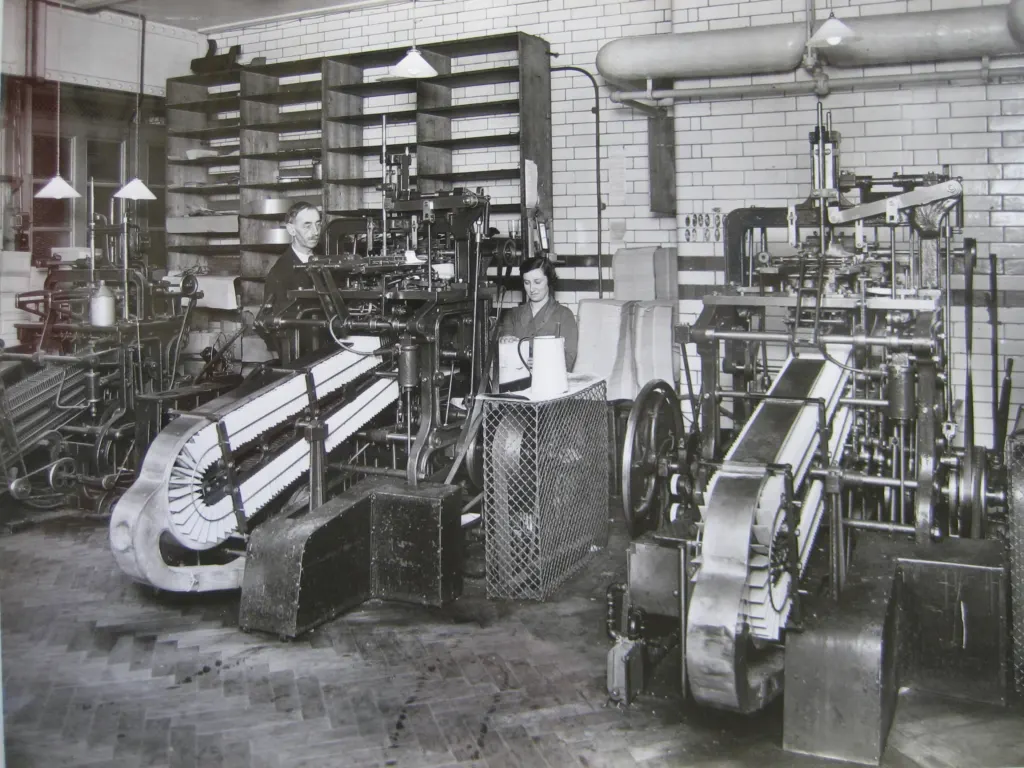
Every envelope in the world was cut and folded by hand until 1840, when George Wilson of London patented a machine that cut the paper blanks. Even then, workers still had to fold each one themselves for another five years.
The folding problem fell in 1845. Edwin Hill and Warren De La Rue won a British patent for the first machine that creased and folded envelope blanks. Their product looked odd by modern standards: flat diamond-shaped sheets that the buyer closed with paste or a single wax seal where the four flaps met. Gumming still needed human hands until the late 1860s, when Thomas Waymouth built a self-gumming folder for the firm Berlin and Jones, later improved by brothers Henry and Daniel Swift so that it ran without a worker’s help.
Clay, money gifts and a failed postal design
The envelope is far older than paper. Around 3500 to 3200 BC, people in the ancient Middle East molded hollow clay balls around tokens used in private deals. Archaeologists Jacques de Morgan and Roland de Mecquenem found the first of them in 1901 and 1907.
Paper envelopes came from China, the birthplace of paper. They were called zhibao and held gifts of money, and under the Southern Song dynasty the imperial court handed cash to officials inside them. In Europe, from the 1200s to the mid-1800s, most people skipped envelopes altogether and folded and sealed the letter itself, sometimes with elaborate locking folds that showed if anyone had tampered with it.
Britain’s postal overhaul of May 1840 brought the Penny Black stamp and a pre-paid illustrated wrapper designed by the artist William Mulready. The public mocked the drawing and the Mulready wrapper was withdrawn, but plain diamond-shaped wrappers caught on, and the British model of stamps plus ready-made envelopes spread worldwide.
Three shapes, one rectangle
Look at the back of almost any envelope and you can reverse-engineer how it was made. Traditional blanks are cut as one of three shapes: a rhombus, a short-armed cross or a kite. Each wraps four flaps around a central rectangle. The cross shape mostly turns up in “pocket” envelopes that close on a short side, the kind used for seed packets; the more common “wallet” style closes on the long side.
The window envelope is younger than many people assume. Americus F. Callahan designed a version with a see-through panel in 1901 and patented it the following year. Wartime shortages produced stranger variations: soldiers in the Confederate army sometimes made envelopes from wallpaper.
Why a letter fits a No. 10
The standard US business envelope, the No. 10, measures 4 1/8 by 9 1/2 inches. A sheet of US letter paper, 8 1/2 by 11 inches, folded into thirds becomes roughly 3 2/3 by 8 1/2 inches. That leaves about 0.46 inches of spare height (4.125 minus 3.667) and a full inch of spare length (9.5 minus 8.5), enough room to slide the letter in without creasing the corners. Europe’s equivalent, the DL size of 110 by 220 millimeters, does the same job for an A4 sheet folded in three and traces back to a German standard from the 1920s.
Size rules still matter at the post office. The US Postal Service charges letter prices only for rectangular pieces between 3 1/2 by 5 inches and 6 1/8 by 11 1/2 inches, no thicker than a quarter inch. Britain’s mail service has its own advice for where the address should sit on an envelope, and the patent trail behind everyday objects can be surprising, as the story of Lewis Latimer’s 1882 filament patent shows.
An envelope whose length is less than 1.3 times its height, or more than 2.5 times, counts as non-machinable in the US and may cost extra to mail.
Further reading
Image: Post Office Savings Bank (UK), Public domain via Wikimedia Commons
This article was produced with AI assistance and reviewed by our Editorial Desk. How we work.