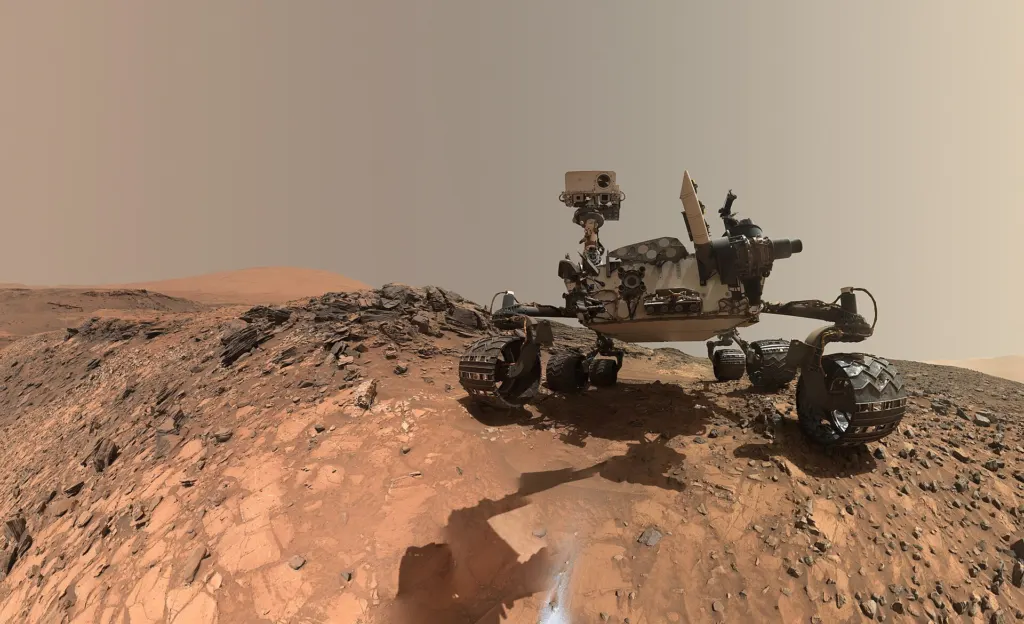
NASA’s Curiosity rover has wrapped up a drilling campaign at a Martian rock nicknamed “Nazca,” bedrock studded with flat, disk-shaped crystal forms that a mission scientist described as, loosely, “potato chip shaped.” Powdered rock from the hole went into the rover’s onboard Sample Analysis at Mars lab, according to the mission team’s latest update, posted November 11, 2026.
The drill stop comes 14 years into a mission first planned to last two. As of November 17, Curiosity has logged 5,076 Martian days, or sols, on the planet.
What Curiosity did at Nazca
William Farrand, a senior research scientist at the Space Science Institute, wrote the update covering sols 5063 to 5069. The main goal was to pin down what the chip-shaped crystal forms are. While the onboard lab worked on the drilled sample, the team kept the rover’s other tools busy:
- ChemCam fired its laser at crystal targets named “Ahi Veremos,” “Colca” and “Bermejo,” including a depth profile that zaps deeper into one spot shot by shot.
- The Remote Micro-Imager took long-distance mosaics of rock clusters below the “Cordillera” ridge and of dark lenses on the “Mishe Mokwa” ridge.
- The arm-mounted MAHLI camera was set to photograph the crystals at night using its own white and ultraviolet LED lamps.
- Cameras were pointed at the sky to catch Phobos, one of Mars’ two moons, passing across the solar disk, an event the team gave priority.
MAHLI’s close-up of the crystal forms was taken on November 7, 2026, Sol 5067. After the drill work, the plan called for a drive back toward the rover’s southbound route.
ChemCam’s laser works by vaporizing a pinpoint of rock up to 7 meters (23 feet) away and reading the light from the glowing plasma, according to the rover’s technical record. That lets the team check the chemistry of a crystal without driving up to it.
Why it matters: a rover still climbing
The Nazca stop is the latest step in a climb that keeps setting milestones. A short timeline of Curiosity’s past few months, from NASA’s own releases:
August 26, 2026: the rover passed 1 kilometer of elevation gained since starting up Mount Sharp, the 5-kilometer-tall (3-mile) peak inside Gale crater it has been scaling since 2014.
August 30, 2026: Curiosity marked its 5,000th sol, and NASA later released a blue-and-yellow “postcard” made from two navigation-camera panoramas shot at a sand ridge called “Chocolatal.”
Early November 2026: the Nazca drill campaign and the Phobos eclipse observations.
Curiosity’s mission is to work out whether Gale crater ever offered conditions suited to microbial life. Sister rover Perseverance is chasing related questions elsewhere on the planet; Badiyaa covered its confirmation of organic carbon in ancient Mars rocks, and a Sahara meteorite from Mars more than 4.1 billion years old.
What is not known yet
The update does not say what minerals make up the chip-shaped crystals, and no results from the onboard analysis of the Nazca powder have been released. Weekly mission notes describe plans, which can change on Mars from one sol to the next.
The next round number is close. Curiosity launched from Cape Canaveral on November 26, 2011, so the rover turns 15 years past launch on November 26, 2026.
Further reading
- NASA: Curiosity Blog, Sols 5063-5069
- NASA: Curiosity Postcard Celebrates Rover's 5,000th Day on Mars
- Wikipedia: Curiosity (rover)
Image: NASA/JPL-Caltech/MSSS, Public domain via Wikimedia Commons
This article was produced with AI assistance and reviewed by our Editorial Desk. How we work.