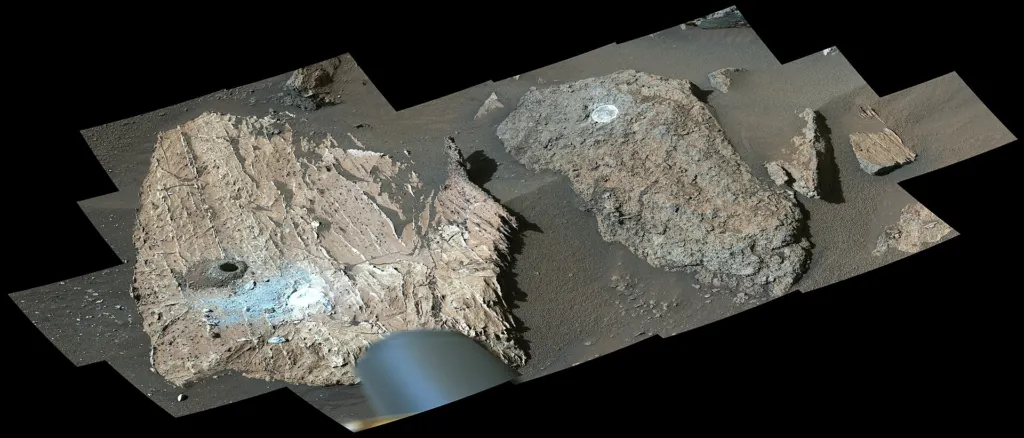
Organic carbon sits just a few microns under the dust on two ancient Martian rocks, less than the thickness of a sheet of paper, according to a new study of data from NASA’s Perseverance rover. The paper in Science Advances confirms that the rocks of the Bright Angel formation in Jezero crater hold macromolecular carbon, and it is the shallowest detection of that kind of carbon ever reported on Mars.
The finding firms up what NASA flagged in September 2025, when the agency called the “Cheyava Falls” rock a potential biosignature. That label meant the rock had features life could have made, though other explanations were possible. The new work does not settle that question. It does show the carbon is real, describes what form it takes, and offers two ways it may have survived.
How Perseverance spotted the carbon
Two scientists led the work: Ashley Murphy, a postdoc at the Planetary Science Institute, and Kyle Uckert, the No. 2 scientist on SHERLOC, the laser instrument on the end of the rover’s robotic arm. SHERLOC uses Raman spectroscopy: it fires laser light at a rock and reads the scattered signal to map minerals and organic compounds without harming the sample.
What it found is macromolecular carbon, or MMC: big, cross-linked networks of carbon atoms. Similar material turns up in Earth rocks and in meteorites. The team chose the neutral term on purpose, because MMC can come from living things or from chemistry with no biology involved. Published accounts of the Cheyava Falls rock research list sources such as serpentinization, igneous processes, dust falling from space, and life.
Bright Angel is a set of mudstones laid down where an ancient river poured into Jezero crater. The carbon shows up both in the original sediment and next to carbonate and sulfate minerals that formed later as water soaked through the rock. That pattern hints that organic material arrived or formed in at least two separate chapters of Mars’ past.
“While the specific formation mechanism of the MMC detected in the Bright Angel mudstones remains unknown, this is still one of the most exciting findings to date,” Murphy said.
Why surviving near the surface matters
The Martian surface is a hostile place for fragile molecules. Radiation and reactive oxidants break organics apart over time, so few researchers expected carbon to last so close to the top of a rock. Murphy said the carbon “is either resistant to degradation and/or has been sufficiently shielded by other minerals, such as clays, or iron-rich Martian soil.”
Distance adds weight to the result. Bright Angel lies more than 2,000 miles (roughly 3,500 kilometers) from Gale crater, where NASA’s Curiosity rover found organic compounds years earlier. Put those two sites on a map and the gap is close to the width of the continental United States, which is why the team argues organics may once have been common in Mars’ lakes and rivers rather than a local quirk. “It is encouraging for Martian habitability,” Murphy said.
Badiyaa has followed other clues to early Mars, including a Sahara meteorite that is a 4.1-billion-year-old piece of Mars and NASA’s twin ESCAPADE probes on their way to the planet.
Limits of the finding
Organic carbon is an ingredient for life, not proof of it. Neither Curiosity nor Perseverance carries the heavy lab gear needed to tell fossil microbes from purely geological chemistry, and Raman data alone cannot reveal the carbon’s isotopes or whether it came from biology.
That is why the rover drilled Cheyava Falls in July 2024 and sealed the core, nicknamed Sapphire Canyon, as its 22nd sample meant for Earth. The NASA-ESA Mars Sample Return plan to collect those tubes was proposed for cancellation in a 2026 budget plan, so for now the sample waits on the Martian surface while Perseverance keeps driving and the SHERLOC team keeps analyzing its scans.
Further reading
Image: NASA/JPL-Caltech/ASU/MSSS, Public domain via Wikimedia Commons
This article was produced with AI assistance and reviewed by our Editorial Desk. How we work.