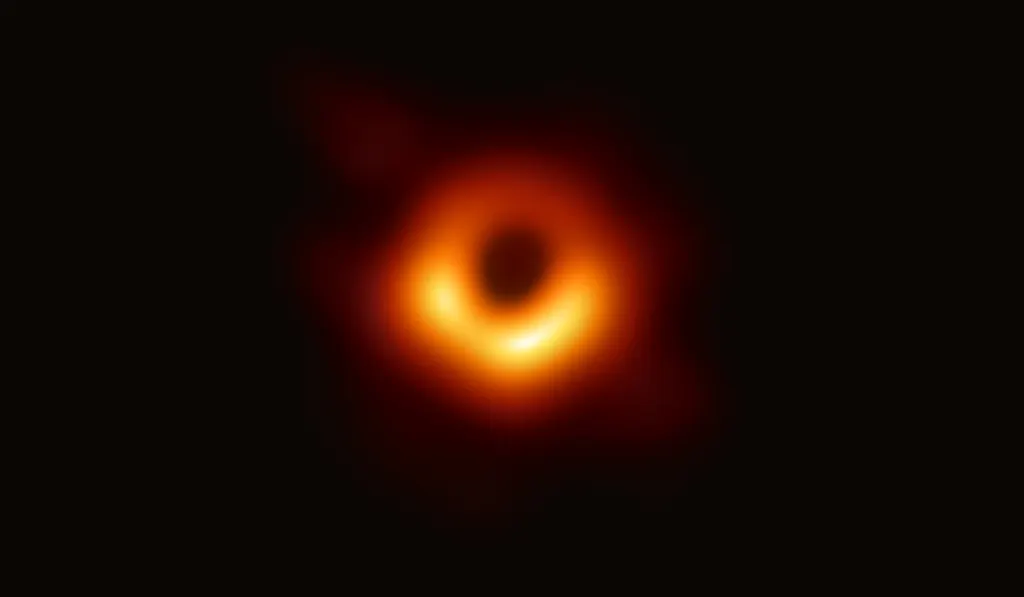
The orange ring that made M87* the first black hole humans ever saw has now been rebuilt from a second year of data, recomputed by outside researchers and dissected by philosophers of science, and the core result has not budged. When the Event Horizon Telescope team imaged the black hole again from observations made in 2018, the ring came out the same size it had in the 2017 data behind the famous 2019 picture.
That matters because the image was always a reconstruction. “The raw data that comes out of these telescopes are basically just voltage values,” Nitika Yadlapalli Yurk, part of the imaging team, said in a Caltech account of the 2018 result.
Check one: new data, same ring
M87* sits at the heart of the galaxy Messier 87, 55 million light-years away, and weighs about 6.5 billion solar masses. The 2018 campaign added a telescope in Greenland to the globe-spanning radio array, which the team said helped its methods recover image features more reliably.
To keep expectations out of the picture, the imagers fed their algorithms synthetic test data built from simple geometric shapes and checked that what came out matched what went in, exploring hundreds of thousands of settings along the way. “We don’t want to plug in our expectations of what the black hole should look like,” said Caltech’s Katie Bouman, a coordinator of the collaboration’s imaging group.
The result: one clear change and one clear constant. The brightest part of the ring rotated about 30 degrees counterclockwise, which the collaboration put down to turbulent gas swirling around the hole. The ring’s diameter stayed fixed, as general relativity predicts it should for a black hole of fixed mass.
Check two: outsiders rerun the code
Separately, a team led by computer scientists including Michela Taufer took the files the collaboration had published and rebuilt the 2017 image themselves, packaging documentation, code and a containerized computing setup so that anyone can repeat the process. They also reported the snags they hit along the way.
Check three: is the logic sound?
Philosophers Juliusz Doboszewski and Jamee Elder asked a different question: how can anyone trust a picture from an experiment that is, practically speaking, impossible to repeat? Their 2024 paper argues the answer is robustness, meaning the same ring emerges across many separate data-analysis pipelines, and that this reasoning applies well beyond the 2019 image.
Put together, those three lines of evidence work like a scorecard. The ring’s size passed a test with new data, the processing passed a test by outsiders, and the reasoning passed a test from philosophy. Bouman summed up why the second year mattered: “Reproducibility with independent data is a big deal, too.”
The limits
None of this makes the image a photograph. The array samples only scattered points of a planet-sized virtual dish, so every picture still depends on algorithms that fill the gaps, and the shifting bright spot shows the gas around M87* changes from year to year. Scrutiny has not stopped either; critics have proposed alternative reconstructions, and the collaboration has pushed back. For the bigger picture on giant black holes, read our story on supermassive black hole pairs and the final parsec problem and on how black holes helped end the cosmic dark ages.
Further reading
Image: Event Horizon Telescope, CC BY 4.0 via Wikimedia Commons
This article was produced with AI assistance and reviewed by our Editorial Desk. How we work.