One of the shortest sayings in the Analects is also one of its most radical. In the Chinese text it is just four characters after “The Master said”: 有教無類. In James Legge’s classic English translation it reads: “In teaching there should be no distinction of classes.”
That line, sitting in Book XV of the Analects, is the closest thing Confucius left to a mission statement for his school. And unlike many famous quotations, this one is genuine in the sense that matters: it appears in the text that his followers compiled.
Where the line actually appears
The Analects is not a book Confucius wrote. His disciples and followers collected his sayings and organized them, and the compilation was made many years after his death around 479 BCE. Modern scholars are therefore careful about pinning any single sentence on the man himself.
Book XV is titled “Wei Ling Kung,” after Duke Ling of Wei, who opens it by asking Confucius about military tactics. The teaching line comes near the end. In Legge’s version it is Chapter XXXVIII, sandwiched between a remark that a minister should put his duties before his pay and the well-known line “Those whose courses are different cannot lay plans for one another.”
A note on numbering: translators split the Analects into chapters differently, so the same saying can carry different references. A famous passage about a stable fire, for example, is cited as X.11 in Arthur Waley’s version, 10-13 in Legge’s and X-17 in D.C. Lau’s. That is why this saying turns up as 15.38 in some places and 15.39 in others.
What Confucius meant, judged by what he did
The best commentary on the saying is Confucius’ own record as a teacher. He began teaching after he turned 30 and is said to have taught more than 3,000 students over his life, about 70 of them considered outstanding.
He charged no tuition. A prospective student was asked only for a symbolic gift: a bundle of dried meat. Students from wealthy families paid an amount in line with their means, treated as a ritual donation. His disciple Zigong compared him to a doctor who treated every patient and turned nobody away.
The roll call backs that up. He took noblemen and commoners alike, and even former criminals such as Yan Zhuoju and Gongye Chang. Most students came from his home state of Lu, 43 on record, but others came from Wey, Qin, Chen, Qi, Cai, Chu and Song. His favorite, Yan Hui, was among the poorest of them all.
Why it was a big deal in his time
Confucius was born into the shi, a class between the aristocracy and ordinary people, and was himself educated at schools for commoners. He built a private school around the Six Arts, aimed at opening education to every social class and at building character, not just job skills. Over time his teaching helped create a new kind of professional in China: the scholar-gentleman who was neither farmer, artisan, merchant nor official.
The translator who lived the same idea
There is a neat echo in the man who gave English readers the wording. Legge, a Scottish missionary, published Volume 1 of The Chinese Classics, containing the Analects, in 1861, with a revised edition in 1893. In 1879, as Oxford’s first professor of Chinese, he joined a committee to found a women’s college “in which no distinction will be made between students on the ground of their belonging to different religious denominations.” That college became Somerville.
For more famous lines checked against their sources, read why Machiavelli never wrote “the end justifies the means” and where Mary McLeod Bethune’s “I leave you love” comes from. Confucius’ school outlived him: his disciples and his only grandson, Zisi, kept it running after his death.
Further reading
- Wikisource: Confucian Analects, Book XV (Legge translation)
- Wikipedia: Confucius
- Wikipedia: James Legge
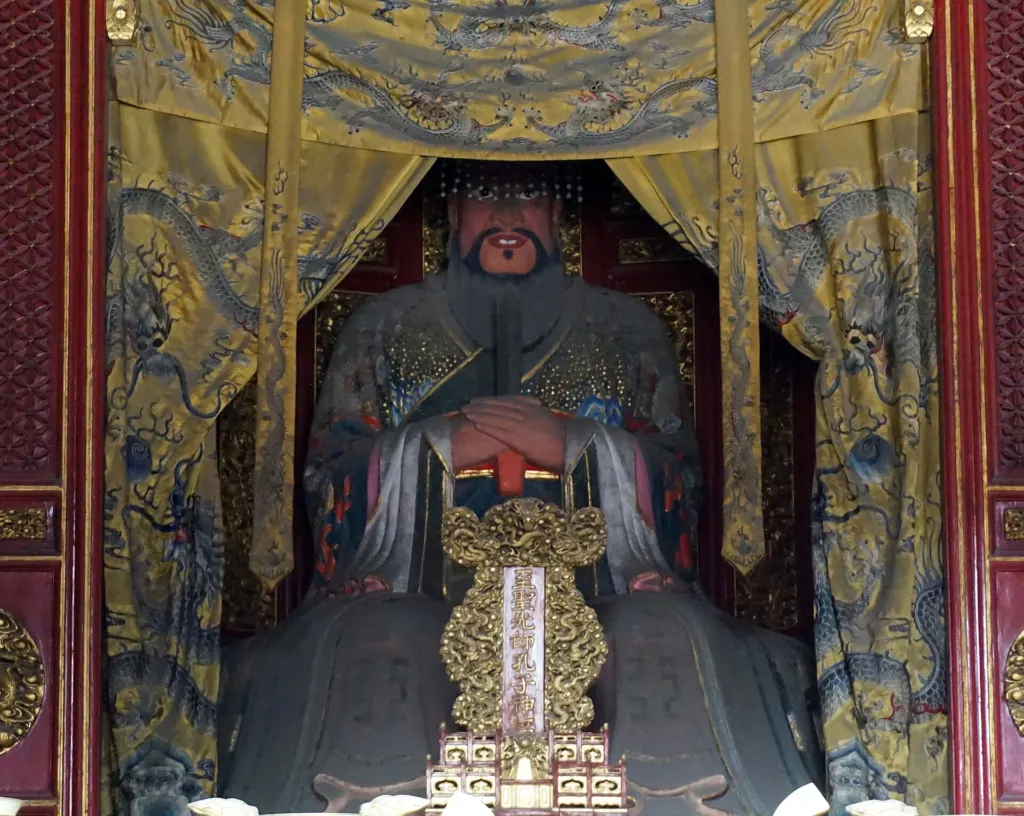
Image: 三猎, CC BY-SA 4.0 via Wikimedia Commons
This article was produced with AI assistance and reviewed by our Editorial Desk. How we work.