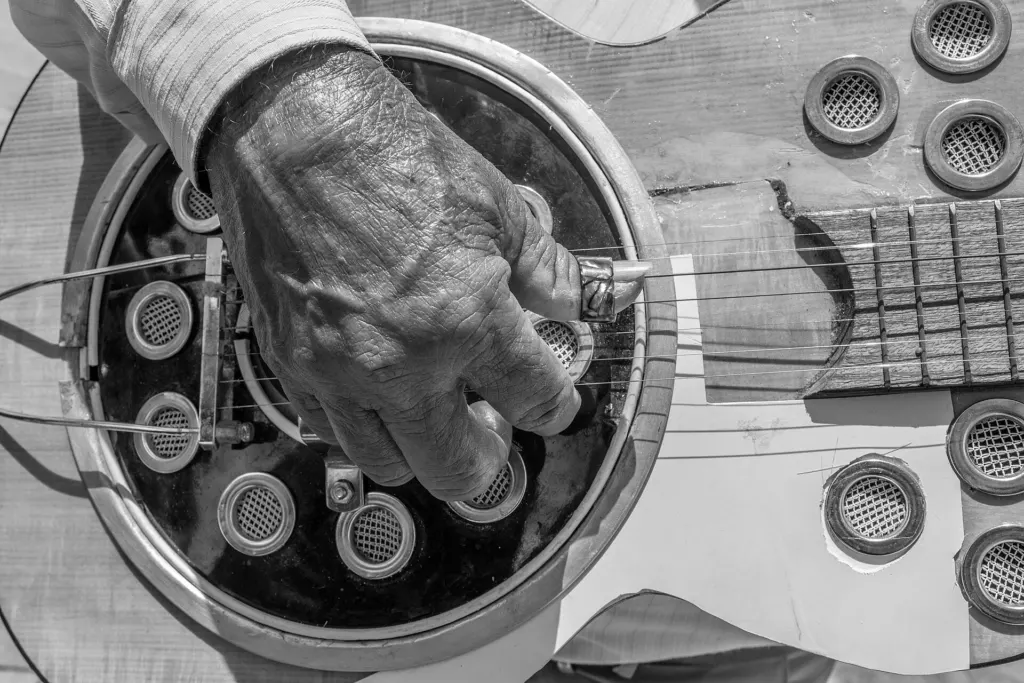
Ben Ranson wanted a second pair of hands on his guitar. So the Minnesota musician built one into the instrument itself: a row of small frets that sit on the guitar’s body, under the strings, where the heel of the picking hand can press them.
He calls them palmfrets, and the technique palmfretting. Ranson, a Berklee-trained guitarist from Sebeka, Minnesota, says the devices let one player run a bass line and a melody at the same time without a looping pedal or a second guitarist.
How palmfretting works
On a normal guitar, every note change happens on the neck. The fretting hand presses a string against a metal fret, and the picking hand only plucks. Ranson’s idea moves part of that job to the other end of the guitar.
According to his own site, the player pushes a string down onto a palmfret with the heel of the picking palm. That raises the pitch of that string. The fretting hand stays free to roam the neck and play something else entirely, and the fingers of the picking hand then pluck the new mix of notes.
For a right-handed player, that means the right palm shifts a bass note while the right thumb plucks it, and the left hand keeps fretting chords or a tune on the higher strings. Left-handed players flip the setup.
Two gadgets, one technique
Ranson has built palmfrets into two devices:
- The palmboard: a block with two saddles and two series of palmfrets serving two strings. He made it first, for electric instruments, and says it lets a player run complete scales and melodies with the picking hand alone.
- The unifret: a single palmfret under a single string, designed for acoustic guitars and for single strings on electrics. Each one adds exactly one note, a semitone up, and they can go under the lower four strings or alongside a palmboard.
The two work differently inside but are played the same way, with the heel of the hand.
“For example, a player can play a bass line and take a solo at the same time,” Ranson said in an interview published this month, ahead of a demonstration at a guitar shop in Fargo, North Dakota, on November 7, where audience members were invited to try the modified guitars.
From punk band to inventor
Ranson got his first guitar at 11 and played in a hardcore punk band in high school. He studied at North Dakota State University and Bemidji State University before Berklee College of Music, then played in a string of bands before going solo. On stage he mixes intricate fingerstyle playing with comic storytelling.
He gives some of the credit for the invention to his mother, a math teacher, who he says taught him the critical-thinking skills he later used to design and engineer the palmfrets. His site describes years of experimenting and testing before the devices worked.
The claim on his site is bold. It says Ranson “became the first person to play a chromatic bass line (by palmfretting) and a fully articulated melody on a guitar at the same time.” Badiyaa has not seen any outside test of that claim, and players of two-handed tapping and harp guitars have chased similar goals for decades by other routes.
Why it is harder than it sounds
Here is the catch, in plain numbers. A standard guitar gives the fretting hand four fingers to cover six strings. Palmfrets do not add fingers; they recruit the fleshy heel of the other hand, which normally just rests on the bridge. Each unifret buys one extra semitone on one string, so a player who fits all four lower-string unifrets gains four new bass notes reachable without moving the left hand at all.
That is the same sort of odd, homemade ingenuity behind the man whose whistle-register cover of Mariah Carey’s “My All” spread on Reddit, and a long way from the stock setup Rory Gallagher played across his 1973 album Tattoo. More inventions like it live in our Offbeat section.
Ranson’s next scheduled shows are on November 15 at Rollie’s in Sauk Rapids, Minnesota, and on December 12 at the New York Mills Cultural Center.
Further reading
Image: Wilfredor, CC0 via Wikimedia Commons
This article was produced with AI assistance and reviewed by our Editorial Desk. How we work.