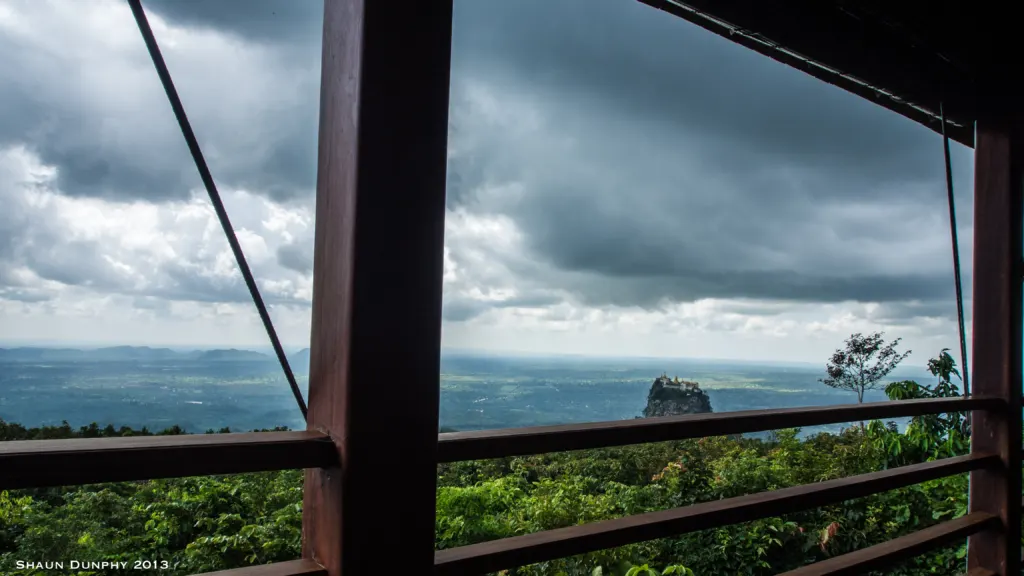
A Buddhist monastery sits on top of a sheer-sided rock column in central Myanmar, reached by a stairway of 777 steps. The column is Taung Kalat, and the mountain behind it is Mount Popa, a dormant volcano that local tradition treats as the home of the country’s most powerful spirits.
The two are often confused. Visitors and postcards regularly call the steep pillar with the monastery “Mount Popa”, but the real volcano is the bigger, broken-topped peak beside it, known locally as Taung Ma-gyi, or “mother hill”. Taung Kalat, which means “pedestal hill”, is a volcanic plug: the hardened throat of old magma left standing after softer rock around it wore away.
Two peaks, side by side
- Mount Popa (Taung Ma-gyi): a stratovolcano rising to 1,518 meters (4,980 feet), with a caldera about 1.6 kilometers wide and 0.85 kilometers deep that is open on its northwest side. Its last eruption is dated to around 6050 BCE.
- Taung Kalat: a plug to the southwest that tops out at 657 meters (2,156 feet) above sea level, crowned by the monastery.
Put side by side, the volcano stands about 2.3 times higher above sea level than the famous pillar, which is why the view from the monastery terrace looks up at its “mother” rather than down on it. On clear days, the volcano can be seen from the Irrawaddy River as far as 60 kilometers away, and the ancient temple city of Bagan, about 50 kilometers to the northwest, is visible from the top of Taung Kalat.
For scale, Taung Kalat is almost exactly as tall as Kalavantin Durg, the 686-meter rock spire in India climbed on steps cut into the cliff, though the Myanmar climb is a covered stairway rather than a bare rock trail. A Buddhist hermit known as U Khandi is remembered for maintaining the steps. Climbers go barefoot all the way up, past stalls selling flowers as offerings, to a cluster of gold-topped stupas at the summit.
Burma’s Mount Olympus
The mountain’s fame comes less from geology than from the nats, the spirits of Burmese folk religion that blended with Buddhism around the 11th century. Mount Popa is the most important center of nat worship in the country and has been nicknamed Burma’s Mount Olympus. All 37 nats of the official pantheon are represented in the shrine, but only four are said to actually live there.
One legend tells of Me Wunna, a flower-eating ogress who lived on the mountain and fell in love with Byatta, a man sent by King Anawrahta of Bagan to gather flowers from Popa. The king had Byatta put to death for disobeying him, Me Wunna died of a broken heart, and both became nats. Her shrine is known as Popa Medaw, the Royal Mother of Popa. The name Popa itself is thought to come from the Pali or Sanskrit word puppha, meaning flower.
Old customs still shape a visit. Tradition says pilgrims should not wear red, black or green on the mountain, and should not bring meat, especially pork, so as not to offend the resident spirits.
An oasis with its own monkey
The plains around Mount Popa are dry, but the mountain holds more than 200 springs and streams, and its volcanic soil grows jackfruit, papaya, mango and banana. Macaque monkeys roam the stairway and have become a tourist attraction in their own right.
The forests are also home to the Popa langur, a leaf-eating monkey with pale rings around its eyes that was only recently described by science. It is critically endangered, with about 200 left. The area is now a nature reserve and national park.
The busiest pilgrim season falls on the full moon of the Burmese month of Nadaw, which lands in November or December, when crowds climb toward the summit shrines. More places like this sit in our story on Portugal’s Berlengas fort, built on a sea-stack islet.
Further reading
Image: ReflectedSerendipity from United Kingdom, CC BY-SA 2.0 via Wikimedia Commons
This article was produced with AI assistance and reviewed by our Editorial Desk. How we work.