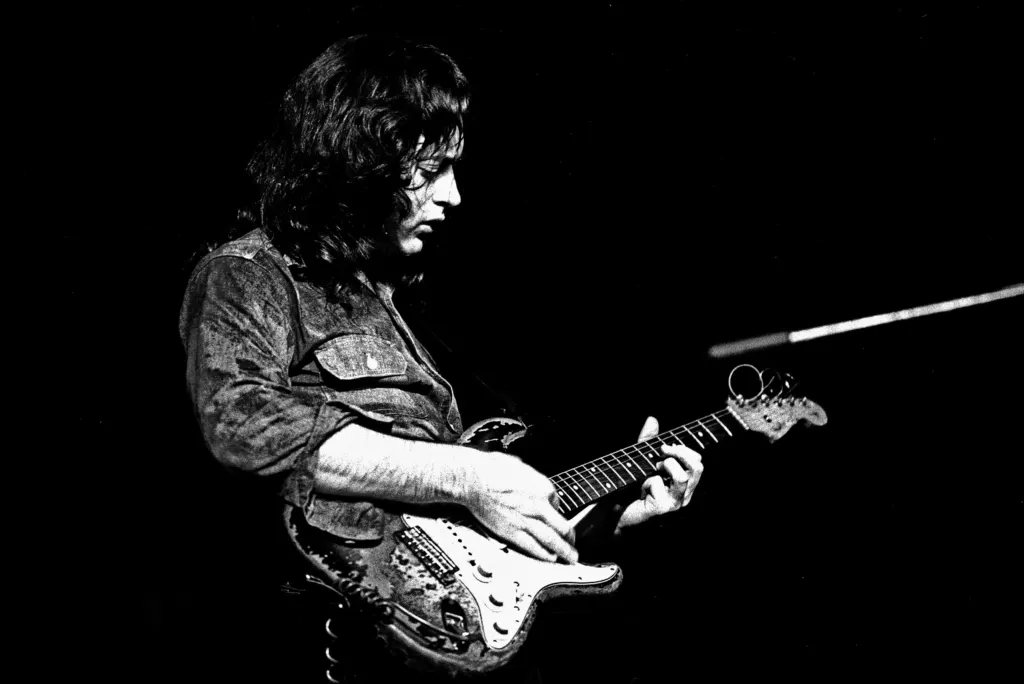
Rory Gallagher’s album Tattoo came out 53 years ago this week, on November 9, 1973, and its opening track, “Tattoo’d Lady,” went on to outlive the record that introduced it. Within two months the Irish guitarist was playing the song to packed halls in Cork, Dublin and Belfast, and those versions became the core of Irish Tour ’74, the live double album that sold more than two million copies.
A busy year in London
Gallagher, born in Ballyshannon, County Donegal, in 1948 and raised in Cork, had already made his name fronting the blues-rock trio Taste. By 1973 he was a solo act with a settled band: Gerry McAvoy on bass, Lou Martin on keyboards and Rod de’Ath on drums.
That year he made two studio albums at Polydor Studios in London. Blueprint arrived in February to mixed reviews. Tattoo, recorded in August and released in November, landed far better. Gallagher himself called it “the most vibrant of the albums,” with “a mixture of forms,” and Martin’s keyboards gave it a wider sound than anything he had made before.
The record runs to nine songs on the original vinyl. Side one opens with “Tattoo’d Lady” at 4 minutes 34 seconds, followed by “Cradle Rock,” a nod to the fact that Gallagher was born at the Rock Hospital in Ballyshannon. Side two closes on “Admit It,” after the slow-building “A Million Miles Away.”
How the song grew on stage
“Tattoo’d Lady” and “A Million Miles Away” quickly became live staples, and the stage versions stretched out. On Irish Tour ’74 the opener runs 5 minutes 4 seconds, about 30 seconds longer than the studio cut, while “A Million Miles Away” grows from 6:55 to 9:29, an extra two and a half minutes of playing.
The live album was recorded between late December 1973 and early January 1974 at the Ulster Hall in Belfast, the Carlton Cinema in Dublin and Cork City Hall, using Ronnie Lane’s Mobile Studio. Four of its ten tracks come from Tattoo: “Cradle Rock,” “Tattoo’d Lady,” “A Million Miles Away” and “Who’s That Coming?” That is a sign of how central the November album had become to his shows only weeks after release.
The Belfast date carried extra weight. During the Troubles, many touring acts stayed away from the city, but Gallagher kept returning throughout the 1970s. Director Tony Palmer filmed the tour, first planning a television special before turning the footage into a feature film.
Lou Martin later explained why the live record worked when studio sessions often felt rushed. “With Rory, if he didn’t have somebody to look at then he couldn’t feed off the energy,” he said.
A timeline of Tattoo and its afterlife
- August 1973: Tattoo recorded at Polydor Studios, London.
- November 9, 1973: album released on Polydor.
- December 1973 to January 1974: Irish shows recorded in Belfast, Dublin and Cork.
- July 1974: Irish Tour ’74 released, opening with “Cradle Rock” and featuring “Tattoo’d Lady.”
- October 20, 2014: a 40th anniversary box set of seven CDs and a DVD adds full shows, including three more live takes of “Tattoo’d Lady.”
Gallagher died in 1995 at 47, but his reputation has kept growing. He sold more than 30 million records, played more than 2,000 concerts, and is cited as an influence by guitarists including Brian May, Johnny Marr, Slash and the Edge. Statues of him stand in Ballyshannon and in Belfast, where one was unveiled outside the Ulster Hall in January 2025.
For more on 1970s rock and the stories behind its songs, read about Roxy Music’s 1975 single “Love Is the Drug” and how Mike Nesmith’s “Different Drum” became Linda Ronstadt’s first hit.
Fans gather each year in his birthplace for the Rory Gallagher International Tribute Festival, held in Ballyshannon every year since 2002.
Further reading
Image: Heinrich Klaffs, CC BY-SA 2.0 via Wikimedia Commons
This article was produced with AI assistance and reviewed by our Editorial Desk. How we work.