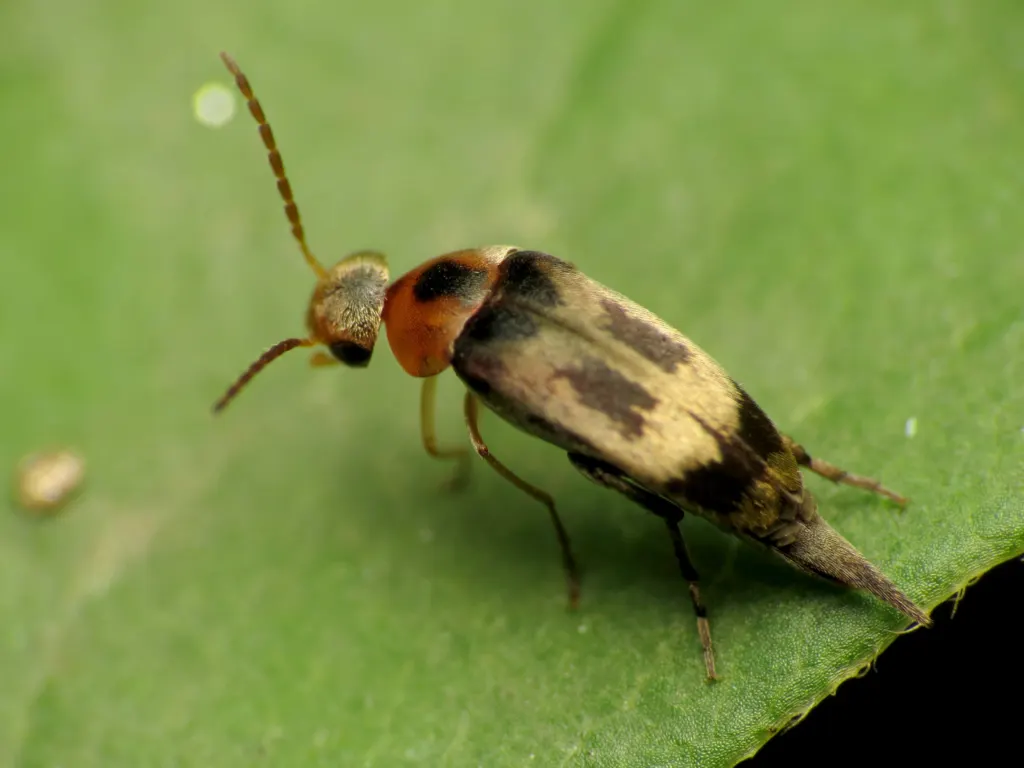
A beetle trapped in amber about 99 million years ago, with 62 grains of flower pollen caught in its body hairs, was hailed in 2019 as the oldest direct proof of an insect pollinating flowers. A fresh look at the same fossil says the story is messier, and more interesting: the beetle was probably not a specialist after all, and a tiny thrips sitting next to it, also dusted with pollen, had gone unnoticed.
The re-examination, led by Yan-Da Li of the University of Bristol’s palaeobiology group and Chen-Yang Cai of the Nanjing Institute of Geology and Palaeontology, was published in the open-access journal BMC Biology in March 2026.
The 2019 claim
The beetle, named Angimordella burmitina, came from amber mines in the Hukawng Valley of Kachin State in northern Myanmar. It belongs to the tumbling flower beetles, the family Mordellidae, whose living members feed on pollen and visit flowers.
In a 2019 Indiana University announcement, paleobotanist David Dilcher said the pollen’s size, surface texture and tendency to clump marked it as pollen built to travel on insects, most likely from a eudicot flower. Researchers found the grains by shining fluorescent light on the specimen, since pollen glows against a dark insect shell. “It’s exceedingly rare to find a specimen where both the insect and the pollen are preserved in a single fossil,” Dilcher said at the time.
That fossil pushed the earliest physical evidence of insect pollination back roughly 50 million years, from the Middle Eocene into the age of the dinosaurs.
What the new study changed
Li and colleagues went back to specimen NIGP171315 in Nanjing with fluorescence and confocal laser microscopes. Two details on the beetle’s body did not fit the original family tree. Its rear plate, the pygidium, is very short, while every living tumbling flower beetle has a long one. And its hind legs lack a second row of spines that modern members carry.
Those traits place Angimordella in an extinct side branch called Apotomourinae, a “stem group” that split off before the modern family took shape. In the team’s words, that move “challenges earlier interpretations of Angimordella as a specialized angiosperm pollinator.” The beetle may instead have visited flowers now and then, sitting partway between relatives that used blossoms mainly as egg-laying sites and modern pollen eaters.
Then there is the hitchhiker. The same piece of amber holds a thrips with two pollen grains touching its body. The authors call it the first fossil record of a thrips associated with flowering-plant pollen.
Why a generalist matters
Today many flowers sit on a spectrum. Some depend on a single kind of pollinator; others welcome any insect that wanders in. Beetle- and thrips-visited flowers usually fall at the generalist end. A blossom 99 million years ago that dusted both a casual beetle and a thrips looks more like that open, mixed system than a tight one-to-one partnership.
Here is the timeline in short form:
- About 99 million years ago: beetle, thrips and pollen sealed in resin in what is now Myanmar.
- November 2019: the beetle is described as a specialist pollinator.
- March 2026: a re-examination moves it to an extinct branch and adds the thrips.
The limits
The thrips is seen only from one angle, so the team could not pin down its exact family. The pollen is most consistent with eudicots, but the authors say a group of gymnosperms cannot be fully ruled out. And one amber piece is a single snapshot, not a census of Cretaceous pollinators.
Amber keeps surprising researchers: our recent stories covered a 98-million-year-old mantis in amber with leaf-like lobes and a Romanian doorstop that turned out to be a record rumanite amber nugget.
The original confocal data for the beetle and thrips are archived on Zenodo for other researchers to check.
Further reading
- University of Bristol research record: Revisiting early angiosperm pollination
- DOI: Li et al., BMC Biology 24, 111 (2026)
Image: Katja Schulz, CC BY 2.0 via Wikimedia Commons
This article was produced with AI assistance and reviewed by our Editorial Desk. How we work.