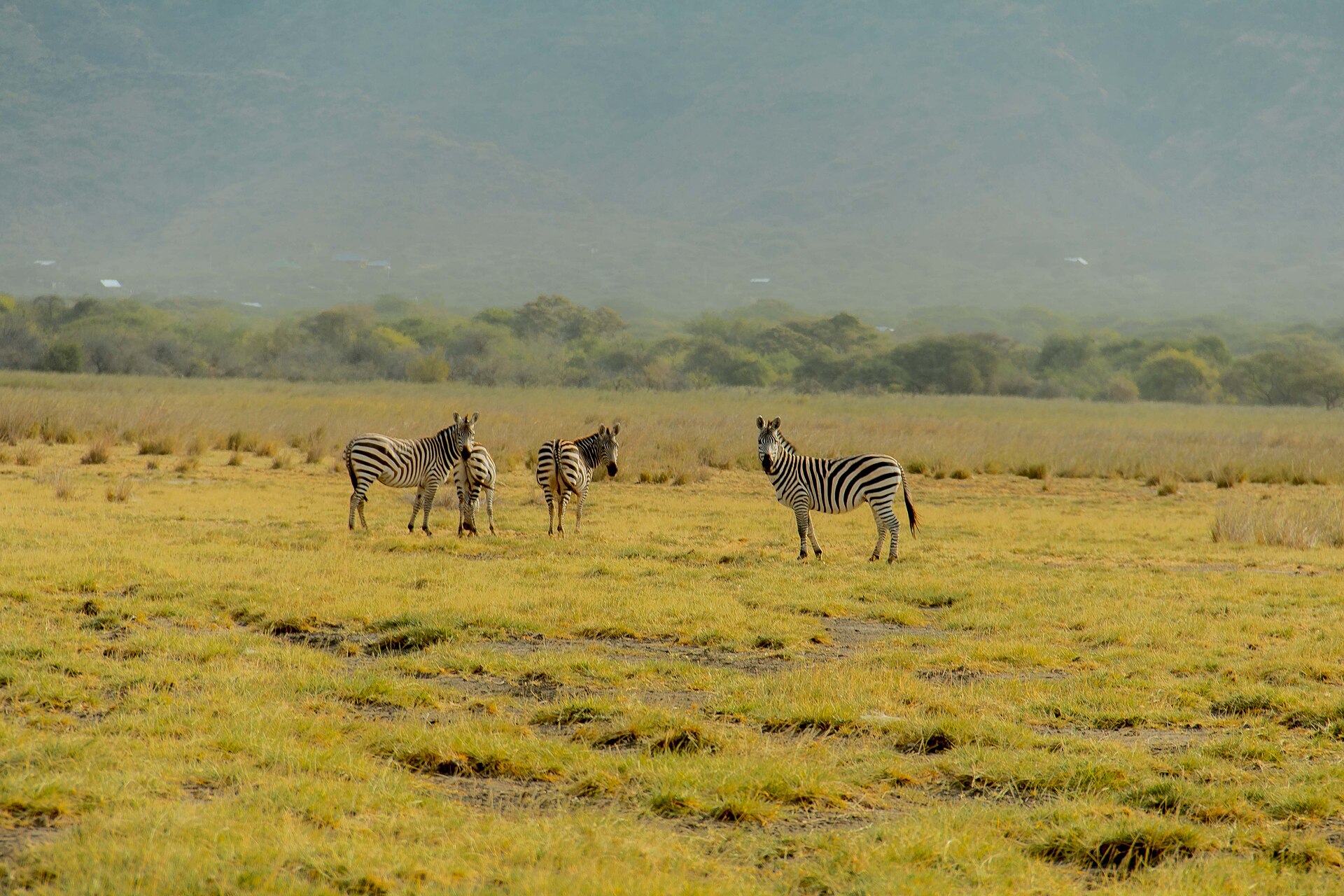
In 5.3 hours of watching zebras on an English horse farm, researchers did not see a single horse fly probe zebra skin for blood. In 11 hours of watching horses in the next fields, they counted 239 probes. That gap is the clearest field evidence yet for why zebras wear stripes.
The study, published in a 2019 paper in PLOS ONE led by Tim Caro of the University of California, Davis, with Martin How of the University of Bristol, compared three captive plains zebras with nine solid-colored horses at a livery in Dundry, North Somerset, over the summers of 2016 and 2017.
Flies find zebras, then fail to land
The surprise was that stripes did not keep flies away. Horse flies circled zebras and horses at similar rates, and bumped into both just as often. The difference came in the last second. Video tracking showed flies slowing smoothly as they came in to land on a horse, but hitting a zebra at speed without braking, then bouncing off or touching down for only a moment.
The authors concluded that, up close, the striped surface stopped flies from making a controlled landing, while having no effect on them at a distance. Their data suggest the insects may only make out the stripes from about two meters away; farther off, a zebra probably looks gray to a fly.
The coat test
To rule out zebra smell or behavior, the team dressed seven horses in three cloth coats in turn, for 30 minutes each: plain black, plain white and black-and-white striped. Far fewer flies touched or landed on the striped coat. The horses' uncovered heads, however, were landed on just as often whatever coat they wore, which shows the flies were still around and simply could not settle on stripes.
Zebras added their own defenses. They flicked their tails more than horses, and in video clips they walked briskly away from flies 10.2% of the time and ran off 4.8% of the time, something the horses never did.
Why flies matter so much to zebras
Wikipedia's entry on horse flies explains that only females bite, because they need protein from blood to make eggs, and that they can spread diseases such as equine infectious anemia and trypanosomes between animals. The PLOS ONE authors add that zebras' short coats make it easier for biting flies to reach the skin.
Wikipedia's zebra article lists the other old explanations: camouflage, confusing lions, social signals and keeping cool. Most have weakened under testing, and fly protection now has the strongest support, although a 2025 review cautioned that it still does not explain why other African grazers never evolved stripes.
The numbers, worked out
At the horses' rate of 239 probes in 11 hours, about 22 an hour, the zebras would have been expected to take around 115 probes in their 5.3 hours under observation. They took none. On video, flies that did land stayed an average of 1.20 seconds on zebras against 10.06 seconds on horses, roughly eight times longer on the plain coats.
One caution: these were European horse flies at a British farm, not African species in the wild, though the authors argue insect vision is similar across regions.
For more animal explainers, Badiyaa has covered why flamingos stand on one leg and how mongooses survive cobra venom. The zebra paper is open access and was published on February 20, 2019.
Sources
- Caro et al., horse fly behavior around striped and plain equids, PLOS ONE (UC Davis and University of Bristol), 2019
- Tabanidae (horse flies), Wikipedia, 2026
- Zebra, Wikipedia, 2026
Image: Bajcetic, CC BY-SA 4.0 via Wikimedia Commons
This article was produced with AI assistance and reviewed by our Editorial Desk. How we work.