Electrons that behave as if they were far heavier than normal have turned up at the boundary between a sheet of metal one atom thick and the copper crystal it sits on. Physicists at the University of Osaka in Japan say they found not one but two of these “heavy” electron states, and one of them exists only because the two materials touch.
The team calls it the first direct evidence of a heavy fermion state created by interactions across such an interface. In plain terms, they built a quantum effect out of a junction, rather than finding it inside a single material.
What the Osaka team built
The starting point was a single atomic layer of ytterbium and copper, written YbCu2, grown on the surface of a copper crystal. Ytterbium is a rare-earth metal whose 4f electrons tend to stay put around each atom. Copper is the opposite: its conduction electrons roam freely.
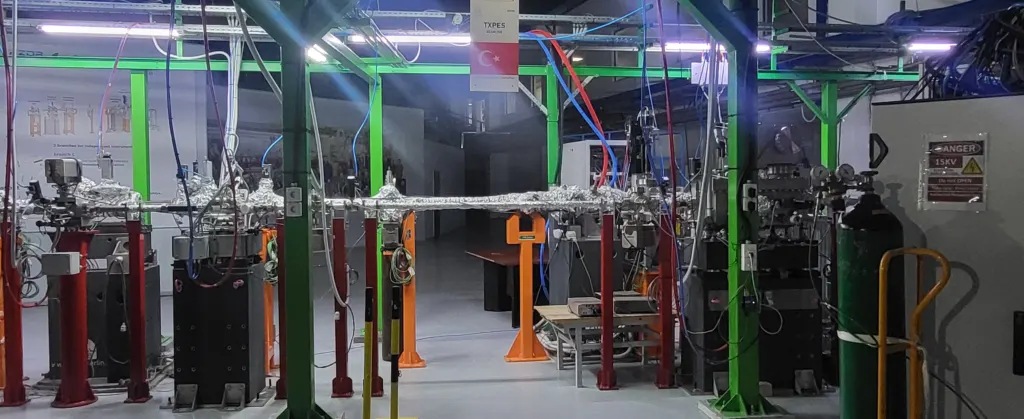
To watch how those two populations behave, the researchers used synchrotron light, an intense beam produced by a particle accelerator, and a technique called angle-resolved photoemission spectroscopy. The light knocks electrons out of the sample, and their energy and direction reveal how electrons were moving inside it.
What they saw split cleanly in two. One heavy state lived mostly inside the flat, two-dimensional ytterbium-copper layer. The second spread down into the three-dimensional copper underneath. According to the university, that second state came from hybridization, the mixing of the stay-at-home ytterbium 4f electrons with the free-moving copper electrons below.
Why heavy electrons matter
A “heavy fermion” is not literally heavier. When localized and mobile electrons interact strongly, the moving electrons respond as if they carry far more mass, which slows them and changes how a material conducts and magnetizes. These states sit close to some of the strangest behavior in condensed-matter physics, including unconventional superconductivity, where electricity flows without resistance by mechanisms standard theory does not fully explain.
The new result builds on the same group’s earlier work. In a 2023 paper, Takuto Nakamura, Shin-ichi Kimura and colleagues reported a two-dimensional heavy fermion in the very same YbCu2 layer on copper, with a coherence temperature of about 30 kelvin and an effective mass boosted by a factor of 100. The step taken now is to show that the copper beneath is not a passive stage: it joins in and helps produce its own heavy state.
“Our next goal is to engineer and control such heavy-electron states, opening the way to previously unexplored quantum states, including unconventional superconductivity,” Kimura, the senior author, said in the university’s release.
A recipe for designer quantum materials
The broader idea is that interfaces could become a design tool. Instead of hunting for a single compound with the right properties, researchers could pair an ultrathin layer with a carefully chosen base and let the junction do the work. The Osaka group points to future steps such as reshaping the interface structure, choosing which electron orbitals take part, and tuning moiré patterns, the interference designs that appear when two atomic grids overlap at slightly different spacings.
That fits a wider push across physics. Badiyaa recently reported on a cuprate study arguing that electron rhythm, not pairing, holds back room-temperature superconductors, and on the niobium-tin superconducting magnets being installed at CERN for its next big accelerator upgrade. Both show how much rides on understanding exactly how electrons cooperate.
Limits
This is a measurement of electronic structure in a carefully prepared sample, not a working device. Heavy fermion effects in YbCu2 appear only at very low temperatures, around 30 kelvin (about minus 405 degrees Fahrenheit) in the earlier study, and the team has not shown superconductivity in this system. The finding is a map of where to look. The group’s stated next target is control: switching these heavy-electron states on and steering them by design.
Further reading
- Wikipedia: Heavy fermion material
- Two-dimensional heavy fermion in a monoatomic-layer Kondo lattice YbCu2 (2023)
Image: Erkcan, CC BY-SA 4.0 via Wikimedia Commons
This article was produced with AI assistance and reviewed by our Editorial Desk. How we work.