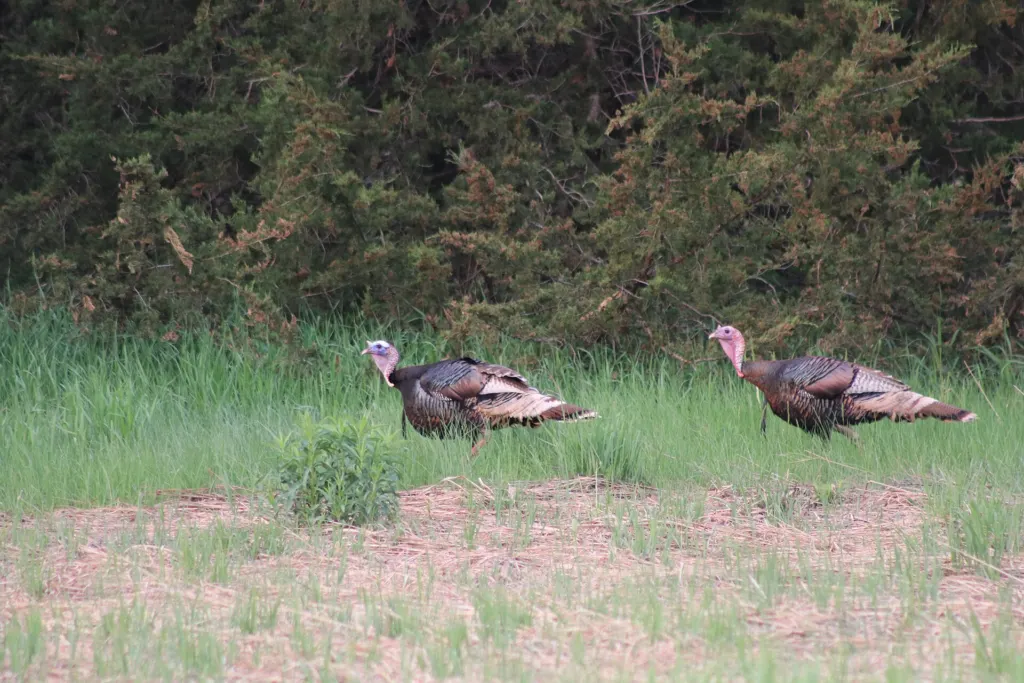
Wild turkeys have sharp eyesight in daylight and very poor vision after dark, and that single fact shapes their whole day. As dusk falls, most turkeys fly up into trees to roost, well out of reach of predators they would not be able to see coming.
Wikipedia’s account of the wild turkey describes the birds’ daytime eyesight as very good and their night vision as very poor, which is why the flock heads for the branches at twilight.
Eyes built for spotting movement
Turkeys share several traits with most birds. Bird eyes are large and can move only about 10 to 20 degrees in their sockets, so birds turn their heads to look around. Eyes set on the sides of the head give a wide field of view that helps with spotting predators, at the cost of a smaller zone where both eyes overlap.
Most birds also see more colors than we do. Wikipedia’s article on bird vision explains that most bird eyes have four types of color-sensing cone cells rather than our three, and in many species one of them responds to ultraviolet light. Birds can also pick out rapid movement: chickens, turkeys’ fellow galliform birds, have flicker thresholds above 100 hertz, while people see anything faster than about 50 to 60 hertz as smooth motion.
Scientists have looked at what that color sense means for turkeys in particular. Scott Werner and colleagues tested ultraviolet feeding cues in wild turkeys in a 2014 paper in Physiology & Behavior, part of a wider line of work on how birds choose their food.
Hearing and the famous gobble
Turkeys are loud as well as watchful. A male’s gobble can carry up to a mile, and toms use it in early spring to announce themselves to hens and rival males. The birds have a large vocabulary beyond the gobble, including yelps, clucks, purrs, cutts, a “putt” alarm note and a fly-down cackle. Weather plays a part: changes in air pressure, rain and temperature can all reduce how much the males gobble.
Males also make a low “drumming” sound with an air sac in the chest, and a sharp “spit” of air from the same sac.
Teamwork with deer and squirrels
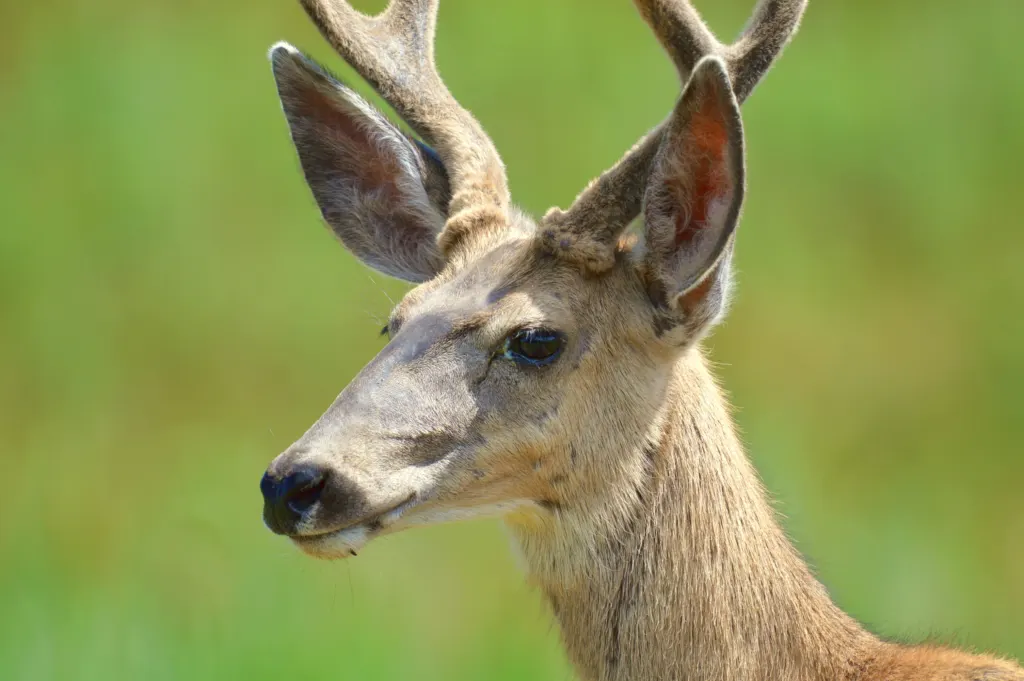
Turkeys sometimes forage alongside deer and squirrels, and the arrangement pools their senses. Deer bring a better nose, turkeys bring sharper eyes, and squirrels add another set of eyes from above. When danger does appear, turkeys and their young usually run rather than fly.
What the senses add up to
- Day: sharp, wide-angle, color-rich vision tuned to movement.
- Night: poor vision, so the birds roost high in trees.
- Sound: a gobble heard up to a mile away and a dozen named calls.
- Signals: a tom’s head can turn solid white when he is most excited.
For more on the bird, see our earlier piece on wild turkeys flying at up to 50 mph and the story of how the turkey traveled from Mexico to Europe and back to Jamestown.
The US wild turkey population, as low as 30,000 in the late 1930s, is now estimated at about 7 million birds.
Sources
- Wild turkey, Wikipedia, 2026
- Bird vision, Wikipedia, 2026
- Functional significance of ultraviolet feeding cues in wild turkeys, Physiology & Behavior (Werner et al.), 2014
Image: USFWS Mountain Prairie, Public domain via Wikimedia Commons
This article was produced with AI assistance and reviewed by our Editorial Desk. How we work.