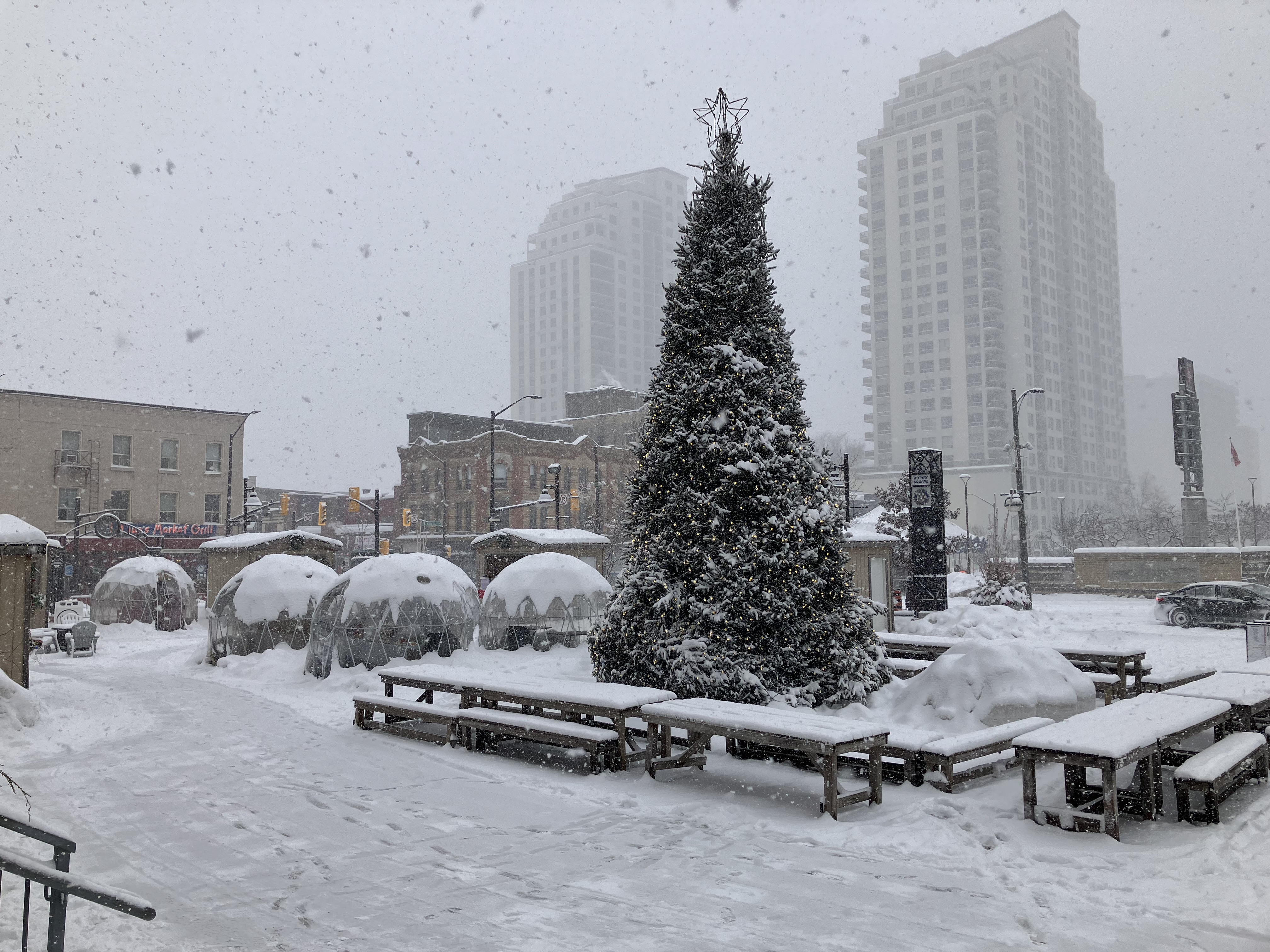
In Britain, one snowflake is enough. If a single flake is seen falling anywhere in the UK during the 24 hours of December 25, even one mixed with rain that melts before it lands, the Met Office counts it as a white Christmas. In the United States, the bar is a full inch of snow sitting on the ground. Three feet of old snow in a London garden would not qualify for the British title; a few wet flakes over Aberdeen would.
That split, laid out in Wikipedia's guide to white Christmas definitions, explains why British headlines declare white Christmases surprisingly often. By the snowflake rule, snow was observed on 38 Christmas Days in the 54 years to 2015, yet a properly snow-covered morning, with lying snow at more than 40% of weather stations at 9 a.m., happened only four times in 51 years.
Three countries, three rulebooks
- United States: at least 1 inch of snow on the ground on December 25.
- Canada: at least 2 centimeters (about 0.8 inch) of snow cover at 7 a.m. on Christmas morning.
- United Kingdom: one snowflake observed falling at any point on the day, recorded by the Met Office.
Where the odds are best in North America
NOAA does not forecast a white Christmas months ahead. Instead it publishes the odds history gives you. NOAA's white Christmas guide maps the chance of at least an inch of snow cover on December 25 using the 1991–2020 Climate Normals, and names most of Idaho, Minnesota and Maine, Upstate New York, the Allegheny Mountains, the Rockies and the Sierra Nevada as the best bets. Crested Butte, Colorado, is one of only a handful of stations with a near-100% record.
Those normals are 30-year averages built from roughly 15,000 stations, refreshed every decade in line with World Meteorological Organization rules, according to NCEI's Climate Normals documentation. The method behind the Christmas map was written up by NOAA scientists Imke Durre and Michael Squires in a 2015 paper in the Bulletin of the American Meteorological Society. They found snow cover is a near certainty in the Sierras, the Cascades, the lee of the Great Lakes and northern New England, while anyone fleeing snow should head for Southern California, the low Southwest or Florida.
The older 1981–2010 figures, tabulated on Wikipedia, show how lopsided the odds are: about 12% for New York City, 41% for Chicago and 74% for Minneapolis. North of the border, Toronto sits at 46%, Montreal at 76% and Vancouver at just 10%. London's chance is put at 9%, Aberdeen's at 23%.
What 2026's long-range signals say
This year the Met Office has a wild card in play: a record-breaking El Niño. In its November 19 winter outlook blog, the forecaster said each winter month has a 70% or greater chance of a negative North Atlantic Oscillation, a pattern that blocks the UK's mild westerlies.
"Whilst negative NAO is by no means a certainty, its increased likelihood indicates that the models as they currently stand are likely to favour colder- and drier-than-average conditions this winter," said Jeff Knight, a Met Office scientific lead.
Colder does not mean snowier, though. The Met Office stresses that snow can only be forecast at much shorter ranges, and NOAA says the same about Christmas Day itself: check a local forecast within seven days of December 25.
Until then, history is the best guide. Badiyaa has also covered NOAA's updated El Niño winter outlook for the US and this season's earliest white Christmas predictions.
Sources
- “Are You Dreaming of a White Christmas?”, NOAA National Centers for Environmental Information, 2026
- U.S. Climate Normals, NOAA National Centers for Environmental Information, 2026
- “White Christmas? An Application of NOAA's 1981–2010 Daily Normals”, Bulletin of the American Meteorological Society, 2015
- “Could we see a cold winter ahead?”, Met Office, 2026
- White Christmas (weather), Wikipedia, 2026
Image: Gogerr, CC BY-SA 4.0 via Wikimedia Commons
This article was produced with AI assistance and reviewed by our Editorial Desk. How we work.