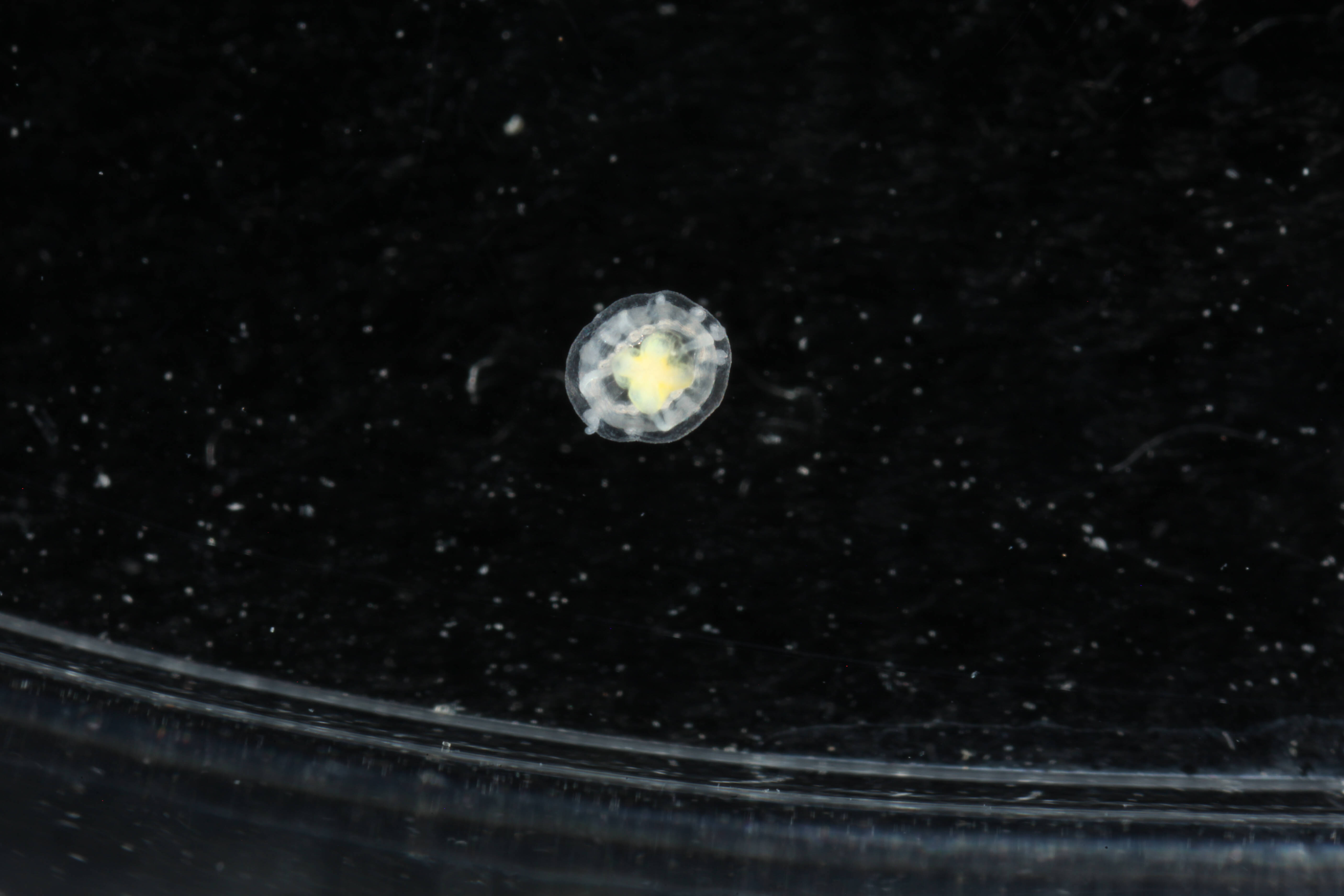
Most animals get one shot at life. Turritopsis dohrnii, a jellyfish smaller than a fingernail, can hit rewind. When it is starved, injured, chilled or simply old, the adult medusa melts down its bell and tentacles, settles on the seabed and rebuilds itself as a polyp, the juvenile stage it started from.
That trick has earned it the nickname "the immortal jellyfish," and it is one of the strangest life stories in the ocean.
A jellyfish that runs its life backwards
Like other hydrozoans, T. dohrnii begins as a drifting larva that anchors itself and grows into a branching colony of polyps. Those polyps bud off tiny free-swimming jellyfish about a millimeter across, which mature in a few weeks. The full-grown bell tops out at roughly 4.5 millimeters wide, according to the species' Wikipedia entry.
Normally that is the end of the line. For this species it is a fork in the road. Under stress, the medusa's cells switch identity through a process called transdifferentiation, turning one specialized cell type into another. The result is a fresh polyp colony, genetically the same animal, ready to bud new jellyfish all over again.
The reversal was documented in detail in a 1996 paper in The Biological Bulletin by marine biologists S. Piraino, F. Boero and colleagues, titled "Reversing the Life Cycle." Their lab tests showed medusae of every age could transform back into polyps when stressed by hunger, sudden temperature swings, lower salinity or a nick from scissors.
Discovered by accident over a weekend
The discovery story has a lab-mishap twist. The jellyfish's immortal streak was first noticed in 1992, after an Italian researcher left a batch to starve over a weekend and came back to find polyps instead of corpses, as the Wikipedia article on the species recounts.
In Japan, Shin Kubota of Kyoto University became the jellyfish's most devoted keeper, reporting that one colony he raised rejuvenated 11 times in two years. He also co-authored a 2016 study in Zoological Science that assembled the animal's gene transcripts, describing it as "a jellyfish that repeatedly rejuvenates." Kubota is known, too, for writing and performing songs about his jellyfish.
What its DNA reveals
In 2022, a team at Spain's University of Oviedo read the full genome of T. dohrnii and compared it with a close relative, Turritopsis rubra, which does not rejuvenate. Their study in PNAS found expanded or altered genes tied to DNA copying and repair, telomere upkeep, protection against oxidative damage and stem cells. During the reversal, the researchers saw genes that keep cells locked into their roles being silenced, while genes linked to pluripotency, the blank-slate state of embryonic cells, switched on.
The authors write that T. dohrnii "is the only metazoan able to rejuvenate repeatedly after its medusae reproduce, hinting at biological immortality and challenging our understanding of aging."
Immortal, with an asterisk
"Biologically immortal" does not mean unkillable. Biologists define biological immortality as a death rate from aging that stays flat or falls instead of rising with age. These jellyfish still get eaten by fish, sea turtles and other jellyfish, and still fall to disease. The rewind has never been watched happening in the wild, partly because it is fast and the animals are tiny.
Even so, the species has spread across temperate and tropical seas worldwide, likely hitching rides in ships' ballast water, a quiet invasion that went largely unnoticed because the animals are so small and harmless.
It is not the only creature with a talent for cheating the odds. Badiyaa has looked at the radiation-proof bacterium Deinococcus radiodurans and at what even tardigrades cannot survive. But no other animal is known to turn its whole adult body back into its childhood form, again and again.
Sources
- “Comparative genomics of mortal and immortal cnidarians”, PNAS (University of Oviedo), 2022
- “Reversing the Life Cycle”, The Biological Bulletin, 1996
- “De Novo Assembly of the Transcriptome of Turritopsis”, Kazusa DNA Research Institute and Kyoto University, published in Zoological Science, 2016
- “Turritopsis dohrnii”, Wikipedia, 2026
- “Biological immortality”, Wikipedia, 2026
Image: Dr. Karen J. Osborn, CC0 via Wikimedia Commons
This article was produced with AI assistance and reviewed by our Editorial Desk. How we work.