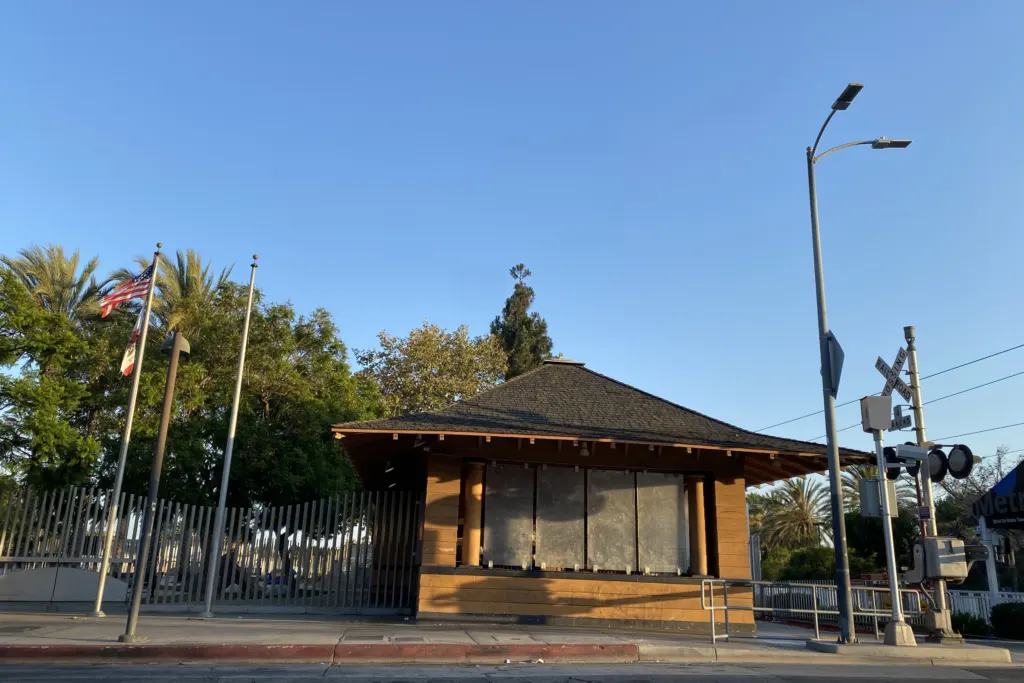
When fires swept 103rd Street in Watts in August 1965, one wooden building in the middle of the burned stretch came through untouched: the old Watts Station, a Red Car depot built in 1904. Los Angeles came to treat the little station as a symbol of continuity, hope and renewal for the neighborhood, and four months later the city made it a Historic-Cultural Monument.
The station, at 1686 East 103rd Street, is one of the oldest buildings in Watts. Its story runs from a land deal on an old rancho to the light rail trains that stop beside it today.
A depot that built a town
Watts grew on the former Rancho La Tajauta. In 1902 the family of Charles H. Watts, who later gave the community its name, donated a 10-acre site to the Pacific Electric Railway to spur development. The depot opened there two years later.
For more than half a century it was a key stop on the Red Car line between Los Angeles and Long Beach. Watts sat at a junction where branches split off to San Pedro and Santa Ana, so the station tied a working-class neighborhood to jobs across the region and to nightclubs and dance halls far from home.
The building itself is modest: one story, about 2,200 square feet, wood-framed and divided into three rooms. It still served as the template for later depots in La Habra, Covina and Glendora.
When the trains stopped
Passenger service ended in 1961. For a community where many residents could not afford cars, losing the Red Car meant fewer reachable jobs and higher travel costs, just as employment was spreading across the Los Angeles basin. The empty station sat vacant for years.
Saving the station
Here is how the building’s second life unfolded:
- 1904: Watts Station opens on land donated two years earlier.
- 1961: Red Car passenger service ends.
- December 1965: The city names it Historic-Cultural Monument No. 36, four months after the August unrest.
- March 15, 1974: It joins the National Register of Historic Places.
- 1980s: The Community Redevelopment Agency spends $700,000 restoring the original exterior.
- 1989: It reopens as a Department of Water and Power customer office and a small museum of Watts history.
- 1990: Metro’s Blue Line brings trains back along the old Pacific Electric route.
That timeline puts 29 years between the last Red Car in 1961 and the return of rail in 1990, almost a full generation of Watts residents who grew up without a train at their door.
Tom Bradley’s promise
Mayor Tom Bradley came to the 1989 dedication. Bradley, the grandson of an enslaved man, had become the first Black member of the Los Angeles City Council in 1963 and the city’s first Black mayor in 1973, and he served 20 years, longer than any mayor before him. A lifelong champion of public transit, he pushed for the light rail network that became Los Angeles Metro in 1990.
At the station he told the crowd: “Those days of glory are going to return, and we are going to be at the heart of the action right here at the Watts train station.”
The new trains do not use the old depot, but they stop right next to it, at the 103rd Street/Watts Towers station. The 1904 building also appears briefly in the 1978 film Killer of Sheep, with children playing around it and its abandoned tracks.
Los Angeles keeps finding new homes for its history, from Space Shuttle Endeavour’s new Samuel Oschin Air and Space Center to the 1941 Santa Monica Pier neon sign. This year the Watts depot turns 122.
Further reading
Image: Jengod, CC BY-SA 4.0 via Wikimedia Commons
This article was produced with AI assistance and reviewed by our Editorial Desk. How we work.