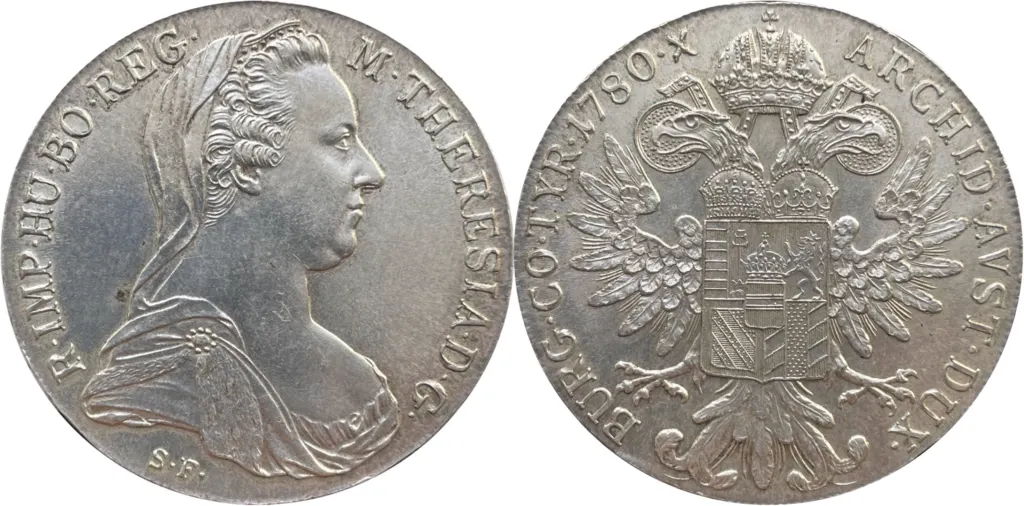
Every new Maria Theresa thaler carries the year 1780, no matter when it leaves the press. The Austrian silver coin was first struck in 1741, and after the empress died in 1780 the mint simply froze the date. That makes the coins being sold today 246 years “old” on their face, and it is only the start of the strangest career any European coin ever had.
The thaler was meant for the Habsburg lands Maria Theresa ruled: Austria, Hungary, Croatia and Bohemia. Instead it became trusted cash across the Red Sea world, the Arabian Peninsula and East Africa, and it stayed in use there long after Austria itself dropped it.
Why traders trusted it
The appeal was simple: the silver was honest. After a 1750 reform each coin weighed about 28 grams and held roughly 23.4 grams of fine silver, a standard the German-speaking states adopted the following year. When the Scottish traveler James Bruce passed through Ethiopia in 1768, he found the coin dominating local trade because, unlike rival currencies, it had not been debased.
Austria made the thaler an official trade coin on September 19, 1857, then stripped its status as Austrian currency on October 31, 1858. By then it hardly mattered. Merchants around the Red Sea would take nothing else, and Arab traders, who first assumed it was French, called it al-riyal al-fransi. It is an ancestor of both the Saudi riyal and the Ethiopian birr.
Ethiopia’s favorite coin
Ethiopia is where the thaler’s story runs deepest. Records place it in circulation under Emperor Iyasu II, who reigned from 1730 to 1755. The British expedition against Emperor Tewodros II in 1868 carried thalers to pay its local costs.
Ethiopian rulers tried to replace it. In the early 1900s Emperor Menelik II, the victor of Adwa, struck his own Menelik thalers with his portrait on a design modeled on the Austrian coin, but people kept choosing the original. Italy’s 1890 Tallero Eritreo failed the same test.
The numbers show how far the coin traveled. One estimate holds that more than a fifth of the 245 million thalers minted up to 1931 ended up in Ethiopia. Working that out, at least 49 million Austrian silver coins went to a single African empire, many of them worn as jewelry as well as spent.
A coin other nations copied
Mints far from Vienna struck the thaler too, including Birmingham, Bombay, Brussels, London, Paris, Rome and Utrecht. Between 1751 and 2000 about 389 million were made. In 1935 Mussolini won a 25-year monopoly on production, so France, Belgium and Britain started striking their own to protect their trade. During World War II Britain minted some 18 million in Bombay to fund the East African campaign that pushed Italian forces out of Ethiopia.
The coin even became a tool of resistance. In the Japanese-occupied Dutch East Indies, so many people preferred thalers to occupation money that the American Office of Strategic Services made counterfeit ones for resistance fighters.
Still in production
The Austrian Mint still strikes the thaler, dated 1780, and sells it uncirculated. A 3-meter steel model of the coin stands in Piazza del Ponterosso in Trieste, and in the UK the 1780 thaler is a protected coin under the Forgery and Counterfeiting Act 1981.
Coins have a way of outliving the empires that made them. Read about the Hoxne Hoard of 14,865 Roman coins found in Suffolk, and how historians weigh the legend of Mansa Musa, the West African ruler often called the richest person ever.
Around its rim each thaler still carries Maria Theresa’s motto, Justitia et Clementia: justice and clemency.
Further reading
Image: Windrain, CC0 via Wikimedia Commons
This article was produced with AI assistance and reviewed by our Editorial Desk. How we work.