The last battle of the American Civil War was a Confederate victory, fought in south Texas five weeks after Appomattox by commanders on both sides who knew Robert E. Lee had surrendered. Counting from April 9 to May 13, the Union lost a battle 34 days after Lee surrendered his army.
The National Park Service calls Palmito Ranch “the last battle in the Civil War.” It happened on May 12 and 13, 1865, on the Rio Grande east of Brownsville. Among the dead was Private John J. Williams of the 34th Indiana, believed to be the last man killed in action in the war.
A truce, and the colonel who broke it
Since early 1865 the two armies on the lower Rio Grande had honored an informal truce. Confederate commanders in the region still had not surrendered, and the far western department would hold out until June 2.
Union Colonel Theodore Barrett commanded the post at Brazos Santiago. He was 30, had been an officer since 1862, and had never seen combat. On May 11 he sent an expedition to the mainland. Why he did it is still argued. Critics at the time accused him of wanting battlefield glory; others point to horses he needed for dismounted cavalry, or to bales of cotton stacked at Brownsville.
The regiment that went first
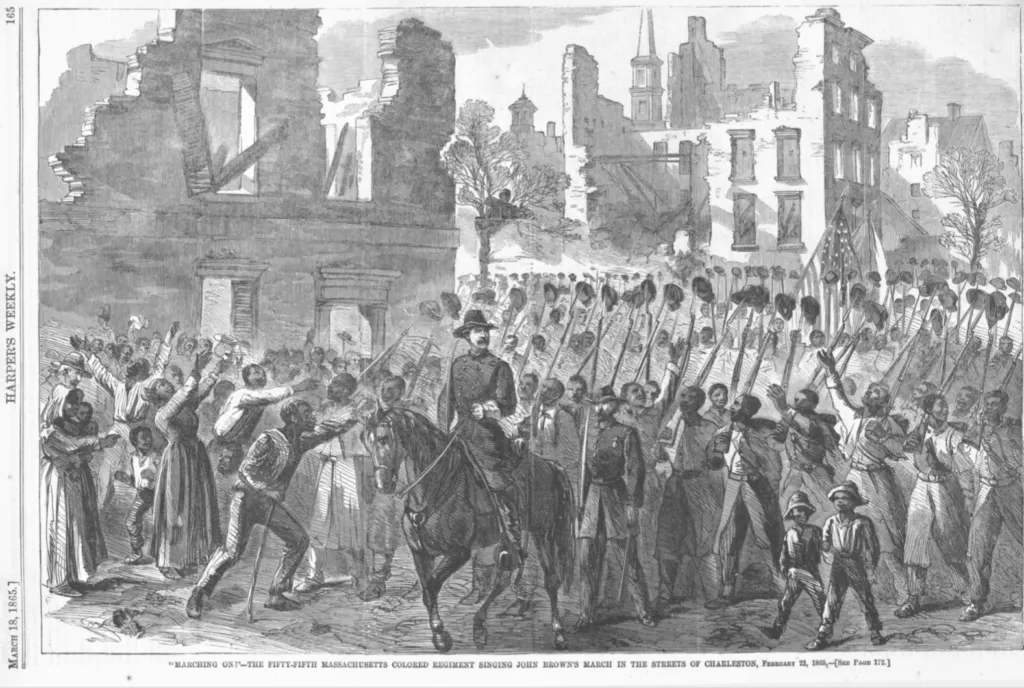
Black soldiers formed the spearhead. Of about 300 men in the first wave, 250 came from the 62nd U.S. Colored Infantry, a regiment largely raised in Missouri, under Lieutenant Colonel David Branson. They hit the camp at Palmito Ranch on May 12 and scattered its defenders before a counterattack pushed them back to White’s Ranch.
Reinforced the next morning by 200 men of the 34th Indiana, the Union force advanced again. Around 4 p.m. on May 13, Colonel John “Rip” Ford struck with about 300 cavalry and six artillery pieces said to have come from the French garrison across the river. Barrett ordered a retreat toward Boca Chica. A rearguard and stragglers, about 100 men, were cut off in a bend of the Rio Grande and captured.
Historian Jerry Thompson has summed up what drove Ford’s side: “What was at stake was honor, money, and perhaps a bit of racism.” Ford had earlier vowed never to give in to “a mongrel force of Abolitionists, Negroes, plundering Mexicans, and perfidious renegades.”
The field was more mixed than the usual picture of the war. The Union’s 2nd Texas Cavalry was largely made up of Texans of Mexican origin. On the other side, Colonel Santos Benavides, the highest-ranking Hispanic officer in either army, led Hispanic Confederates in the campaign. Native American soldiers also fought.
How many died
The counts disagree widely:
- Barrett’s own report: 1 killed, 9 wounded, 105 captured.
- Thompson, using court-martial testimony and post returns: 4 killed, 12 wounded, 101 captured, including 2 killed from the 62nd.
- Biographer Stephen Oates: around 30 Union dead, many drowned in the river.
Williams’s distinction carries a caveat too. Union records place one more combat death, Corporal John W. Skinner, at Hobdy’s Bridge in Alabama on May 19, and some writers count that skirmish as the true end.
Men of the 62nd left a different monument. During the war the regiment ran classes for its own soldiers, and afterward it raised $6,300 to start a school. Lincoln Institute opened in Jefferson City, Missouri, in 1866 and is now Lincoln University.
The 5,400-acre battlefield, a National Historic Landmark since 1997, is marked by a sign on Texas State Highway 4. Its 162nd anniversary falls on May 13, 2027.
Further reading
Illustrative image. Image: Unknown artist, Public domain via Wikimedia Commons
This article was produced with AI assistance and reviewed by our Editorial Desk. How we work.