The internet’s favorite fact about Mansa Musa comes with a price tag: an inflation-adjusted net worth of around $400 billion, enough to make him the richest human who ever lived. No 14th-century document contains that number. The medieval sources describe a ruler with staggering amounts of gold, and the most famous European portrait of him ranks him the richest only in his own part of the world.
Musa ruled the Mali Empire in West Africa from about 1312 until his death, most likely in 1337. His realm took in land now in Mali, Guinea, Senegal, Mauritania and the Gambia, and its wealth rested on taxing the salt trade and on gold from the Bambuk and Bure fields to the south.
What al-Umari actually recorded
The core evidence is the account of Shihab al-Din al-Umari, a Damascus-born scholar who reached Cairo a few years after Musa’s caravan camped by the Pyramids of Giza in July 1324. Al-Umari interviewed officials who had dealt with the Malian king, and his report survives in the standard English translation of early Arabic sources on West Africa, edited by Nehemia Levtzion and J. F. P. Hopkins (pages 269 to 273).
His informants said Musa “flooded Cairo with his benefactions” and “left no court emir nor holder of a royal office without the gift of a load of gold.” Then comes the one hard number in the whole story. Before the Malians arrived, al-Umari wrote, “the mithqal did not go below 25 dirhams and was generally above.” Afterward, “the mithqal does not exceed 22 dirhams or less,” and that had been “the state of affairs for about twelve years.”
Running the numbers
A mithqal was a gold coin weight; dirhams were silver. So al-Umari is giving a gold-to-silver exchange rate, and the math is simple:
- Drop in the gold price: 25 minus 22 equals 3 dirhams.
- As a share of the old price: 3 divided by 25 equals 0.12, a fall of at least 12 percent, since the old rate was “generally above” 25.
- Duration: about 12 years, by al-Umari’s count, which places his writing around 1337.
That is a real, measurable shock to one city’s gold market. It is not a net worth. The historian Warren Schultz has argued that the dip sat well inside the normal swings of gold’s value in Mamluk Egypt, which undercuts the popular line that Musa single-handedly wrecked the Egyptian economy.
The caravan figures are softer still. Later Arabic accounts describe 80 camels each carrying between 23 and 136 kilograms of gold dust. Multiply out and you get anywhere from 1,840 to 10,880 kilograms, a spread of nearly six to one, which is why modern historians treat those loads as storytelling rather than an audit. Online retellings stretch the gap further, quoting anything from two tonnes to 20.
The map that started a myth
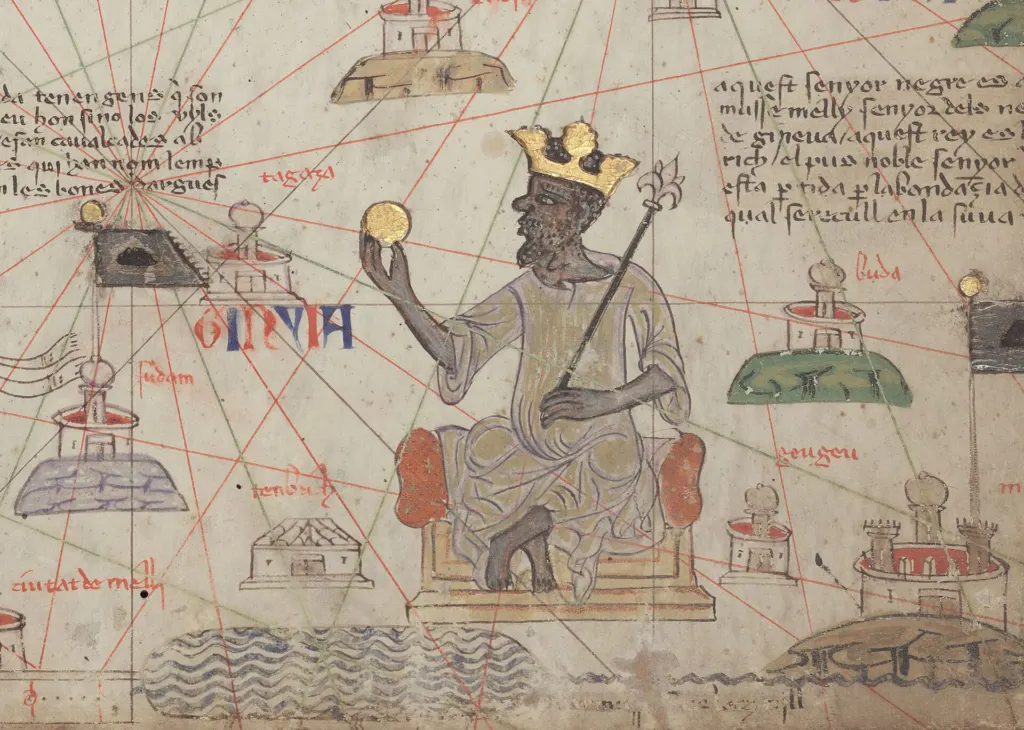
The image most often attached to the “richest ever” claim comes from the Catalan Atlas, made by the Majorcan cartographer Cresques Abraham and conventionally dated 1375. It shows Musa enthroned in the Sahara holding a gold object. Its caption calls him “the richest and noblest of all these lands due to the abundance of gold that is extracted from his lands.”
All these lands, not the whole world. The same atlas, now held by the national library of France, gives the global superlative to someone else. Beside the enthroned Kublai Khan it says: “This emperor is richer than any other emperor in the world.” The historian Hadrien Collet has traced how Musa’s regional praise was later inflated into an all-time title.
Why historians will not put a figure on it
Collet has argued that Musa’s wealth is impossible to calculate accurately, and other scholars note how hard it is to separate a medieval king’s personal riches from his state’s treasury. Ferrum College historian Richard Smith said in an interview that Mali was likely the world’s largest gold producer at the time, but that “contemporary sources describe the king’s riches in terms that are impossible for the time.”
There is also an awkward detail the viral version leaves out. On the way home from Mecca, Musa’s party ran out of money. Al-Umari and others report that he borrowed from Egyptian merchants at high interest, and one merchant family lent him 50,000 dinars; the sources disagree about whether all the lenders were ever repaid.
None of that makes Musa ordinary. A West African king moved enough gold through Cairo to shift its price for over a decade, and Egyptians were still talking about it when al-Umari arrived. Musa is ranked as the richest person ever only by modern guesswork. The verdict his own era left behind is on sheet 6 of the Catalan Atlas: richest of “all these lands.”
Further reading
- Boston University African Studies Center: Kingdom of Mali primary source
- Wikipedia: Mansa Musa
- Wikipedia: Catalan Atlas
Image: Attributed to Abraham Cresques, Public domain via Wikimedia Commons
This article was produced with AI assistance and reviewed by our Editorial Desk. How we work.