Every bottle of tequila is, technically, a mezcal. Mezcal is the broad name for spirits distilled from agave, and it can be made from more than 30 agave species, varieties and subvarieties. Tequila is the one branch of that family that may use only a single plant, the blue agave.
Think of it the way Scotch relates to whisky: a specific, protected style inside a much bigger category.
Where each one comes from
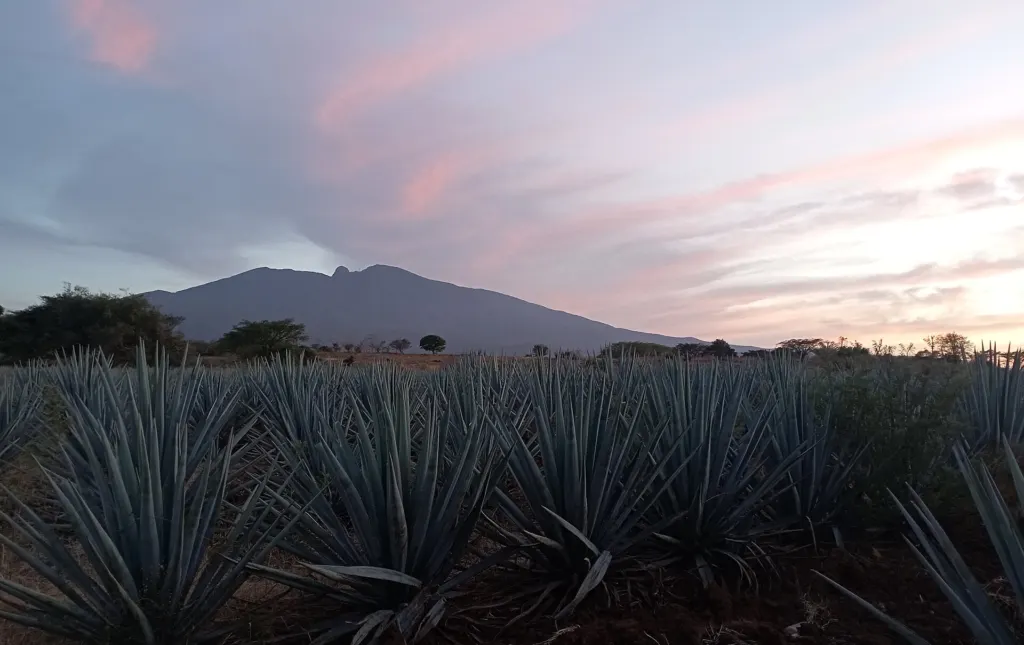
Tequila is tied to a place. It is made mainly around the town of Tequila, about 40 miles northwest of Guadalajara, and in the Jalisco highlands. Mexican law limits production to Jalisco plus selected municipalities in Guanajuato, Michoacán, Nayarit and Tamaulipas. The agave landscape around the town became a UNESCO World Heritage Site in 2006.
Mezcal’s heartland is farther south. About 90% of Mexico’s mezcal comes from Oaxaca, and the protected mezcal region covers states including Oaxaca, Guerrero, Durango, Puebla and Zacatecas.
The name, and a surprise in the history
The word mezcal comes from the Nahuatl mexcalli, meaning “baked agave.” People in Mexico were fermenting agave sap into pulque long before Europeans arrived, but distilling agave seems to have come later, by an unexpected route. Filipino sailors and settlers crossing the Pacific on the Manila galleons, which ran between Mexico and the Philippines from 1565 to 1815, brought a simple style of still that local communities turned on roasted agave.
A colonial record from 1619 already mentions distilled “mexcales.” By the mid-1700s, distillers in the highland valleys around Amatitán, Tequila, Magdalena and El Arenal were making a blue agave version that took the name of its town. Mexico declared “tequila” a protected appellation of origin in 1974; mezcal gained the same status in 1994.
Mezcal vs. tequila at a glance
- Plant: mezcal can use dozens of agaves, with espadín the most common; tequila uses blue agave only.
- Cooking: mezcal’s agave hearts are traditionally roasted for about three days in earthen pit ovens, which gives its smoky taste; tequila’s are baked in ovens.
- Scale: mezcal is still largely made by small producers; tequila is now mostly industrial.
- The worm: only some mezcals ever come with a moth larva in the bottle, and tequila rules do not allow it.
- Labels: tequila is either “100% agave” or a mixto made with at least 51% blue agave sugars.
The longest wait is in the field
Aging labels get the attention. Tequila reposado rests at least two months in oak, añejo at least a year and extra añejo at least three years. Mezcal has its own unusual class, madurado en vidrio, rested in glass for a year or more, sometimes buried underground.
But an agave plant itself needs seven to 15 years to mature before harvest. Add the three-year minimum for extra añejo, and the spirit in that bottle may represent 10 to 18 years from planting to pouring.
Outside Mexico the rules hold too: both US and Canadian regulations say a product sold as tequila must be made in Mexico. For more from Badiyaa’s food coverage, see our check of a viral homemade tortilla breakfast and the story of Calexico and Mexicali, the border towns with mirror-image names.
Further reading
Image: Juan Carlos Fonseca Mata, CC BY-SA 4.0 via Wikimedia Commons
This article was produced with AI assistance and reviewed by our Editorial Desk. How we work.