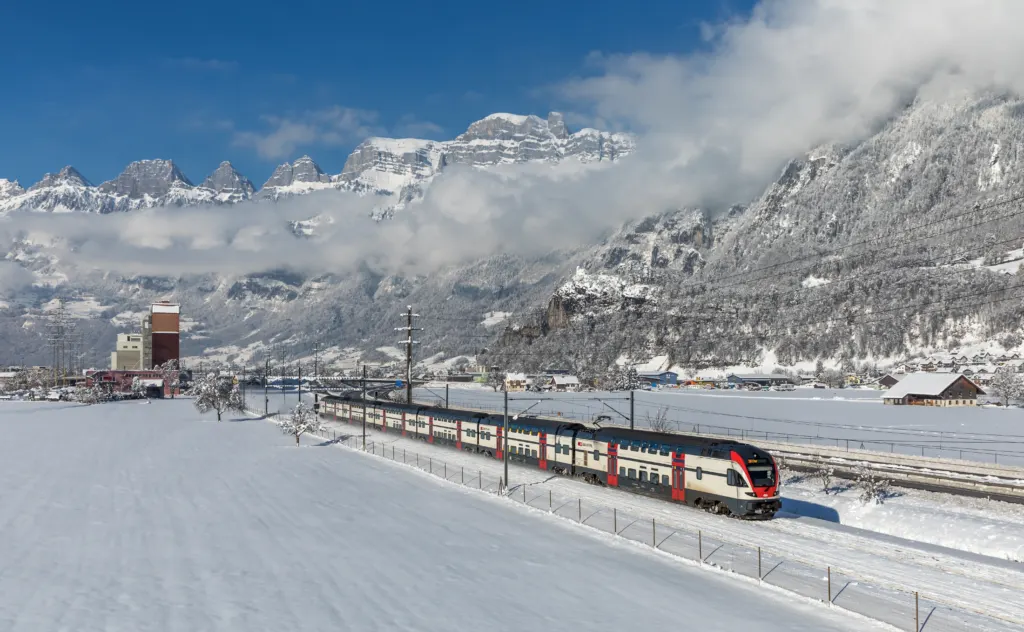
Thousands of glowing dots crawl across a map of Switzerland, pulse together at the big stations, then scatter again. The animation shows every Swiss passenger train moving through a single ordinary Tuesday, and it climbed to the upper reaches of a popular Reddit community for interesting things on November 16.
What makes the clip hypnotic is the rhythm. The dots do not drift around at random. They bunch up at Zurich, Bern and Basel at regular beats, pause, and fan out across the valleys like a heartbeat. That pattern is not a quirk of the animation. It is how the Swiss network was designed to work.
Why the trains arrive together
Switzerland switched its whole rail system to clock-face scheduling in 1982, so a given route repeats at the same minutes past every hour. The national planners then went further. Travel times between the main hubs are set to multiples of 15 minutes, which lets trains from several directions reach a hub station on the hour or half hour, swap passengers across the platform, and leave again within minutes.
Speed was deliberately treated as secondary. Instead of building a large high-speed network like its neighbors, the country spent money shaving the right minutes off the right lines. The Rothrist–Mattstetten line, for example, trimmed the Bern to Zurich run from 72 minutes to 57, which is exactly what was needed for both cities to sit on the same half-hourly pulse.
The timetable does not end at the station door. Postal buses into mountain villages, lake boats, cable cars and funiculars are timed to meet the trains, which is why the dots on the map keep feeding smaller lines that run off into the hills.
The numbers behind the dots
- The Swiss network covers about 5,300 kilometers (3,300 miles) of track, and roughly 99% of it is electrified.
- There are 74 railway companies in the country, with Swiss Federal Railways (SBB) the largest.
- SBB alone carried about 1.39 million passengers a day in 2024, and 93.2% of them reached their destination less than three minutes late.
- Zurich’s main station handled roughly 398,300 passengers a day in 2023, more than any other Swiss station.
- The Gotthard Base Tunnel, at 57.1 kilometers (35.5 miles), is the longest railway tunnel in the world.
The Swiss also ride trains more than almost anyone. In 2019 the average resident covered 2,505 kilometers (1,557 miles) by rail. Spread over a year, that works out to nearly 7 kilometers (about 4.3 miles) per person every single day, a figure only Japan beats.
Where maps like this come from
Animations of this kind are possible because Switzerland publishes its entire public transport timetable as open data. The 2026 timetable file, maintained by an SBB customer information office, uses the GTFS format that mapping software and route planners read. It covers December 14, 2025 to December 12, 2026, is refreshed about twice a week, and each download is now close to 280 megabytes. Anyone can turn it into moving dots.
The clock obsession even shows up on the station walls. The classic Swiss railway clock designed by Hans Hilfiker sweeps its second hand around in about 58.5 seconds, then waits at the top of the dial for a signal from a master clock before starting the next minute, because Swiss trains leave on the full minute.
If the clip leaves you wanting more Swiss oddities, Badiyaa has also looked at the 480-year-old Child Eater Fountain in Bern and at a Swiss trial that wrapped glacier ice in sheep’s wool. The current timetable runs until December 12, when the 2027 schedule takes over and the dots will shift again.
Further reading
Image: Kabelleger / David Gubler, CC BY-SA 4.0 via Wikimedia Commons
This article was produced with AI assistance and reviewed by our Editorial Desk. How we work.