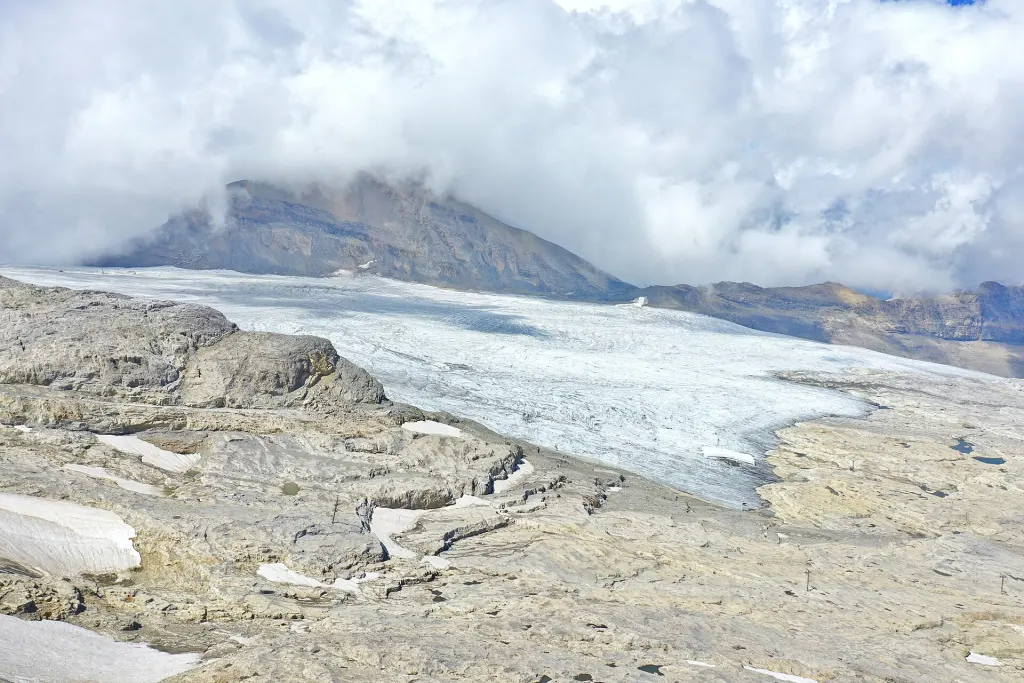
Blankets of Swiss sheep’s wool slowed summer melting on a patch of the Tsanfleuron Glacier about as well as the synthetic fleece that resorts normally use, according to early results from the Summit Foundation, a Swiss environmental nonprofit, and the University of Lausanne. Covers of either kind cut melt in the protected zones by 50 to 70 percent, the foundation said. That matters because the standard plastic-based covers can shed microfibers into meltwater, while wool breaks down naturally.
How a team tested two 1,080-square-foot wool blankets
The “Keep it Wool” project began as an idea from four master’s students. In late June 2026 the team spread two wool blankets, each about 1,080 square feet (100 square meters), on the Tsanfleuron Glacier, a 2.2-mile (3.5-kilometer) ice field on the Vaud-Valais border that tops out near 9,840 feet (3,000 meters) and is mostly run as the Glacier 3000 ski area above Les Diablerets. The blankets were held down with used malt sacks filled with gravel. Staff from GLAMOS, the Swiss glacier monitoring network, supervised the science.
Through the summer the team measured the ice every two weeks and compared the wool with a conventional geotextile, the synthetic fabric already laid on Swiss glaciers. A two-week interval is coarse, but it should be enough to compare total melt under each cover across one season.
The wool came from Fisolan, a Swiss wool company whose own staff doubted it would hold. “I thought it wouldn’t be stable enough,” said Niklaus Saegesser of Fisolan. Student Elliot Gaffiot, one of the four, saw it differently once the data came in: “Now we have a result we can see and even touch. It worked incredibly well.”
There is a second payoff. Project manager Timothee Steiner said the aim was to test a biodegradable cover while using Swiss wool, of which 40 to 70 percent is thrown away each year.
What 20 years of Swiss glacier covers already show
Covering ice is an established, if small, practice. A 2021 study by glaciologist Matthias Huss, who holds posts at the federal research institute WSL, at ETH Zurich and at the University of Fribourg, appeared in Cold Regions Science and Technology as “Quantifying the overall effect of artificial glacier melt reduction in Switzerland, 2005–2019,” and was the first national tally of glacier covers. The first site, the Gurschenfirn above Andermatt, has been covered each summer since 2004, and covers have since spread to seven more sites, at altitudes from 7,380 feet (2,250 meters) up to 10,660 feet (3,250 meters).
Compared with uncovered ice next to them, the white sheets cut melt by about 60 percent. Added up across the country, as much as 12.4 million cubic feet (350,000 cubic meters) of glacier ice survives each summer that otherwise would not, at a cost of 0.60 to 7.90 Swiss francs per cubic meter per year. Yet all the sheets together span about 44 acres (0.18 square kilometers), which is a mere 0.02 percent of Swiss glacier ice by area. Wrapping every glacier in the country, the authors calculated, would run to over 1 billion francs annually.
Scale puts the wool trial in perspective. Its two blankets total about 2,150 square feet (200 square meters). Switzerland’s biggest single sheet, laid over the Rhône Glacier to save a tourist ice grotto, is about 50,000 square meters, so it is about 250 times the size of the whole wool test (50,000 divided by 200). Even swapping every existing cover for wool would change the material on just 0.02 percent of the country’s ice.
Why one summer on 200 square meters is not yet proof
The results so far are preliminary. The foundation describes them as initial observations, and we found no peer-reviewed paper yet. The test covered one site, one season and two blankets, so it cannot yet say whether wool keeps its strength after a second summer, how often it would need replacing, or whether it can be reused. The foundation published no cost comparison with synthetic fleece. It also gave a range, 50 to 70 percent, for both materials together rather than a separate figure for each.
The season itself was extreme. Swiss glaciers lost more than 5 percent of their volume in 2026, according to the GLAMOS annual report, after a winter with little snow and a summer when the freezing level sat above 13,100 feet (4,000 meters) on 76 days, a Swiss record. Nearly 20 percent of the country’s glacier volume has vanished in five years, and small glaciers including Bella Tola and Griessfirn are gone. A cover that works in such a summer has been tested hard, but a single extreme year is also not typical.
Neither the students nor Huss present covers as a fix. “The only way to effectively limit the global retreat of glaciers is to reduce greenhouse gas emissions and thus the warming of the atmosphere,” Huss said when the 2021 study came out. Covers buy time for ski slopes and ice grottoes, not for whole glaciers.
The useful test comes next summer. At sites such as the Gurschenfirn, covers stay on from late spring to autumn, and a second season on Tsanfleuron would show whether the same wool can survive a year of sun, wind and gravel weights before anyone orders it by the acre.
Further reading
Image: Jérémy Toma, CC BY-SA 4.0 via Wikimedia Commons
This article was produced with AI assistance and reviewed by our Editorial Desk. How we work.