The short answer is that Roman aqueducts almost never sent water uphill. They worked by gravity alone, letting water slide down an incline so gentle you could not see it with the naked eye. The clever part was what happened when the landscape refused to cooperate.
A slope of one metre per kilometre
Most of an aqueduct’s length was not the soaring arches people photograph. It was a covered channel, often buried, that followed the contours of the land. On the Gier aqueduct, which supplied Roman Lyon, the channel falls by an average of 0.1 per cent: about one metre for every kilometre. Across its 85-kilometre route it passes through 11 tunnels and dozens of buried and raised sections, with manholes every 77 metres for cleaning.
Keeping a gradient that shallow over that distance, with surveying tools of wood, water and string, is the real engineering marvel. Too steep and the water scours the channel; too flat and it stagnates.
The trick for crossing valleys
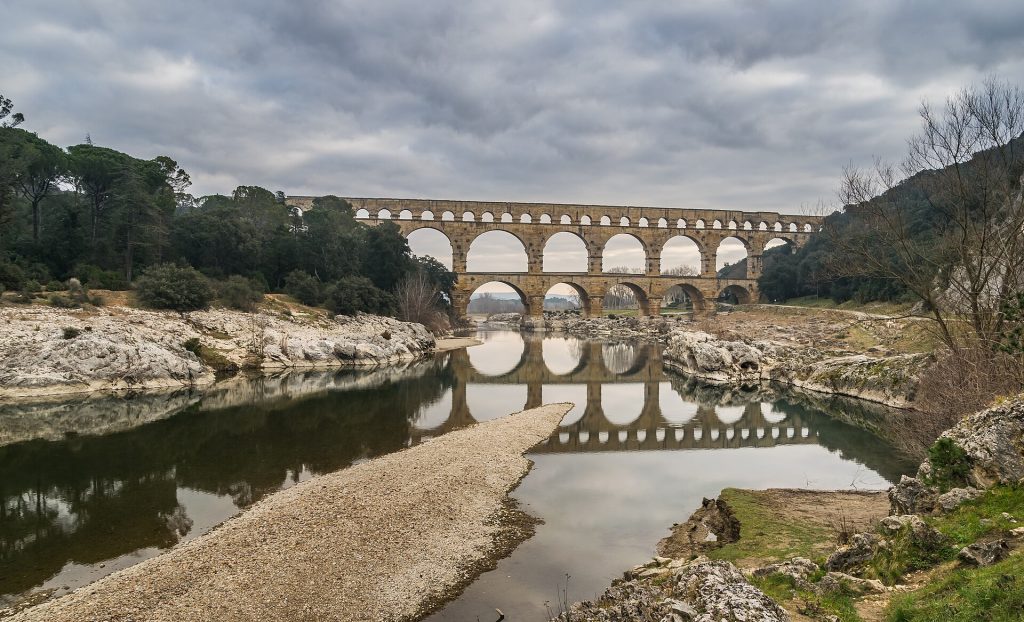
When a deep valley lay in the way, engineers had two options. They could carry the channel across on a bridge, as at the Pont du Gard near Nîmes, or they could use an inverted siphon.
A siphon works like this. Water collects in a header tank on one side of the valley. From there it drops into sealed pipes of lead, ceramic or stone, runs down the slope, across the valley floor and up the far side into a receiving tank. The weight of the water behind it pushes it up the opposite slope.
There is one rule nature will not break: the water can climb back almost to the height it started from, but never higher. So the receiving tank always sits a little lower than the header tank. To an onlooker, it looked like water flowing uphill. In fact, it was still falling overall.
Siphons were impressive and risky. The pressure at the bottom of a deep valley is enormous, and pipe joints could burst. That is one reason Roman engineers often preferred long detours or towering bridges when they had the choice.
Why it mattered
Rome’s first aqueduct, the Aqua Appia, was commissioned in 312 BC by the censor Appius Claudius Caecus. By the 3rd century AD the city had 11, supporting a population of more than a million. Most of the water fed public baths and fountains; distribution tanks and stopcocks controlled the supply, with public fountains given priority over baths and private homes. Some aqueducts stayed in service for centuries, and a few are still partly in use.
Next time you see a photograph of the Pont du Gard, look past the arches to the narrow channel on top. That thin line, falling a few centimetres at a time, is the engineering that kept an empire watered.
Further reading
- Roman aqueduct — Wikipedia
- Inverted siphon — Wikipedia
- Aqueduct of the Gier — Wikipedia
- Pont du Gard — Wikipedia
- Aqua Appia — Wikipedia
Image: Krzysztof Golik, CC BY-SA 4.0 via Wikimedia Commons
This article was produced with AI assistance and reviewed by our Editorial Desk. How we work.