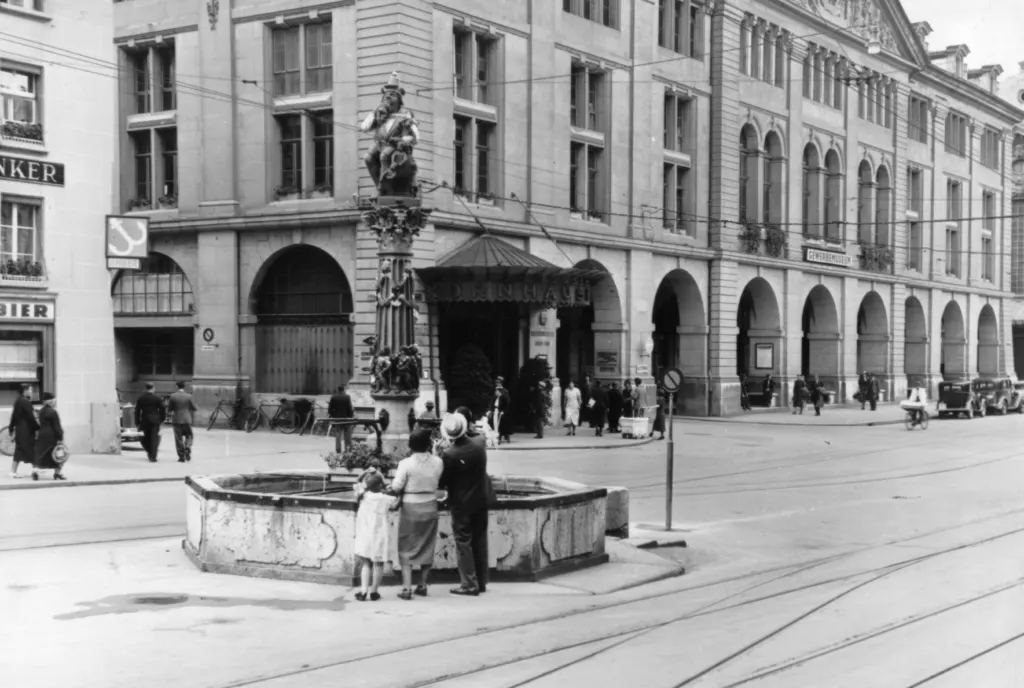
In the middle of Bern’s old town stands a painted stone ogre with a sack over his shoulder, and after about 480 years the Swiss capital still cannot say who he is. The Kindlifresserbrunnen, Swiss German for “Child Eater Fountain,” has drawn at least eight competing explanations, and one of them is a serious charge against the people who put him there.
The sculptor is not in doubt. Hans Gieng, who worked in Fribourg and came originally from Swabia, built the fountain in 1545 and 1546 on Kornhausplatz, the old granary square, replacing a wooden one from the previous century. When workers shifted the fountain slightly in 1997 for tram-line repairs, the year MDXXXXV, or 1545, turned up on the floor of the basin.
The name came later. For more than a century the monument was simply the Platzbrunnen, the Plaza Fountain. The grim title first appears in writing in 1666.
What the figure shows
A seated ogre in a pointed hat has a child at his mouth, with more in a bag at his side. Below him, on the column, a parade of armed bears marches to war with muskets, helmets, a piper and a drummer. Bears are the emblem of Bern, so that part needs no decoding.
The theories, from gentle to dark
The simplest answer is that he was a bogeyman. Child-eater figures with shoulder bags were a familiar scare for unruly children in medieval and early modern Europe. A carnival-character version of that idea has a problem, though: Bern’s authorities tried to stamp out carnival after the Reformation arrived in 1529, so they were unlikely to order a monument to it.
Mythology offers another route. Cronus swallowed his children and Saturn devoured the months, but the numbers do not fit, since the sculpture has eight children against six for Cronus and 12 for Saturn, and Gieng left off Saturn’s sickle. One art-historical reading holds that he blended the two traditions, drawing the hat from a 1531 image of Saturn by the printmaker Georg Pencz.
Then come the local and political readings. He has been cast as Krampus, the Alpine punisher of naughty children; as Cardinal Schiner, who led the Swiss into costly defeats in northern Italy; as a jealous elder brother of Bern’s founder, Duke Berchtold, a story absent from the city’s records; and as an enemy such as Charles the Bold of Burgundy, trying to swallow the eight cantons of the old Swiss Confederacy. The marching bears give that last idea some appeal.
The theory Bern cannot ignore
The hardest reading concerns the hat. Some have taken it for the pointed hat Jews were forced to wear in parts of medieval Europe, and the figure as a hostile caricature tied to the blood libel, the false and deadly accusation that Jews harmed Christian children. Roy Oppenheim has backed that interpretation, arguing that the friendlier explanations hide an anti-Jewish background. No single explanation has won out.
A 1492 woodcut from Nuremberg shows how close these ideas could sit, with a figure labeled Saturn wearing that kind of hat and a badge on his clothing. In the Yiddish writer David Einhorn’s short story “Der Kinderli-Freser,” the statue confides that he is a medieval Jewish victim forced to wear a monstrous face by day.
The ogre has been repaired more than once, in 1997, 2015 and again in early 2024 after vandalism. He also still does the job he was built for. The fountain beneath him is fed from Bern’s public water network, and its drinking water is tested regularly.
Further reading
Image: Fortepan / MZSL / Ofner Károly, CC BY-SA 3.0 via Wikimedia Commons
This article was produced with AI assistance and reviewed by our Editorial Desk. How we work.