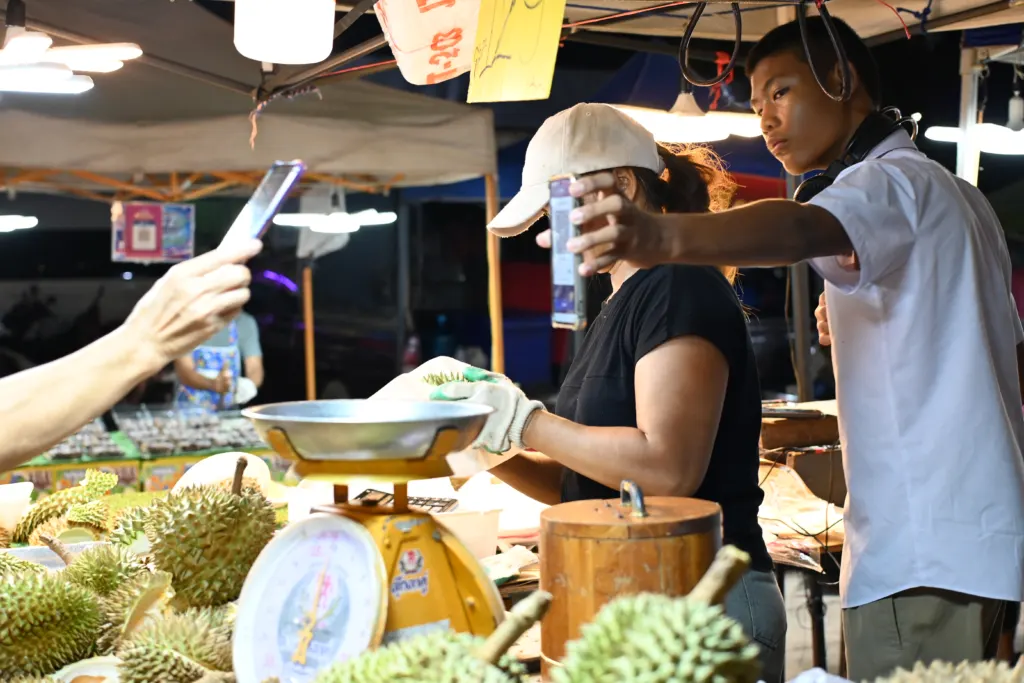
The QR code on a restaurant table or a parcel label was designed for car parts. Masahiro Hara and his team at Denso Wave, a Toyota group supplier in Japan, created the square barcode in 1994 to track automobile components on factory lines. Three decades later it opens menus, pays bills and logs phones into Wi-Fi.
Here is how the format’s design, capacity and standards work.
Inspired by a Go board
QR stands for quick response. Hara’s team took inspiration from the black and white stones on a Go board. The three large squares in the corners, called finder patterns, were chosen by searching printed matter for the ratio of black and white bands that appeared least often, 1:1:3:1:1, so a scanner would rarely mistake anything else for a code.
Unlike an old one-dimensional barcode, read by a narrow laser line, a QR code is photographed by an image sensor. Software finds the three corner squares, uses a smaller alignment square near the fourth corner to correct for tilt and distance, and then reads the grid of light and dark modules.
How much it can hold
QR codes come in 40 versions. Version 1 is a grid of 21 by 21 modules, and each step up adds four modules per side, so version 40 is 177 by 177. At that largest size, with the lightest error correction, a single code can hold 7,089 digits, 4,296 alphanumeric characters, 2,953 bytes of binary data or 1,817 Japanese kanji.
Why a scratched code still scans
The format uses Reed-Solomon error correction, the same family of maths used on CDs and in deep-space links. The creator of a code picks one of four levels. Level L can restore about 7 percent of the data, M about 15 percent, Q about 25 percent and H about 30 percent. Higher levels leave less room for data but let a code survive scuffs, dirt or a logo placed in the middle.
Free to use
Denso Wave holds patents on the technology but chose not to enforce a key one for codes that follow the published standards, which helped QR codes spread. The US patent expired on March 14, 2015, and the Japanese one a year earlier. The format is standardised as ISO/IEC 18004.
A word of caution
Because a QR code hides its destination until it is scanned, it can also be misused. Malicious codes can be printed and stuck over legitimate ones, a trick known as attagging. Checking the web address your phone shows before opening it is a sensible habit, the same instinct that helps with fake emails like the one in Madison Square Garden’s Knicks ring phishing test. More explainers sit in Badiyaa’s Tech section.
Further reading
Image: PattayaPatrol, CC BY-SA 4.0 via Wikimedia Commons
This article was produced with AI assistance and reviewed by our Editorial Desk. How we work.